Two shifts can report the same flow time and still have measured different things. One may have taken its sample as soon as mixing ended, while the other recorded a sample that had been waiting beside the line. They may also have used different cups or measured the liquid at different temperatures. If the worksheet holds only a value in seconds, there is no way to tell which explanation is plausible. An acrylic thinner trial sheet makes the reading traceable to a defined setup and a known sample. It also shows how the resulting panel was judged, so an apparently good reading does not silently become an approval of the finish.
The NanoMix archive identifies acrylic thinner on page 41 and describes a specific semi-matt acrylic coating on page 25. Use the current instructions for the specified coating and the NanoMix acrylic thinner entry to identify the materials for the trial. The archived pages do not supply a universal reduction rate, target viscosity or release condition. Likewise, a test intended for an industrial acrylic finish should not inherit rules from a product selected only because it shares a resin name. The purpose of the worksheet is to document a one-to-one comparison under the relevant instructions rather than to generate a new formulation or a product specification.
Write down the decision the trial must support
Ask a question narrow enough to be answered by the comparison. A workshop might want to know whether the afternoon shift can reproduce the morning shift's flow reading and panel assessment for an approved mixture. Another trial might compare two identified batches while keeping the measuring conditions constant. A comparison that changes the mixture, instrument, temperature and application together can identify a difference between finished panels, but it cannot assign that difference to the thinner. Record a combined trial as exploratory when the variables cannot be separated. If the result is needed to release work, agree in advance who decides whether a controlled repeat is necessary.
Give the trial an identifier and link each preparation to its own sample and panel. Record the paint and thinner references and lots, the relevant instruction revision and the identity of any separate component. The acrylic hardener and thinner have different roles. A two-component acrylic topcoat and a single-component acrylic topcoat therefore should not share a preparation record by default. When the question really concerns which thinner has been approved for the coating, use the guide to matching acrylic thinner and coating systems to resolve that question first. The measurements are meaningful only for the system the team actually used.
An independent reference is useful even in a small comparison. In one hypothetical worksheet, the baseline refers to a previous accepted setup with an identified reference panel. A fresh sample prepared under that setup receives its own sample identity. A changed batch receives a different sample identity, even if both materials came from the same supplier. The form records why each panel is present and which observation would count as a meaningful difference. Labelling all the pieces with the day or colour alone leaves someone to reconstruct the trial after the measurement and application teams have gone home.
Give the reading its method and instrument identity
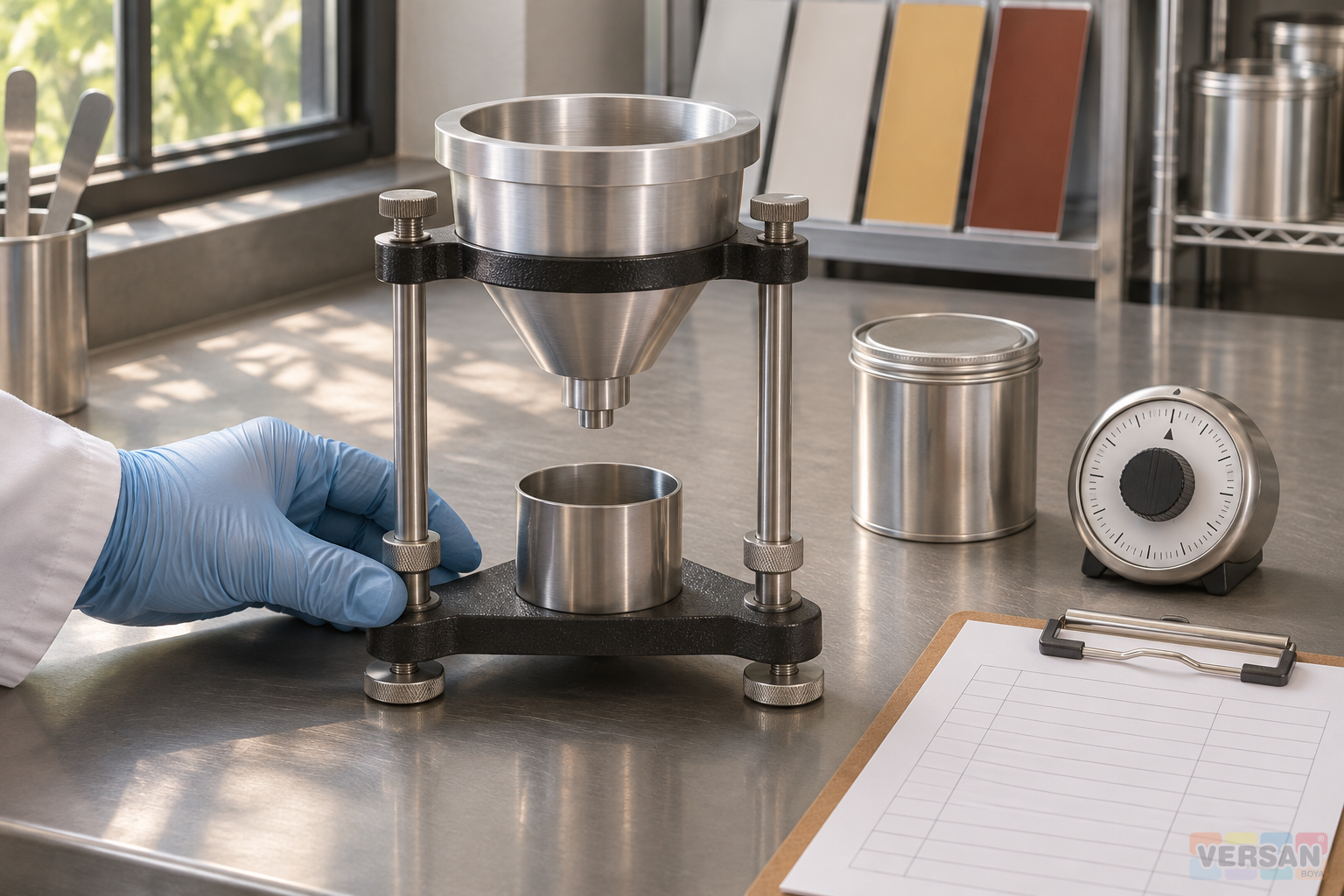
A flow cup reading is the time measured between a prescribed start and endpoint for liquid passing through a particular orifice. Seconds on one cup are not interchangeable with seconds on another simply because the units match. Record the measuring method and revision, cup family, model or orifice designation and equipment identifier. Record which equipment check or maintenance entry was current on the day. A row should let a reader distinguish a different cup design from another physical cup of the same model. That distinction matters when an apparent batch trend begins on the day one tool is replaced.
The published scope of ASTM D1200 covers a Ford-type efflux cup for Newtonian or near-Newtonian liquids. That public scope is a useful check on the choice of procedure. It does not make the cup appropriate for every acrylic paint, and a reference to the standard does not establish conformity with the full method. If the liquid does not suit the specified cup method, obtain a method suited to the material before using a time for release. Keep the output labelled as flow time in seconds when that is what was recorded. Do not relabel it as a viscosity in other units unless the selected method specifically supports that conversion.
The Elcometer user guide for its stand-mounted cups illustrates several setup details worth making traceable. The instrument must be prepared for its published procedure, the orifice must be clean, and the liquid should be in a condition suitable for the method. Define checks using the instruction for the actual equipment. A verified equipment identifier and a check against the working procedure are more useful than a generic tick saying the cup was available. If a seat, stand or removable component is changed, record that change before taking a new result. Keep a reading taken with visible residue or a questionable setup as an observation, with the reason it cannot enter the comparison.
Document temperature, timing and sample handling separately
Record the liquid temperature at the point specified by your method. Room temperature is a separate observation. A container moved from storage may remain cooler or warmer than the bench. Even two samples in the same room can have different temperatures because their storage and measurement histories differ. Enter the temperature with each reading or otherwise link the reading to its verified condition. When the relevant temperature is missing, identify that gap in the worksheet rather than filling it with the room reading. If the values are part of a trend, exclude the unqualified row from the comparison until a suitable repeat can be made.
Define the start of the elapsed time used on the worksheet. Depending on the written product and trial instructions, the end of preparation, the point at which a sample is separated and the measurement start can be different events. Logging those times makes sample age visible when a measurement differs. Where the applicable system has a stated working period or preparation requirement, record the reference and observe it. A timestamp documents the condition and does not extend the period. If the team measures the same material again after an interruption, it should be clear whether the second measurement is another repeat at the specified condition or a deliberate observation of a later state.
Include a short entry for any sample handling condition that might account for a difference. Examples are a change of sampling point, a different preparation sequence, visible bubbles or an interruption before measurement. Note whether the sample had the same preparation history as the reference. Do not decide from a single reading that a later sample has changed chemically, and do not assign the difference to temperature if the cup and timing were different as well. A trial sheet that captures only the factors the operator expected to matter can make an unusual result impossible to explain. Leave space for a specific exception with enough detail to be independently reviewed.
Preserve valid repeats and unsuccessful attempts
Keep an individual row for every attempt. Use a common sample code and add the reading identity, instrument, temperature, start time, measured seconds and an observation field. Agree with the person responsible for the method which repeats will count and how their result will be reported. If the stream starts irregularly or the prescribed endpoint cannot be observed, show the reason the attempt is invalid. A new qualified attempt does not replace or silently delete the first one. A reader needs to know whether the recorded result was reproducible on the first attempt, required a setup correction or is still unresolved.
Suppose a first observation has no defensible endpoint but appears much longer than a second, completed reading. Averaging the two makes the result look more precise without improving its basis. Record the first as invalid with the cause observed, then decide whether the second is sufficient under the specified repeat rules. If two qualified attempts disagree, investigate their conditions before treating either as an outlier. Check whether a different receiver or timing practice changed the observation, or whether the liquid and setup are still matched. The right outcome can be a request for a controlled repeat, not the addition of more decimal places to a worksheet.
The distinction is practical for manufacturing records. Someone who sees a conspicuously high number should know whether the procedure failed, the material behaved differently during an eligible test, or the cause remains unknown. Those are three different observations. A raw reading, its eligibility for the comparison and the final reported result should have different fields. Preserve the observations and let the decision rules determine which enter the summary. That gives the next shift a reproducible starting point and lets a future reviewer see when a changed method, rather than a changed coating, explains a shift in the numbers.
Link the panel to the sample and judge it in its own conditions
When you coat the witness panel, tag it to the sample that was actually applied. Record substrate, preparation, application setup, coat sequence and evaluation time using the relevant instructions. A specified film thickness check has its own instrument and measuring stage. The guide to paint dilution, viscosity and film build discusses those relationships. For the trial sheet, the essential point is that a liquid reading and the appearance of a film answer different questions. One can inform an investigation of the other, but a repeated flow time does not by itself show that the panel satisfies its finish requirement.
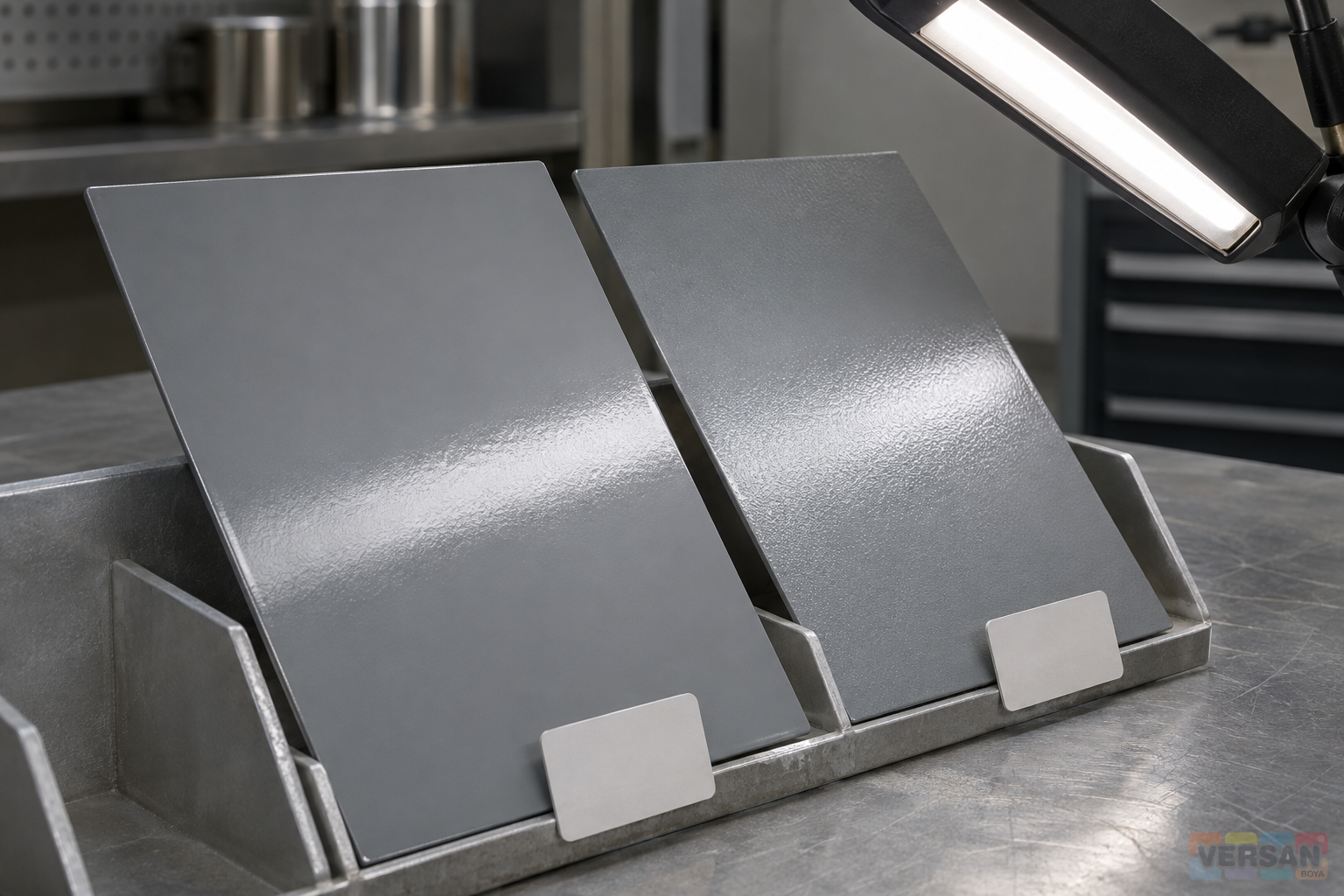
A reference for a semi-matt acrylic topcoat can show a different acceptable appearance from one for a gloss two-component acrylic topcoat. Compare the matching references under the intended light and viewing conditions. A reflection that makes texture obvious on one panel can hide it on another if their angles differ. When photographs are needed, keep both panels at the same angle and include an identifier in the record. Inspect face and edge if both are within scope. A thin band of visible difference close to an edge may be more informative than a general note saying the whole panel looks dull.
If the panel shows a change that resembles dry spray, record where and how it is seen. The guide to acrylic thinner, dry spray and surface assessment treats that symptom directly. A measurement trial preserves the evidence needed to tell whether the panel difference tracks a changed sample or a changed application condition. It is quite possible for two apparently comparable flow results to accompany noticeably different panels. Check the application and viewing records before changing the liquid conditions. The panel section should permit the team to mark a result for inspection without overwriting otherwise valid liquid measurements.
Close the trial with two explicit dispositions
Organise the record in three parts. The top identifies the trial purpose, instruction, materials, instrument and reference. The middle holds a row for each attempt. The bottom contains the witness panel identity, assessment details, comparison decision, panel decision and the person responsible for following up. Avoid a single pass box that hides which evidence passed. In professional coating systems, comparability is a condition for interpreting measurements, while panel acceptance belongs to the defined finish and application. If one is unresolved, show which action is waiting rather than treating the whole form as complete.
Imagine two grey panels judged alike beside their shared reference. The morning worksheet shows a cup ID, a liquid temperature and an elapsed time. The afternoon record omits the cup ID. The appearance judgment may still be usable if its own conditions are documented, but the two sets of flow readings are not a verified pair. A defensible disposition retains the two valid panel observations while asking for instrument identification or a controlled measurement repeat. In the reverse case, comparable readings with an edge-level appearance mismatch may leave the measurement result intact and send the panel to a focused application review. Each next step follows the evidence available for that part of the trial.
Clarify which work can reuse the trial reference. The acrylic primer, acrylic varnish and gloss acrylic varnish catalogue entries illustrate different coating roles and appearance selections. The finish reference for one does not become an approval for the others. Even a sample of industrial paint with the same colour name needs its own matched reference when the coating or substrate changes. Look up the proper entry through thinners and auxiliaries or the product range, then check that the instructions and reference panel in the form apply to that system.
Make tomorrow's shift able to repeat the comparison
At handover, give the next shift the location of the reference panel and the next permitted comparison, not just a printout of the finish values. State whether any sample or panel is on hold, what condition was missing and what must be verified before the result can be used. A note about repeated residues on a single cup calls for an equipment review. A note about an absent liquid temperature calls for a new qualified measurement. A finish difference supported by matching measurements calls for a review of the panel and application records. Assign an owner to the unresolved item so the next shift can separate a new observation from an action already underway.
If the workshop uses the measurements to spot a longer trend, compare rows with a common method and an equivalent preparation and evaluation window. Keep older records interpretable when the worksheet changes. Identify the first date and jobs using the revised instructions, and retain the previous form definition with its records. A new orifice, procedure or sample handling rule may change the series that can be compared. The goal of the acrylic thinner trial sheet is that someone else can recover what was measured, which panels were compared and why the disposition was made. That continuity is what makes the record useful after the immediate trial is over.