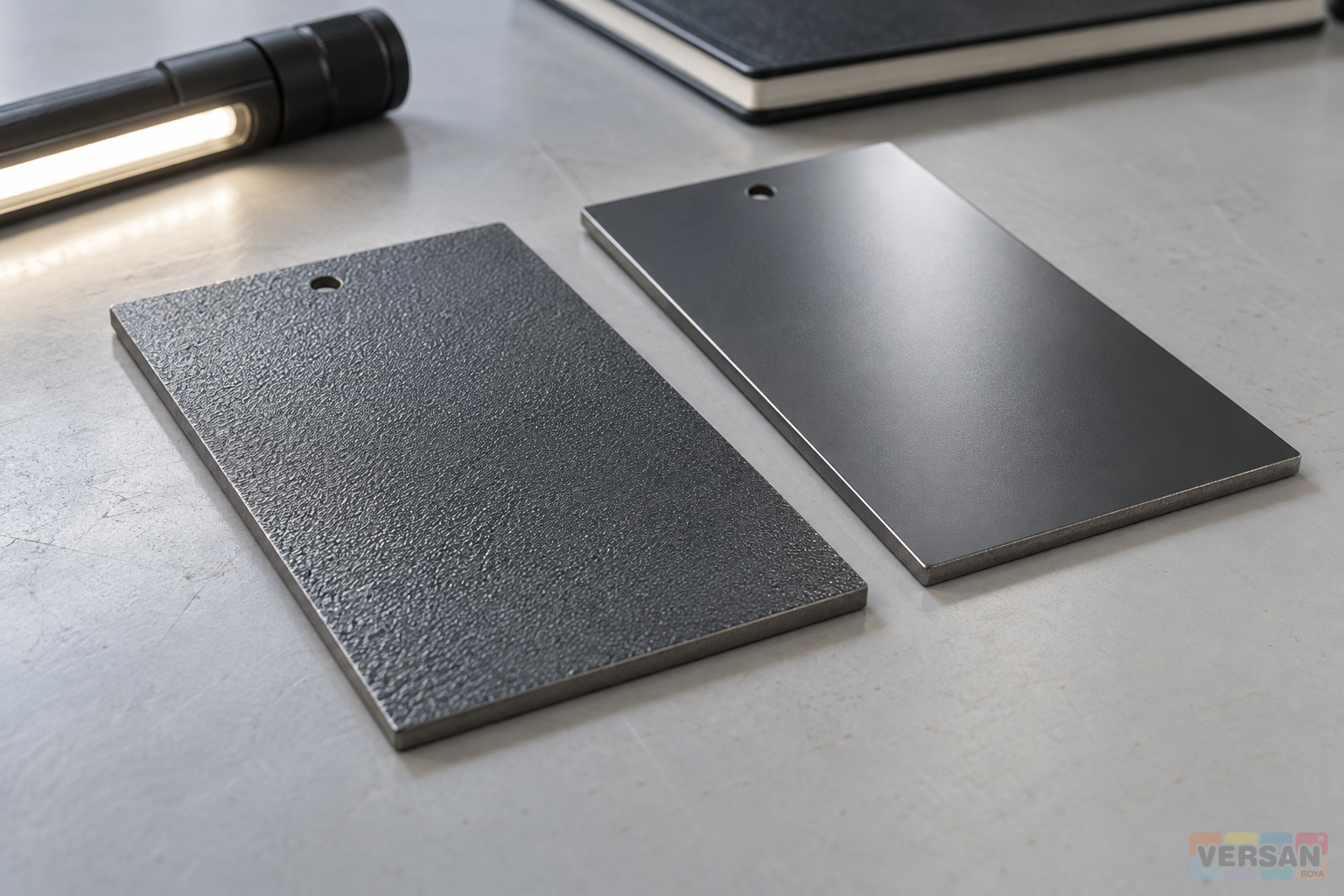
A rough spray finish does not establish that an acrylic thinner is unsuitable. The coating identity, the approved combination of materials, the equipment condition and the application record all need to be understood before one visible texture is assigned to a single cause. The useful first response is to describe what can actually be observed, preserve the evidence and identify the information needed for a controlled assessment.
This article proposes a practical review process for professional applicators and technical suppliers. It does not prescribe a universal thinning percentage, air pressure, nozzle size, spraying distance or repair operation. The Nanomix Acrylic Thinner page provides a starting point for product identification. Permission to use a particular material and the applicable working conditions must come from current information for the actual coating system, including any additional components.
The intended outcome is a traceable decision: which panel was assessed, what was known about its preparation, what remained uncertain and why the result was accepted or referred for further work. A photograph labelled “better” cannot communicate all of that. If the coating and reducer have not yet been identified correctly, the earlier guide to matching acrylic thinner to the coating system addresses that preliminary task.
Describe the finish before naming the cause
Start with a part identifier and a simple location record. A rough edge, a broad flat face and a recessed junction may require different comparison samples. Record whether the appearance is local or widespread, and whether the surrounding area provides a useful visual reference. A distant photograph can hide texture, while a close-up may exaggerate its importance in normal service. Keep both views under the same part identity so that the reviewer can move between detail and context.
PPG describes dry spray as a coarse, low-gloss finish and identifies several possible material, equipment and airflow influences. That description supports considering more than one explanation. It does not make every rough surface a confirmed case, and its refinish repair guidance is not permission to repair a different manufacturer's product. In this review, the published defect description informs the questions being asked rather than supplying a transferable operating recipe.
Use observational language such as interrupted reflection, visible granularity, an edge texture change or different sheen between areas. Keep a separate field for possible explanations and the evidence needed to investigate them. Touching, wiping or abrading the film can alter the original condition and should not become an improvised diagnostic test. If the application time is uncertain, record the observation time without presenting it as a verified picture of the freshly applied film.
Identify the complete material combination
A thinner label alone does not identify the job. Record the coating name and code, the batch, any additional components and the document revision used for the work. Acrylic topcoat and acrylic primer are different product functions. Sharing a family description does not establish that they use the same auxiliary material or the same application settings. The relevant question is what is approved for the exact product and task.
Keep two-component acrylic topcoat and single-component acrylic topcoat records distinct. An unverified remainder from an earlier job should not enter a trial merely because its appearance seems familiar. Uncertain identity is a reason to pause the assessment before changing operating conditions. A trial cannot resolve the meaning of a material whose origin and intended use are still unknown.
Where an acrylic hardener forms part of the specified system, its identity and documented combination also belong in the record. Hardener and thinner have different functions; neither should be treated as an interchangeable adjustment to the other. If the mixing history is missing, adding more material can make the history harder to reconstruct. Obtain the current product information and a suitable technical assessment before moving from an uncertain mixture to production work.
Separate catalogue evidence from current instructions
The site's historical catalogue provides an accepted reference for researching product families. A short archive description is not a current technical data sheet, safety data sheet or job-specific application plan. Record the document title, revision, date obtained and the product to which it applies. If the archive contains an unreadable or incomplete field, leave that limitation visible. Supplying a plausible value would create false certainty precisely where the reviewer needs a clear question.
The thinners and auxiliaries category contains several material families. Their presence in the same catalogue does not authorise substitutions within a trial. A useful decision field asks whether the designated reducer has been confirmed and identifies the supporting document or written manufacturer response. That is more informative than an isolated tick marked “correct”, because the next person can understand what the confirmation actually covered.
Prepare a small, organised evidence set: label images, current documents, part photographs and trial records have different purposes. Use identifiers that connect each photograph to its panel and preparation history. Keep the initial record intact when new information becomes available, adding a dated revision rather than silently replacing the earlier explanation. Good document control helps a reviewer investigate uncertainty without turning an initial assumption into an established technical fact.
Record equipment condition before making changes
Identify the spray gun and its relevant components, maintenance history and the source of any reported settings. A photograph of a control knob may not establish the working condition during the original application. Distinguish instrument readings from an operator's recollection and from values inferred later. Do not fill an unmeasured field with a familiar number. An explicitly unknown value tells technical support what needs to be established during a properly planned trial.
Cleaning history is a separate subject. The cleaning thinner page is not a recommendation to add that product to an application mixture. Equipment cleaning and coating reduction require different decisions. If the previous material or cleaning method is unknown, record that uncertainty and ask what preparation is needed before a comparison can be meaningful. The assessment should not imply that any solvent available in the workshop is an acceptable substitute.
Ask for the sequence of events as well as the final impression. When was the part positioned, where was the difference first noticed, were settings changed and was the sample made using the same equipment as the production part? These questions reconstruct the comparison. They do not prove that an operator, a supplier or a material caused the problem. Preserve that distinction so that people can provide useful facts without the review becoming a premature assignment of responsibility.
Keep environment review within the established safety controls
Relate available observations about the workplace, material and part to the relevant period. Booth maintenance records, an authorised airflow assessment and changes made during the work may all be relevant, but they are different kinds of evidence. Do not reduce extraction informally to improve the appearance of a test panel. Investigating a finish problem does not justify disabling exposure controls or moving an operation outside the workplace's authorised arrangements.
HSE's solvent guidance supports assessing exposure for the particular task and product. It is not a universal respirator specification, ventilation setting or booth-clearance time, and its legal context is not presented as Turkish legislation. Use the product safety information and the competent workplace assessment. If the required arrangements are not in place, the cosmetic comparison should wait; a small test quantity does not remove the need for an appropriate working environment.
Review the intended use of the product within the industrial coatings range as well. A successful example from another process does not establish suitability for the present part. Describe practical observation conditions, including lighting and sample handling, but do not write “conditions verified” where no relevant check was made. Record what was actually confirmed and what remains open. That distinction gives the technical reviewer a sound basis for selecting the next step.
Give each trial a defined question
Write the question before preparing the panel. Are you checking whether the original appearance can be reproduced, comparing a verified material combination or evaluating a change proposed by the manufacturer? Trying to answer all three questions with one poorly documented sample makes the result difficult to interpret. A beautifully finished card may still be irrelevant if its substrate and preparation do not represent the production part that prompted the review.
Record the panel material, surface preparation and underlying coating. Explain the difference between the control and the proposed trial, keeping changes within the applicable manufacturer instructions. Changing several settings and materials together cannot show which change influenced the result. Equally, a smooth appearance obtained outside the permitted application conditions does not establish an acceptable process. Visual acceptance and technical suitability must remain separate decisions even when the sample looks attractive.
Give the panel a durable identity without introducing arbitrary marks into the area being assessed. Its record can identify the materials, documents, preparation team, time, observation conditions and the specific question under investigation. These fields are an editorial proposal for workshop communication, not a replacement for a laboratory standard. If the acceptance question changes after the trial begins, record that change rather than judging the sample against a silently revised objective.
Agree what surface uniformity means for the job
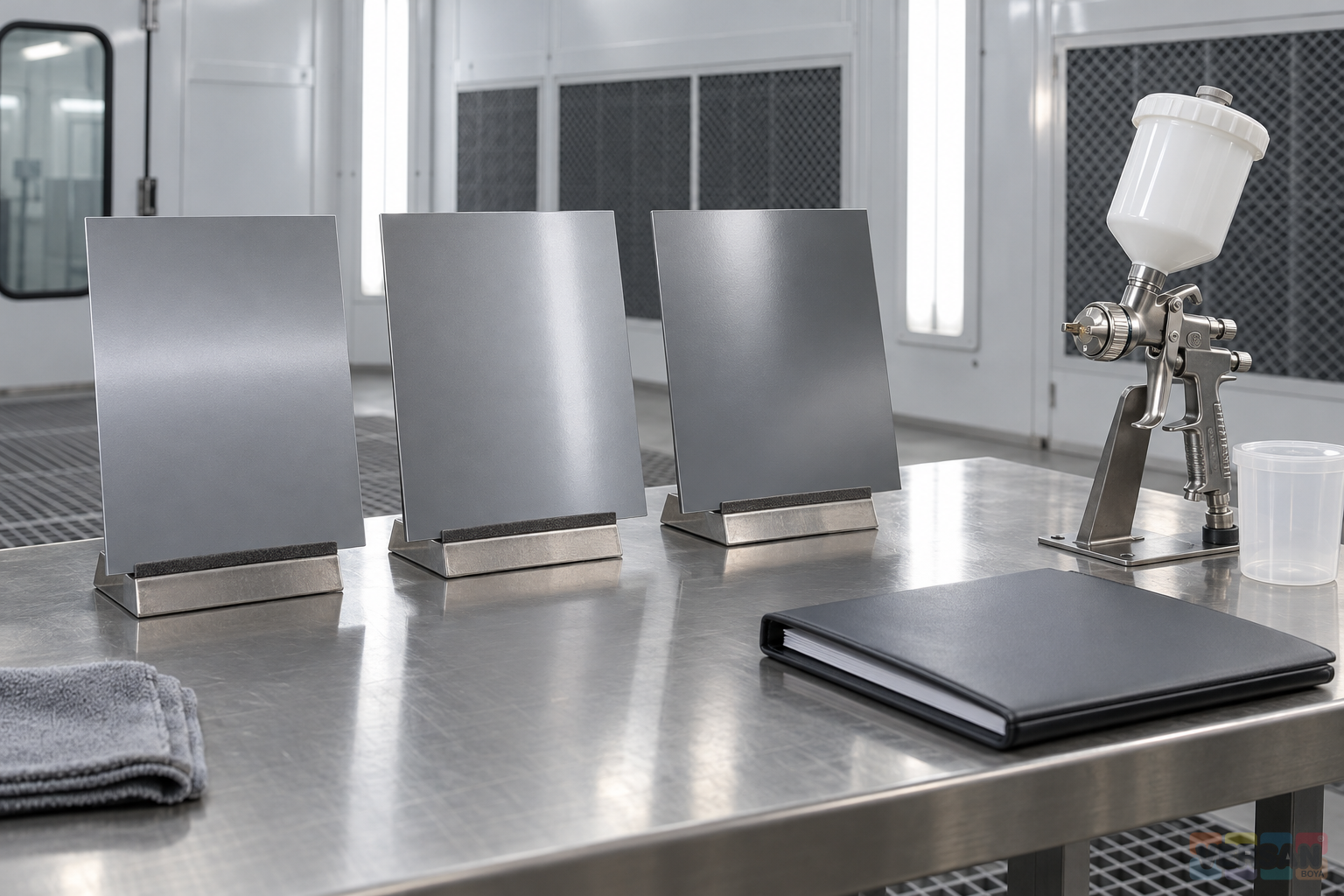
Expressions such as “perfectly smooth” or “factory quality” are not sufficient acceptance definitions on their own. Discuss the normal viewing direction, the intended service context and the physical comparison sample. A local edge change may have a different significance from texture across the whole face. When reviewers use different lighting or angles, their disagreement may concern observation conditions before it concerns a material difference. Establish the basis of comparison before collecting approval signatures.
Record colour, sheen and texture separately. Researching acrylic varnish does not define a finish merely by its family name. Gloss acrylic varnish and matt acrylic varnish illustrate distinct appearance objectives; neither link recommends adding a clear coat to correct the present defect. The approved system and the agreed appearance remain the basis of the decision, rather than an assumed improvement from another product.
For photographic comparisons, preserve the viewing direction, lighting and relevant area as consistently as practical. Automatic exposure and image compression can change the apparent difference. Do not make a phone image the sole acceptance document. A retained physical sample should remain linked to its identity and storage record. Where instrument measurements are required, the competent parties must define the method and acceptance limit separately; this article establishes no numerical threshold for a pass.
Do not turn a possible diagnosis into an immediate repair
An appearance that suggests dry spray does not automatically authorise sanding, polishing or solvent treatment. The condition of the film, the coating build-up and the product-specific repair guidance must be understood. The review may properly end with a request to confirm material identity, complete the equipment record or prepare a controlled comparison. Those are valid decisions that prevent an uncertain interpretation from becoming an irreversible operation on the production part.
Another coating family's example should not be transferred directly. The guide to spray quality in rapid enamel discusses related observations in a different product context. It does not demonstrate equivalent materials, settings or repair permissions. When technical support provides a response, identify the actual product code and the specific scope of that advice. A shared defect name is not evidence that two systems permit the same correction.
If a technical assessment allows a corrective option, evaluate it on a representative sample before extending it to the relevant production work. An unsatisfactory trial is a reason to reconsider the proposal, not to apply more material over a larger area in the hope of a better result. Record the proposed boundary of the work, the appearance being sought and the condition that would require another pause. This makes the commercial scope easier to discuss as well.
Use different observations to ask different questions
Consider a hypothetical workshop part with a more granular, dull appearance only around the outer edges. A satisfactory centre does not establish operator error. The reviewer can first examine part positioning, sequence, equipment information and the completeness of the original record. A flat sample card may not represent the relevant edge behaviour. The useful question is how to build a comparison that represents the actual feature, rather than how quickly to obtain one attractive panel.
In a second hypothetical case, the whole surface is rough but the reducer label cannot be verified. The priority is material identification before experimenting with settings. Similar containers and a verbal recollection do not provide a reliable starting point for a technical comparison. Neither example describes a real customer or completed project. They demonstrate why similar visual descriptions can lead to different information requests and different decisions about whether a trial should proceed.
Keep the language of the record disciplined. “The edge looks duller” is an observation; “the thinner is too fast” is an interpretation that needs support. Identify who assessed that interpretation and what document or trial informed the assessment. Preserve the earlier view when assumptions change. A revision history prevents the next team from treating a convenient initial explanation as a confirmed finding merely because it appears in a neatly formatted report.
Carry the accepted comparison into production
Once a trial is accepted, hand over more than its photograph. Include panel identity, the applicable product documents, the approved work scope and the circumstances requiring renewed review. If the next shift cannot locate the information used by the previous one, the result has not become an adequately communicated working decision. Accessible records reduce the need for missing details to be reconstructed from memory at the point where the work is already under way.
A new batch, equipment maintenance, a different part geometry or a changed working arrangement may require the previous trial's scope to be reconsidered. Agree the relevant change triggers with the technical lead. An earlier satisfactory result is not a guarantee for all future work. The related article on colour and gloss from sample to production offers a complementary discussion of reference control, while remaining a separate coating-family context rather than an interchangeable recipe.
At completion, retain the original observation, the control sample information, the final acceptance and the document versions under the same job identity. Record unsuccessful comparisons and why they were rejected as well as the accepted result. Otherwise an abandoned adjustment may return on the next job as an apparently new idea. The purpose is not to accumulate the largest possible folder, but to show which decision was actually made and what evidence supported it.
Prepare a question that technical support can answer
The initial support request should identify the part and affected face, the stage at which work stopped and the information that has been verified. Match the actual container image to the material record rather than photographing a similar product on the shelf. Name the panel in every sample photograph. Preserve original images instead of changing brightness or applying filters to make a preferred explanation seem more obvious. Clear evidence often matters more than a long speculative account.
Separate the requested decisions. Confirmation of an approved thinner combination is not the same as approval of a repair to a particular coated part. Do not treat a positive answer to the first question as answering both. Identify the expected response, the person responsible for supplying missing information and the work affected while the question remains open. A delivery deadline can explain the urgency, but cannot make an incomplete material history technically complete.
When advice arrives, retain its stated limits. A response for one product, sample or condition should not become an unrestricted workshop rule. Checks that were requested but have not been carried out remain outstanding. If the sample needs later review, keep the first observation, interim decision and final acceptance as separate dated entries. This prevents a well-organised folder from being mistaken for a completed assessment when an essential part of the work is still pending.
Technical sources and limits
- Nanomix historical thinner catalogue: family identification, not current application instructions.
- PPG, Dry Spray: defect description and possible influences, not approval for another product.
- Hempel, explanatory notes to product data sheets: product-specific document interpretation.
- HSE, Solvents: task-specific exposure assessment.