
Colour and gloss consistency in polyurethane coatings requires more than ordering the right colour code. The same product may produce a different appearance when preparation, application or assessment conditions change. For an approved panel to become a dependable production reference, the product, substrate, primer, mixing, application and evaluation arrangements must be defined together. When selecting a polyurethane gloss topcoat, retaining that complete record is more useful than explaining every later difference as a colour mismatch. This guide considers how a sample produced in a laboratory or workshop can be transferred into a controlled production decision, with traceable references and clearly defined acceptance responsibilities.
Turn the colour code into an identifiable physical reference
A colour name or number gives the parties a common starting point, but it does not describe every aspect of the finished appearance. Gloss, texture, the underlying surface and viewing conditions may affect visual assessment. When a colour is selected from the RAL colour catalogue, record the physical chart or panel that will serve as the reference. A monitor image, telephone photograph or printed approximation should not become the sole final acceptance standard. Give the sample an identity, preparation date and product record. This reduces the chance that purchasing, application and quality teams are comparing the work with different examples while believing they share the same target.
An approved panel should have a defined purpose and a suitable storage arrangement. If the colour reference and the example intended to show texture or application quality are different objects, make that distinction explicit. Decide what happens if a reference becomes dirty, damaged or no longer suitable for comparison. If several production locations receive reference copies, compare those copies before issuing them. A historical customer photograph, a piece finished with another product and a newly approved panel do not necessarily carry the same authority. Define which one controls the decision and which ones are supporting information, so that an informal example cannot override the agreed production reference.
Specify gloss, matt and satin appearance separately
Words such as gloss or matt can describe a product family, but they do not independently create a measurable acceptance condition. Explain the intended appearance through a physical example and any agreed measurement arrangement. A polyurethane matt topcoat does not become visually equivalent to a gloss finish simply because both use the same colour designation. Compare samples under consistent viewing conditions. Consider the design objective, cleaning expectations and production method together. If the initial discussion covers colour alone, a difference in sheen may become an unexpected dispute during delivery even though the purchasing team considers the colour code correct.
For clear finishes, the underlying material forms part of the final appearance. When reviewing polyurethane gloss varnish, satin varnish and matt varnish, describe timber type, sanding, filling and any colouring treatment in the same record. Comparing clear panels on different underlying materials does not isolate the effect of the varnish. Establish what each sample actually represents before selecting a product. If approval concerns appearance only, do not use it later as evidence that unrelated properties have also been demonstrated. A clear description of the approval scope protects both the design expectation and the application decision.
Include the primer and substrate in appearance control
The topcoat may have the intended colour while the finished piece still varies because the underlying surface is uneven or differently absorbent. Examine edges, corners, filled areas and broad flat faces separately. Verify the compatibility of the polyurethane primer with the topcoat and confirm its intended substrate scope. Record primer colour, preparation and sanding in the sample file. If production changes to another primer, retaining the same topcoat does not demonstrate that all the original sample conditions remain valid. Review the effect of the change and establish a revised reference when necessary. The primer should not disappear from the discussion merely because the visible colour is provided by the final layer.
A sample on metal, MDF or solid timber cannot automatically be transferred to another substrate. Follow the scope stated for the actual product and seek confirmation when the proposed use differs. The Nanomix polyurethane catalogue available on the site includes information concerning furniture substrates; it should not be interpreted as a general approval of every polyurethane material for all metal or marine uses. Compare furniture coating options and industrial coating options through individual product information rather than resin-family names alone. The sample substrate should represent the real component and its preparation, or the limitation should be clearly recorded before approval.
Create a complete identity record for the sample
A panel becomes reproducible through its records rather than its photograph alone. Identify the product code, colour reference, batch, component pairing, mixing basis, thinner, application equipment and operator. Connect the substrate material, size, preparation and primer to the same record. Document the environmental and part conditions that are relevant to the application. Record curing and assessment times separately so that an application date does not become an assumed inspection age. When information is missing, leave the gap visible and assign an action to close it. Filling a blank with a guessed value gives the record an appearance of completeness without making it technically dependable.
A colour label alone is insufficient. Link the approval date, authorised reviewer and accepted characteristics to the panel identity. If preparation or product selection changes after the first sample, revise the record accordingly. Photographs support traceability but do not replace a controlled measurement or the physical reference. The article on first-sample approval in industrial coatings provides a useful approach to approval scope and change boundaries. Before production begins, confirm that every relevant team is working to the same revision. An obsolete panel left in circulation can cause the workshop to reproduce a result that no longer matches the purchasing or customer approval.
Keep mixing and thinning traceable
For two-component polyurethane materials, preparation of the mixture is a significant process step. Apply the ratio, measuring basis and mixing instructions in the current information for that product. A mass-based ratio must not be treated as a volume ratio, and an alternative hardener should not be assumed equivalent. Do not transfer an instruction from another material simply because both are described as polyurethane or because one is matt and the other glossy. Record when the mixture was prepared and when it was used. If working behaviour changes during use, investigate the applicable instructions and conditions instead of making undocumented additions to make it resemble the original sample.
Select polyurethane thinner with regard to the product information. The identity, quantity, measuring arrangement and any application-stage adjustment should remain traceable. A mixture prepared by eye in production is not directly comparable to a laboratory panel prepared under recorded conditions merely because both used the same paint batch. Hardener and thinner perform different functions; the two-component coating mixing guide explains this distinction. Read numerical instructions alongside the conditions to which they apply. An archived value should not become a universal production setting for every current gloss, matt or clear polyurethane product.
Transfer the process from the panel to the real component
A neatly coated flat panel does not prove that a complex component will have the same appearance. Geometry, recesses, edges and orientation may change application distribution. If sample equipment differs from production equipment, run a transition trial rather than assuming equivalence. Choose the method in line with the product instructions and the assessment of the actual work. Explain how thickness or application consistency will be checked instead of relying only on a visual estimate of the number of passes. Organise the workflow so that preparation and intervals do not drift when the production load increases. The fastest application arrangement is not necessarily the one that produces the most consistent accepted finish.
Differences in curing conditions can also undermine a comparison between the sample and the finished component. Provide appropriate space for drying, storage and inspection. A component assessed before it is ready can lead to a premature rejection or acceptance. Bring the actual production constraints into the technical discussion while checking product suitability. Safety must remain part of application planning. For products containing isocyanates, follow the safety data sheet and an appropriate exposure-control assessment; HSE guidance addresses extracted spray enclosures and suitable respiratory protection. Appearance checks should not require an operator to abandon those controls or enter an area before it is safe to do so.
Record colour and gloss as different characteristics
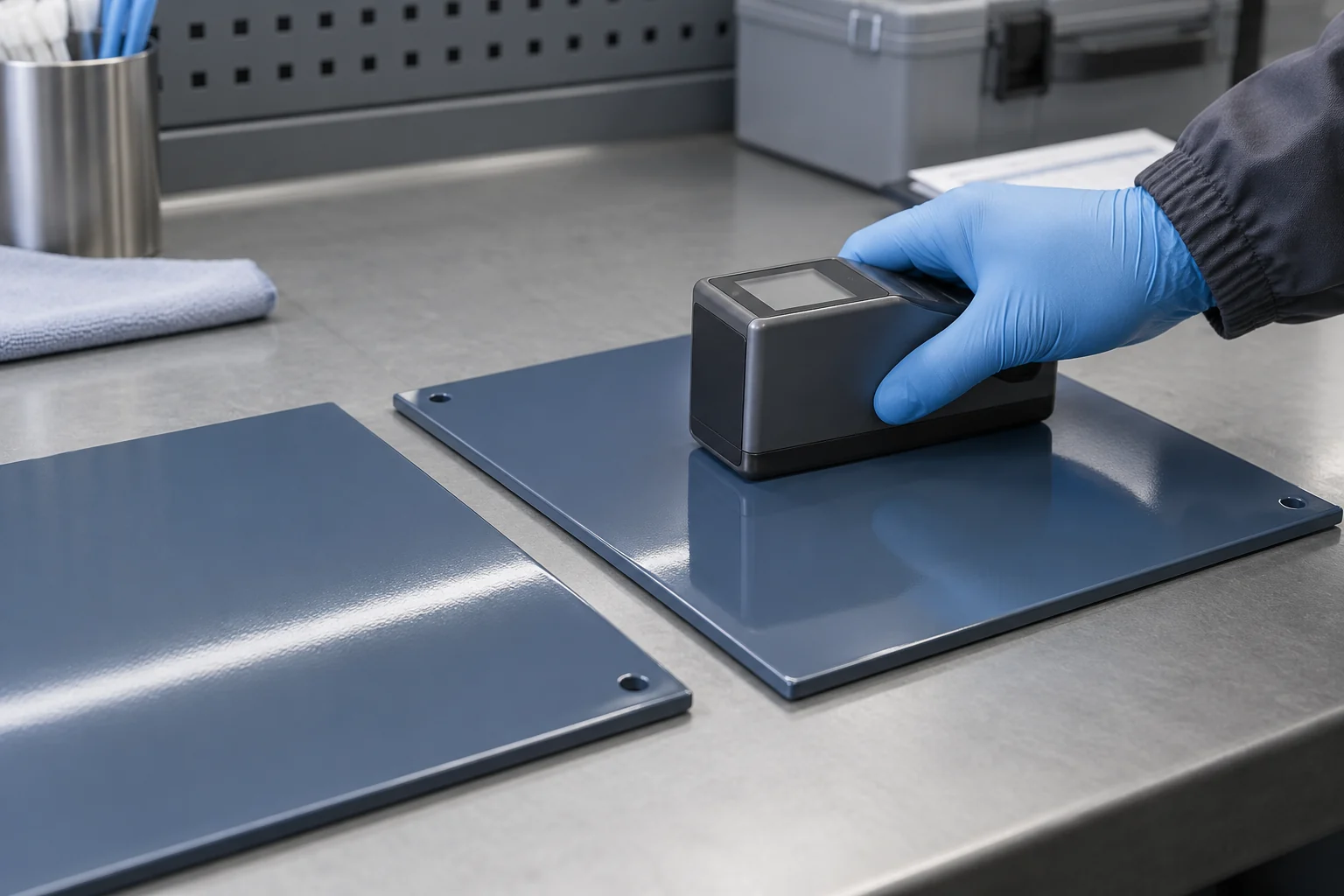
Colour and gloss are not the same characteristic and should not be reported as one combined result. ASTM D523 addresses specular gloss measurement, while ASTM D2244 concerns calculation of colour differences and tolerances from instrumentally measured coordinates. Referring to these standards does not automatically assign a project acceptance tolerance. Agree the method, instrument conditions and evaluation arrangement with competent technical input. Record where the sample is measured and which reference is used for comparison. Rather than treating results obtained with different settings as equivalent, establish that the comparison is valid. Keep the measurement record connected to the sample identity so that the data can be interpreted later.
Agree acceptance requirements through the customer's expectation, the system and the project conditions. A visual review can be recorded alongside instrumental results, but neither should silently erase the other. Use clean specimens that are ready for evaluation and suitable for the agreed comparison. Changing measurement locations without a recorded reason makes production trends harder to follow. The file should contain enough information to reproduce the evaluation arrangement. Replace the statement that an instrument passed the sample with an explanation of which results were acceptable, under what conditions and against which reference. That approach gives supplier and customer a clearer basis for review than an unexplained numerical reading or a general appearance judgement.
Manage batch changes and protect the reference set
When a new paint batch arrives, comparison of the first production pieces with the approved reference provides a useful control point. Check that primer, hardener, thinner and process conditions also remain appropriate; paint-batch identity alone is not the whole comparison. Records should show which materials were used on which components. If a difference is identified, define the affected scope rather than continuing the entire production run against an uncertain sample. State which pieces are being held and what must be reassessed before release. This makes a local discrepancy manageable without losing traceability across the wider shipment or turning every finished piece into an unresolved inspection question.
The approved reference and a production witness panel have different purposes. The reference describes the target; the witness panel records a particular production event. Keeping them distinct helps a later investigation reconstruct what was actually done. Storage and labels should follow the same revision logic as the production documents. If another material or method is trialled, identify where it falls outside the existing approval. The article on machinery coating and production-line planning complements this approach by considering appearance alongside drying, assembly and operating constraints. A visually acceptable panel should be connected to a process the workshop can carry out consistently, not just to an isolated successful preparation.
Investigate a difference without assigning one cause too early
Start by establishing that the components are being evaluated under comparable conditions. Review the reference, substrate, primer, product and batch, mixture, application, cure and assessment in a structured order. If several variables are changed simultaneously, it becomes difficult to identify which intervention affected the result. In a controlled trial, record the changed condition and preserve the other conditions as far as practicable. The purpose is not only to correct one appearance discrepancy but to establish a production decision that reduces its recurrence. Photographs sent for technical assessment are more useful when accompanied by this process record than when presented as the sole evidence of a colour problem.
Adding colour, changing thinner or applying another coat as an immediate response can introduce new variables and compatibility questions. Base intervention on the technical scope and a verified trial. Keep separate records for rejecting, touching up or recoating a component. Explain how a repaired area will be compared with the original finish. When reviewing alternative products, do not consider the new selection automatically equivalent to the previously approved sample. Restate the appearance target and application conditions, then verify suitability through the relevant documents and a new sample where necessary. This prevents a short-term adjustment from becoming an undocumented production formulation that cannot be repeated or defended later.
Put the appearance requirement into the enquiry and order
Include colour reference, target finish, sample revision and substrate alongside the product code and quantity. Select pack or set options against current product information. If the order needs different primers or hardeners, identify them as separate items rather than relying on an informal instruction. The quotation basket and enquiry form can bring the requested products together, while the technical notes identify the approved panel and production method. Decide who authorises later changes. This keeps appearance requirements attached to the purchasing record instead of leaving them in a conversation that the workshop or quality reviewer may never have received.
If document scope or currency is uncertain, use the technical contact channel for clarification. The archived catalogue on the site can provide authoritative product-family information, but current labels, technical information and safety documentation should be consistent for the actual work. Appearance approval is not independent evidence of chemical resistance or outdoor service life. A final one-page summary can connect product, substrate, preparation, mixture, application, inspection and release conditions. It should point to the underlying records rather than replace test reports. Such a summary helps purchasing and production follow the same decision while retaining the detailed evidence needed for a later review.
Use a first-piece release point before the main run
A practical way to connect the file to production is to define a first-piece release point. The operator prepares a representative component using the agreed process, and the quality reviewer checks the required characteristics against the current reference. Purchasing or production planning should know that the remaining run depends on this decision. If the part differs from the approved sample in geometry or substrate, the review records that limitation instead of concealing it. This is an organisational control, not a claim that any particular paint automatically meets a stated tolerance. Its value comes from making the point of authorisation visible before a large quantity is committed.
For example, a revised primer may be introduced to solve a preparation issue while the colour and topcoat remain unchanged. The first-piece review then checks whether the change affects the agreed appearance and whether the revised layer arrangement has technical approval. This is an illustrative decision sequence rather than a report of a completed customer installation. If the result is accepted, update the revision and issue it to the relevant teams. If it is not accepted, hold the affected pieces and decide which variable needs a controlled trial. The production record should show the decision and its scope, not merely that an operator made an adjustment and continued.
Common production questions about appearance
Why can the same colour code appear different?
The samples may differ in sheen, texture, substrate, preparation or viewing conditions. Confirm that the physical reference and evaluation arrangement are the same, then review product and process records. A difference visible on a screen does not independently establish product nonconformity. Make the decision through controlled comparison and any agreed measurement results rather than through a photograph alone.
Can colour and gloss use the same tolerance?
No. They are different characteristics with different evaluation arrangements. Explain separately how each one is assessed and against which reference. One numerical tolerance should not be assigned indiscriminately to every project and polyurethane product. Define the acceptance conditions before production begins so that the measurement or review has a clear purpose.
Can production use a different thinner from the sample?
A change can alter the conditions of the earlier approval. Confirm suitability for the actual product and evaluate the effect through a controlled trial. Easier application alone is not a sufficient reason to substitute an auxiliary material. Track the change through an approved record and a revised sample where required.
Is it appropriate to modify a matt material to make it glossy?
An addition not defined by the manufacturer can change the material's behaviour and technical scope. Select a suitable product for the appearance target and preserve the intended layer compatibility. An undocumented workshop formulation makes later batches difficult to reproduce. Treat a changed finish requirement through technical review and an approved sample process.
Does a panel approval accept every performance property?
No. It provides a reference for the characteristics expressly covered by the approval. Colour and gloss acceptance does not establish adhesion, chemical resistance or service life. Evaluate those requirements through their own documents or tests. A clear approval scope gives both customer expectations and production responsibilities a more precise basis.