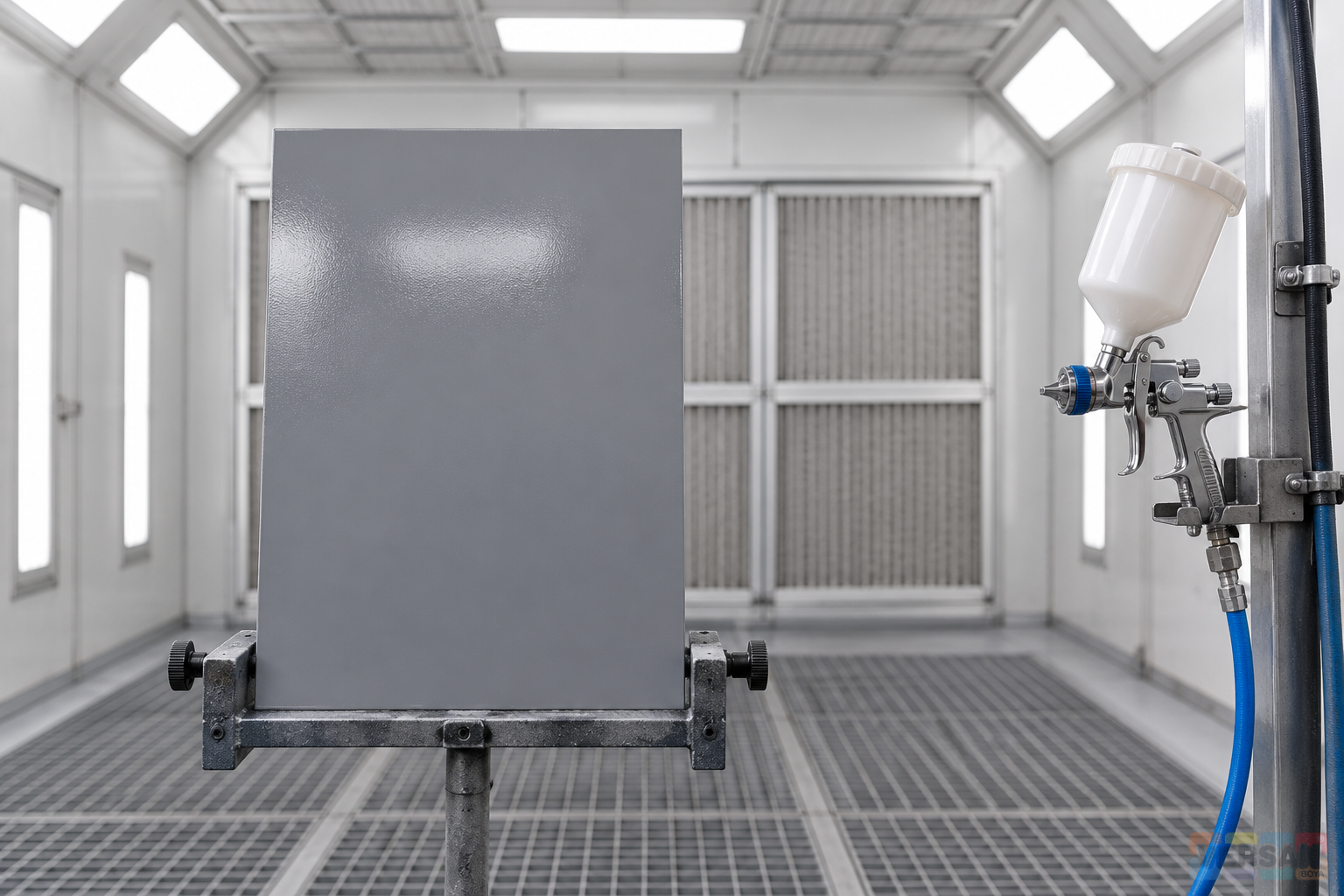
A smooth rapid enamel finish depends on more than finding a convenient spray gun setting. A run, a rough patch and visible substrate colour can appear on the same component while raising different questions. Trying to resolve all three by adding thinner can obscure the original evidence. Begin by describing what is visible, then review the substrate, material, equipment and application record together. Neither the first appearance of the wet film nor a setting remembered from another job provides a complete basis for accepting the work or deciding how it should be corrected.
This guide provides a working framework for assessing sagging, suspected dry spray and hiding when applying industrial rapid enamel. It does not prescribe a universal air pressure, tip size, spraying distance or thinning percentage. Use the current coating instructions alongside the actual equipment manual. The recording suggestions below help a responsible application team design a controlled trial. If the substrate or equipment condition is uncertain, identify that uncertainty before experimenting on production components. A useful trial should answer a defined question and retain enough information for another qualified person to understand its result.
Identify the actual coating
Record the complete product name and batch information before investigating the finish. The word rapid does not describe every application requirement. Match the container label to the job instruction and consider whether an incorrect product, colour or material left from another job may be involved. When reviewing the rapid industrial topcoat page alongside similarly named products, do not assume that names are interchangeable. If the current technical document is unavailable, keep that question open. An archived reference is not a licence to construct a new application recipe for an unidentified container.
The NanoMix catalogue archive describes its rapid topcoat as a single-component, alkyd-resin product and presents application, thinning and drying under separate headings. Those categories should remain separate during quality review. Where the archived Turkish and English entries differ, do not silently combine them into one operating instruction. Confirm the current requirements with the relevant technical contact. This article does not transfer archived numerical values to every rapid coating or gun. It uses the archive to establish product context while leaving the actual job subject to current coating instructions and the approved application plan.
Separate an observation from its proposed cause
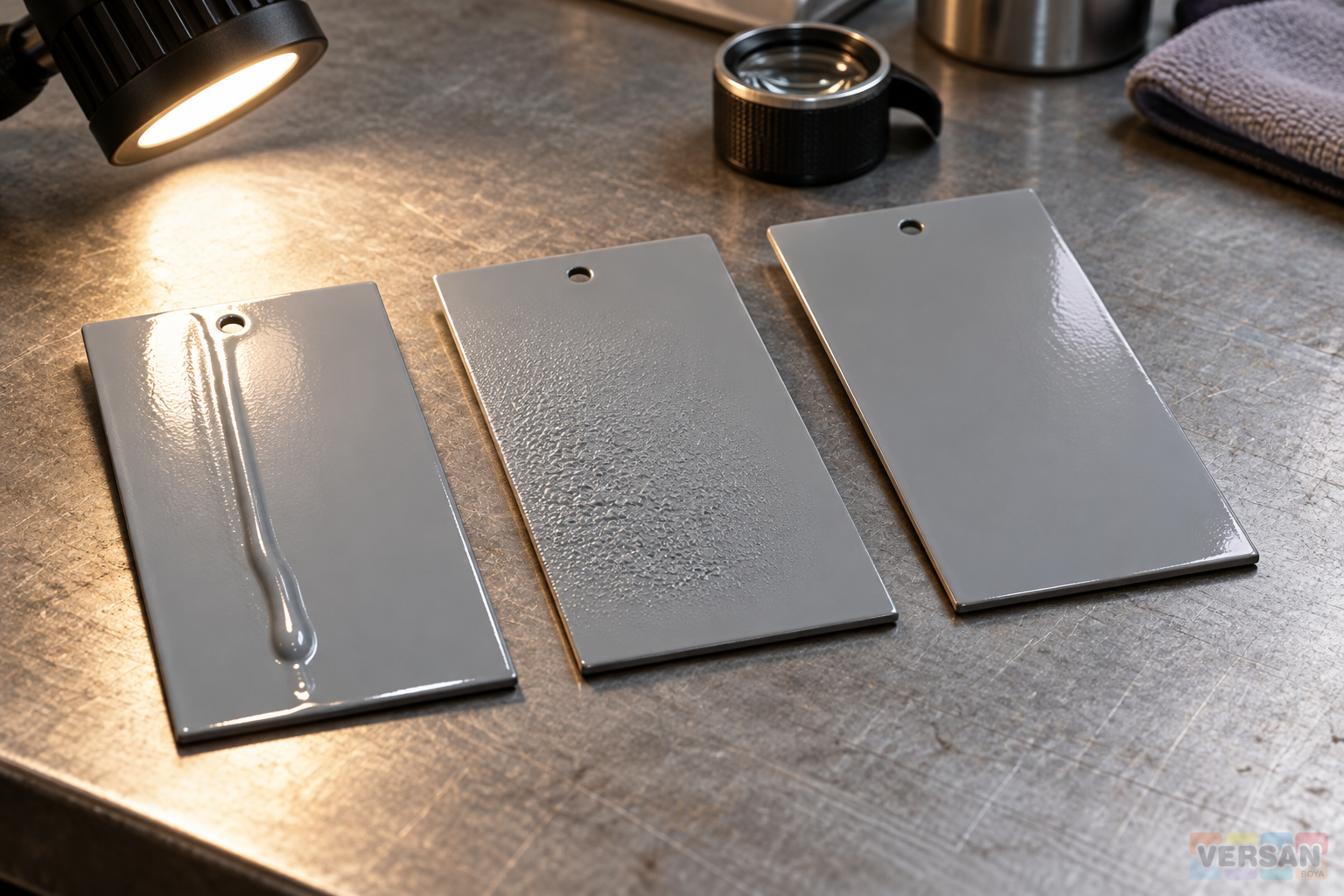
Describe a suspected sag by its location and downward shape rather than simply declaring the paint too thin. Describe a rough region by its texture and extent rather than immediately diagnosing dry spray. If the underlying colour or pattern remains visible, record that as a hiding observation. Light, viewing direction, substrate texture and the time of inspection can influence what is seen. A photograph becomes more useful when it includes a component reference, orientation and observation time. It still remains evidence of appearance, not proof that a single operating variable caused the defect.
A sample labelled good or bad gives the next reviewer little information. Mark whether the difference covers the entire panel, follows a pass edge, occurs near a reversal or is confined to a connection. A matt rapid finish and a glossier finish should not be assessed as though their intended appearance were identical. Establish the required finish first. Do not call every matt area dry spray or every bright reflection excessive film build. Where an approved reference exists, compare it under a consistent lighting and viewing arrangement rather than relying on photographs displayed on different screens.
Include the surface beneath the topcoat
If the condition before coating is missing from the record, every visible difference may be attributed to the gun. Review cleanliness, dryness, existing coating, abrasion condition and variation in the primer. The site's rapid catalogue archive calls for a clean, dry substrate. That general instruction does not approve a particular preparation grade for every project. Determine the required preparation through the actual system review. If contamination, loose material or an unidentified previous coating is present, improving the upper film's appearance does not by itself resolve the substrate question or provide a basis for acceptance.
If industrial rapid primer was used, record its identity, application history and condition before topcoating. Where another family such as epoxy primer is present, verify compatibility and the applicable interval conditions separately. Two products being marketed for metal does not approve every possible pairing. If the trial panel has a different primer from the real component, state that limitation beside the result. Otherwise an apparently successful trial can hide a major difference that becomes important only when the process moves to production.
Check condition before changing settings
Identify the gun model, air cap, fluid tip and needle combination, together with maintenance condition. The maker's manual defines the applicable components and cleaning procedure. The DeVilbiss DV1 troubleshooting section treats contamination at the air cap or fluid tip as identifiable possibilities in an abnormal pattern. The limited lesson used here is to inspect equipment rather than attribute every poor pattern to material dilution. DV1 component choices and settings must not be copied to another gun. Maintenance should be performed by authorised personnel following the relevant equipment's isolation, pressure-relief and servicing instructions.
A clean exterior does not demonstrate that the internal fluid path and air cap are suitable. Resolve missing, worn, incorrectly assembled or damaged parts before the trial proceeds. Materials such as cleaning thinner must also be checked against equipment and coating instructions. Do not improvise with an unapproved solvent or enlarge a passage using a hard object. Air supply, filtration and connections belong within the workplace maintenance arrangement. Recording equipment condition before adjustments helps distinguish an improvement caused by cleaning or repair from one associated with a subsequent authorised change in application settings.
Keep material preparation traceable
Record which material was used for preparation, which instruction governed it and when the mixture was prepared. The name industrial rapid thinner identifies a product to investigate; it does not approve its use in every container. Retain the amount added and the measurement method. If flow is evaluated, identify the method and conditions used. Material with an unknown history from an earlier shift should not be treated as equivalent to a freshly prepared batch. Further dilution of an unidentified mixture is not a controlled diagnosis of the coating process.
If one sample changes the thinner while another changes the operator technique, the comparison cannot isolate either variable. Products within the thinner group are not a list of interchangeable general solvents. Keep cleaning and application purposes separate. An unverified solvent should not enter the mixture simply because the gun appears easier to operate. All preparation changes remain inside the boundaries of the coating and equipment instructions. Continue the workplace's ventilation, personal protection and fire precautions according to the relevant safety information; a trial panel does not suspend those operating requirements.
Read the position and history of a sag
When a run is visible, locate where it begins and compare that location with the application sequence. Is it near a lower edge, a reversal, a connection or a region that received an additional pass? This helps identify where to investigate material accumulation, but does not establish the cause on its own. Keep surfaces painted in different orientations distinguishable in the record. Repeated attempts to correct the wet film can erase the initial observation. Mark the affected area and let the responsible technical team define repair and further trials through an appropriate work instruction.
A sagging investigation should not be reduced to the advice to use less thinner. Review material preparation, equipment delivery, application movement and geometry together. The published guide to marks and sagging in synthetic paint offers a related discussion, but a brush application remedy is not automatically a rapid spray recipe. State the initial condition and the one authorised change being tested. If the run disappears, also check whether hiding, texture or another acceptance property has deteriorated. A visually improved defect does not justify ignoring the rest of the approved finish requirements.
Investigate roughness without premature diagnosis
A rough region can contain preparation marks, foreign material or texture inherited from a previous layer. Review the earlier surface condition before naming every rough patch dry spray. Record whether it appears only at a pattern edge, on a distant face or across the whole panel. Close photographs under suitable grazing light can clarify location and texture without proving the mechanism. Uncontrolled rubbing, solvent wiping or touching may alter the evidence. Decide how the surface will be examined and accepted before those actions are performed, and retain any limitations of the chosen inspection method in the record.
Changes in airflow or booth conditions should also be recorded. Assess atomisation through the equipment manual and application conditions through the coating instructions. Reviewing a family such as rapid coating binders does not authorise adding binder or another additive to solve a workshop defect. Do not make an unapproved formulation change. Where an allowed trial improves appearance, consider whether other acceptance properties remain satisfactory. Without a record of what changed, the improved panel cannot be presented as a reproducible production setting or as proof that the original proposed cause was correct.
Assess hiding under comparable conditions
When the underlying colour remains visible, compare samples with a consistent starting surface, primer and lighting arrangement. Photographs of coatings over a dark and a light base cannot isolate the paint's contribution. Do not compare a wet observation with a dry acceptance result as though both represent the same stage. Use whatever film measurement or appearance comparison the approved system requires. No single number of coats or universal hiding result is promised here. Record differences that appear only from particular angles, and do not extend a limited observation to the whole component without an appropriate inspection.
Repeatedly adding material at a weak-looking spot can create another problem. First examine the approved application sequence and relevant measurements. Experience with synthetic topcoat on another job does not replace the current rapid product instructions. Colour, gloss, texture and film condition can be retained as separate observations so that an improvement in one does not conceal deterioration in another. The absence of visible substrate colour in a photograph is not proof of complete system suitability. Finish acceptance only after the other applicable checks have also been addressed.
Build a trial around one question
The starting sample should represent the production substrate, primer and orientation as closely as practicable. State which details it cannot represent. Keep the sample code, batch, preparation time, equipment identity and observation time together. After recording the baseline, change one variable that the applicable technical documents allow. Compare results using the same lighting and acceptance arrangement. Where several changes are unavoidable, state that the exercise is not an isolated-variable diagnosis. A good-looking final panel should not become the production standard without a clear account of the changes that produced it and the limits under which it was assessed.
Consider an illustrative case in which a panel shows a sag and a second panel is prepared after an equipment check. If cleaning, a component replacement and application settings all changed, improvement cannot be assigned confidently to one of them. This is a reasoning example, not a factory result or a product performance claim. A form that lists each intervention makes the next trial easier to narrow. Retain the original unsuccessful sample or a suitable photographic record as well. Keeping only successful panels removes the evidence needed to understand why the process was changed and where uncertainty remains.
Check whether the result can be repeated
A trial that answers its first question should still be reviewed for repeatability within the approved operating plan. Record the conditions needed to reproduce it rather than treating the operator's memory as the complete instruction. If another authorised operator prepares the comparison panel, preserve that change in the record. A difference between samples does not automatically indicate poor workmanship; it may reveal an unresolved part of the method. Examine the documented steps before assigning blame. The aim is an instruction that the team can understand and follow, with clear conditions for pausing work when a required input is missing.
Agree which sample becomes the reference and how it will be stored or represented. Its code should connect to the preparation and inspection records, including the time at which its appearance was accepted. A later panel viewed under a different lamp or at an earlier drying stage is not directly equivalent. If the reference is damaged or no longer useful, replace it through the agreed review rather than allowing an informal photograph to become the new standard. This preserves the relationship between the approved appearance and the actual process that produced it.
Validate the move to real components
A flat panel does not reproduce every recess, corner, tube back or complicated assembly. Reassess geometry and access when the trial moves to production. The rapid coating process guide provides a complementary framework for those workflow questions. Identify the first components to be checked, the person who reviews the result and the boundary at which work is held if a problem appears. Make this transition an explicit inspection point rather than discovering a mismatch only after a large batch has been completed using an unverified extension of the panel result.
Handling and assembly readiness also require their own assessment. The rapid enamel drying and handling guide distinguishes surface drying from readiness for subsequent operations. A film that feels dry is not automatically suitable for every loading, packing or service condition. Use the applicable product information and job requirements. Carry the accepted sample's observation stage into the production record. Labelling a component accepted after an earlier inspection does not create a consistent comparison and can make later handling damage harder to investigate.
Close the defect with identifiable evidence
A closure record should connect the initial observation, corrective action, repeat inspection and responsible decision. Writing that the gun was adjusted does not explain what was accepted. Identify the area reviewed, the criterion met and any limitation that remains. If an equipment problem could affect earlier work, the responsible team should determine the scope of that review. A successful local repair does not demonstrate that every previously coated component was satisfactory. Keep follow-up actions open where required and connect the closure to surfaces that have actually been assessed, rather than to an optimistic interpretation of the latest sample.
Rapid enamel spray quality is best managed through comparable evidence. Sagging, roughness and hiding can coexist, yet each needs its own observation and acceptance question. Complete product identity, suitable equipment condition, an appropriate substrate and controlled samples make corrective decisions easier to explain. Update the approved process record instead of inventing a new undocumented adjustment each shift. The useful result is more than a panel that looks attractive at one moment: it is a transferable working method with identifiable documents, clear boundaries and a defensible check before production continues.