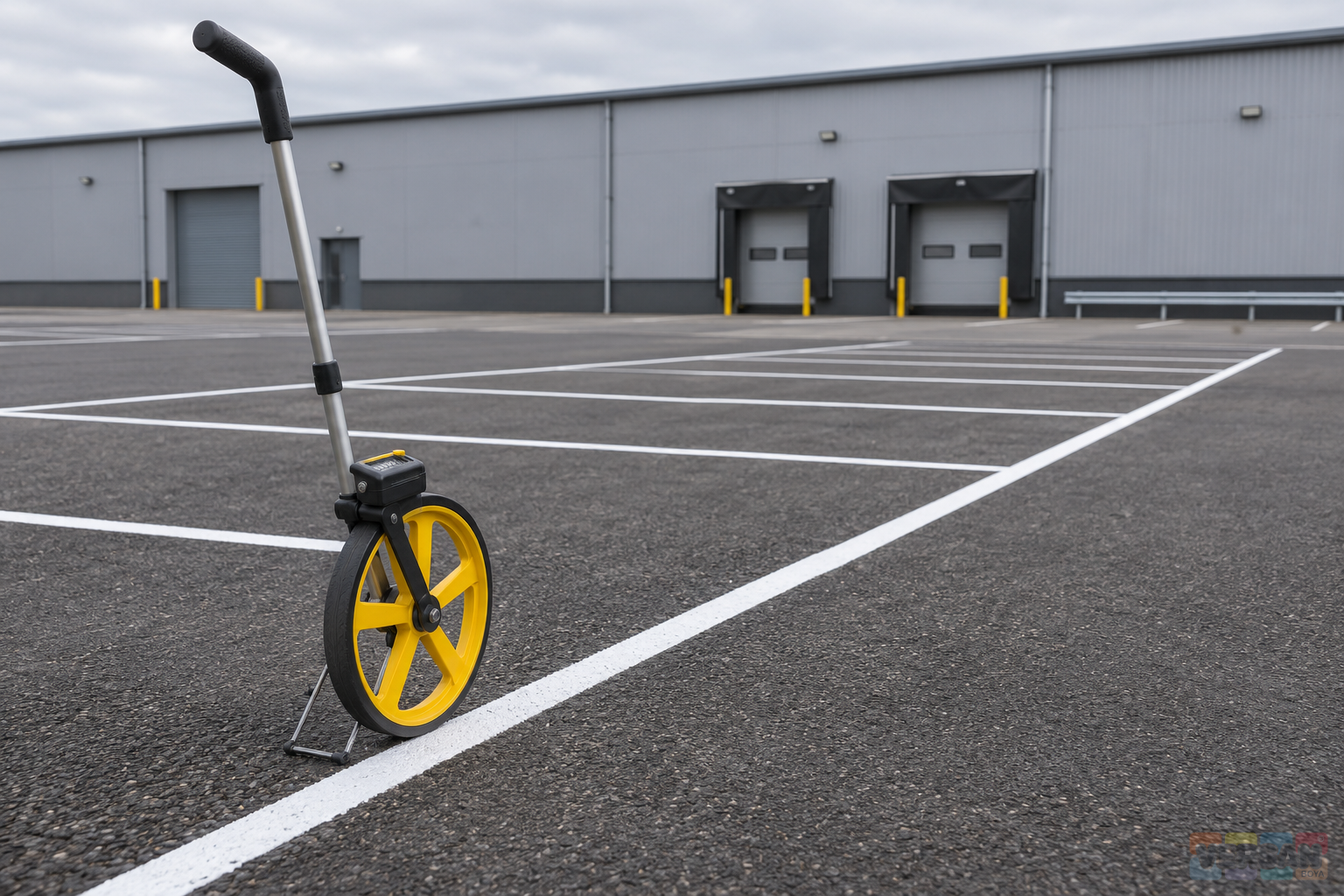
The final walk through a road marking job can reveal three different versions of the same quantity. The installer can identify the paint placed on the pavement. The contract administrator can identify the work eligible for payment. The storekeeper can account for the containers and auxiliary materials issued to the crew, returned to stores or held for continued use. If those three records are condensed into one figure, a reviewer cannot tell whether a difference represents an unpainted gap, a design change, extra work, an unopened return or a missing entry. A closeout file keeps the evidence connected while preserving the definitions that each team needs.
Map the boundary of the job before counting the work
Identify the work order, drawing revision, site zone, shift and measurement date. On a private logistics site, a loading apron, a visitor car park and a connecting lane may form part of the same project but be completed by different shifts. Give each physical section a short code that can be recovered from a drawing and verified at the site. Useful reference points may include a doorway, a column line or the end of a traffic island. A broad description such as “the rear delivery area” becomes less useful after adjacent lines are repainted or a loading bay is renumbered. Locate the ends of each measured section with a mark another person can identify.
An approved drawing describes the required layout. A marked-up drawing or final survey records what is actually on the site after changes. Date and retain both where appropriate. The original document helps explain the estimate and provides the reason for measuring a particular item. The as-installed update makes clear which revision is operative for maintenance. Where a turn arrow was moved after a layout review, attach the dated approval to the new location. Where a change was not approved or a section is inaccessible, put that section into a separately named status. A summary should not make all sites appear equally complete simply because they share one work order.
Separate tender, installed and accepted quantities
A tender takeoff estimates the work at the point it was specified. The site measurement records the completed geometry. An accepted quantity depends on the inspection outcome and the applicable rules of measurement. A broken line supplies a clear example. A measure along the alignment can include blank intervals, while a calculation for painted area counts only the lengths that carry paint and their applicable widths. A contract may use the alignment length for a specific pay item. Neither a material record nor a photograph can establish that contract rule. The project team reads the governing provisions and identifies the rule by name in the quantity schedule.
Keep one column for permitted payment quantities and another for the dimensions used in the material review. For unresolved items, include a provisional amount and the reason it remains provisional. A drawing change that removes a crossing may explain why the installed work is smaller than the tender takeoff. An unmeasured length, by contrast, leaves a gap in the evidence. The road marking quotation and quantity guide focuses on estimates before work. The closeout schedule gives a later reviewer a reproducible path from the estimate through approved changes to the physical result and the final acceptance decision.
Give lines and symbols the units that describe them
Measure a continuous line independently from a broken line, hatch area or stop bar. For a constant-width strip, the painted area can be calculated from the painted length multiplied by the measured width. Keep a double line distinct from its reference axis. A length entered against the axis may represent a different extent from the sum of the two painted lengths. Break a varied-width strip into segments or use the method required by the project. Record enough of the calculation for an independent checker to reconstruct it without converting feet, metres or square metres from an unlabeled column. Duplicate areas at joins deserve an explicit check.
Symbols need a count and may also need their painted area. A template with a stable reference can provide a basis for standard symbols if that use is authorised under the measurement procedure. The enclosing rectangle around an arrow, letter or access symbol includes blank pavement, so it is not automatically the painted footprint. A field-modified stencil may need an independent check. Identify the geometry that was actually used, and name the relevant revision in the record. The guide to symbol drawings and revisions explains why precise drawing identifiers matter before tender and throughout the changes that follow.
Reconcile stock using the right boundary and units
Begin the material account with the usable paint already assigned to the job at the start of the period, then record additional receipts or issues. Keep these separate from the paint taken to another order, returned in unopened containers, or available to use at the end. Give each movement a date, type, unit and container or batch identifier. If the team weighs an open pail, the record should explain the source of the tare and whether the figure is a measurement or a rough estimate. A transfer between shifts changes where the material is held. Treating it as consumption on both shifts overstates the net quantity and makes comparison with installed work misleading.
Use the full product identity for Nanomix Road Marking Paint or the actual material in use. For example, record the product or stock code, lot, colour and document reference with the issue or return. The Nanomix technical catalogue archive identifies the marking product and described uses such as asphalt and car parks. Current product documentation and the project requirements govern decisions for the particular work. The industrial coatings catalogue and the industrial paint range can help identify a purchase as a marking material, an adjacent coating or another stock issue. Use the verified label to resolve the actual container.
Keep losses and ancillary materials attributable
The record should show which thinner or ancillary item was issued, and whether it was added to paint, used for authorised equipment cleaning or returned. A listing under thinners and auxiliaries identifies a product group. A reference to acrylic thinner or cleaning thinner identifies a specific stock item. Product pages do not establish compatibility with the marking paint. The current product and work instructions determine the permitted material and purpose. Enter the actual transfer of the applicable product under the correct heading. Do not compare a volume of mixed material to a mass of packaged coating without a documented conversion basis for that material and condition.
An adjustment test, material held in the equipment, a documented loss and a repeat coat need their own traceable rows. Record glass beads separately where used. Rework may increase the material committed to the area without increasing the final installed length. Mark which existing lines were removed or replaced and link the rework record to the corrected installation. One section should not appear in the durable inventory twice simply because it was completed twice. Reviewers benefit from a distinction between a measured amount and an estimated allocation, especially when one machine worked on more than one site zone before being returned to its staging point.
Work the arithmetic through without inventing an explanation
Use this hypothetical example to test the structure of the report. The alignment length of a broken line is 360 metres, but the sum of the painted segments is 120 metres. At a recorded width of 0.12 metres, the painted area is 14.4 square metres. A continuous 60-metre line with a width of 0.15 metres adds 9 square metres. Six arrows with an accepted painted footprint of 0.60 square metres each add 3.6 square metres. The unique finished area is 27 square metres under these assumptions. The figure does not dictate the pay quantities. A different project can value the different pay items by alignment length, painted area, item count or another unit provided in the contract.
Suppose the work order opened with 5 kilograms of usable stock and received another 22 kilograms. The crew returned 3 kilograms unopened and retained 4 kilograms of usable material. It separately recorded 1 kilogram of waste, 2 kilograms for a trial and 1 kilogram for rework. This leaves 16 kilograms for reconciliation with the principal installation. If records link only 14 kilograms to that installation, there is an unresolved 2 kilograms. Filling the gap by increasing every zone's allocation would turn a missing record into a false explanation. These figures are neither a coverage recommendation nor a price basis. They illustrate why the evidence associated with an amount matters as much as a balanced total.
Separate adjacent flooring or plant work
It is common for project records to cover more than one coating operation at a site. A range of epoxy coatings may serve an adjacent floor or a separate prepared surface. The records for epoxy primer, self-levelling epoxy paint and epoxy topcoat should remain on the related flooring work order. That keeps both the road marking account and the flooring maintenance history readable. The presence of two products in one building does not establish their compatibility. Keep the actual work scope and layer identifiers with each zone. If two teams shared a stores delivery, distribute verified quantities using the recorded movements instead of the colour of a container or the date of delivery.
Some industrial paint work in the same complex could relate to metal bollards or equipment, with a similar colour but a different substrate and separate acceptance. The acrylic paint range provides a useful lookup when a stock entry lacks a complete description. Product records still need the confirmed identity of the contents and the surface to which they were applied. The warehouse line marking layout and handover guide explores coordination across an occupied facility. In this closeout, the goal is to preserve the boundary where one recorded scope ends and another begins.
Give inspection and acceptance their own evidence
The volume issued from stores cannot show the position of a line, the actual film thickness or its observed visibility under specified conditions. The closeout file needs the inspection evidence required by the contract. That can include geometry, appearance, thickness or the measured retroreflectivity where specified. A measurement row should state what was checked, where, when, using which method, and under which conditions. Keep the inspector's decision linked to the observed location. A test location on a trial line is not automatically evidence of performance on the finished installation. The competent project team uses the inspection and site traffic control arrangements that apply to the work.
The WSDOT measurement specification illustrates how different pay items may be measured by line length, painted area or number of symbols. The NCDOT construction manual discusses in-place inspection and retroreflectivity independently of its table of pay items and units. Together these examples illustrate why separate records are useful. They do not determine a project's acceptance method, thresholds or units outside their own scope. If a deficiency is found, link the actual period and location to the correction and the second inspection. An increase in recorded consumption during the correction can then be explained without changing the physical inventory for an unchanged length.
Keep revision status with the measurement
A complete table should allow the reader to trace any reported total back to a row and its evidence. Save the origin of the measurement, the calculation and the name or role responsible for checking it. If a second survey produces a different result, check whether the boundary, width, reference revision or units have changed before attributing the difference to extra work. Add a dated correction and retain the original figure. Use a status for values that are reported but not checked. This prevents the quantity summary from presenting a temporary amount as the agreed final total. It also makes the closeout useful when incomplete evidence must be explained to multiple teams.
Documentation differs between types of projects. In professional coating systems work, a change approved in the field may require a revised drawing, a change order, an updated site measurement and a new inspection record. There might be several records for one decision, with different owners and dates. The useful closeout file will make that relationship navigable. Record when the measurement took place and separately when the revised scope was approved. For a disputed item, mark which period and which surface are affected. Avoid resolving a difference by deleting measurements that are inconvenient or by applying a blanket percentage across unrelated work.
Test whether a different team can use the file
At closeout, select a line and a symbol from the final plan. Ask a colleague to locate the recorded measurement, follow the material or shift reference and find the associated inspection decision. That simple check can expose a route name that no longer exists, an unidentified pail or a calculation based on the wrong width. Agree who will retain the signed record and who will update it after maintenance. Missing stock and acceptance exceptions need their own owners and a stated follow-up. A line which will be corrected after the handover should remain findable and should not be presented as accepted until the responsible party records the decision.
Provide a concise summary showing contractual quantities, physical painted area and the material reconciliation side by side with clear units and qualification. Store the supporting calculation sheets, drawings, container movements and photographs under consistent identifiers. A photograph can document location or physical condition, but if it is used for measurement it needs an appropriate reference and method. Finish by recording where remaining stock is held and how later staff can identify it. When another team returns after surface work or a revised layout, this file can distinguish which markings were originally installed, which were subsequently changed and whether a difference still requires investigation.