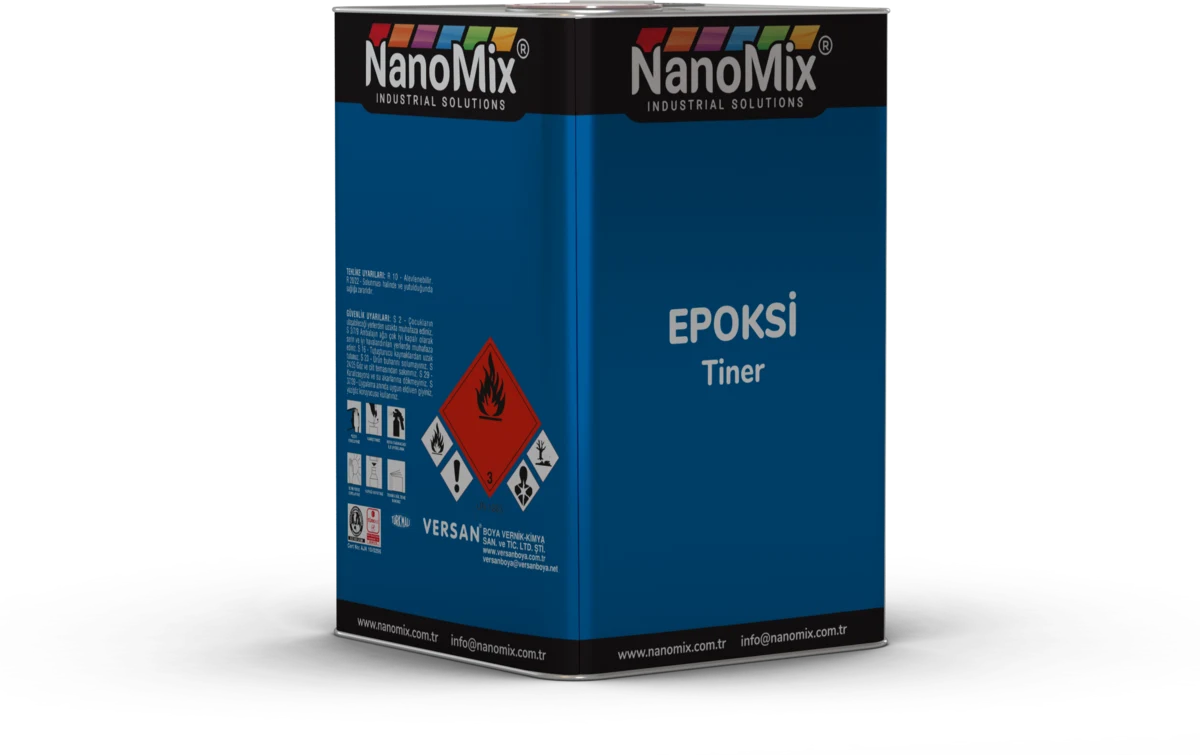
Nanomix Epoxy Topcoat packaging
Versan
coating system
Epoxy Systems

Epoxy Topcoat

Category
Epoxy Systems
Stock code
NMX-EPX-004

Nanomix Epoxy Topcoat is a two-component, epoxy resin-based gloss finish for metal, wood and mineral substrates, as described in the technical catalogue.

  • Two-component epoxy system
  • Protection against chemical and physical stresses
  • Gloss topcoat appearance
Build your quotationNo account · No payment

This is a quotation request, not a purchase. Pack size, colour and availability are confirmed in your quotation.

Review my quote basket 0

Our sales team will confirm colour, packaging and stock options according to your project requirements.

Product characteristics

Controlled performance
for the right surface.

Developed for surfaces exposed to chemical and physical stresses, this epoxy topcoat is listed for general industry, machinery manufacturing, metal protection and marine applications. Suitability depends on surface preparation, primer selection, exposure conditions and the application environment.

Areas of use

Metal, concrete and other mineral substrates, and wood; machinery, general industrial and marine applications. Continuous immersion and resistance to specific chemicals require separate technical confirmation.

A complete system approach

Surface preparation, a compatible primer, the appropriate coating build and controlled environmental conditions are considered together.

Technical overview

Essential information for application planning

Values are compiled from the catalogue archive. Before application, verify them against the current technical data sheet for the relevant production batch, colour and project conditions.

System typeTwo-component, epoxy resin-based
FinishGloss
Recommended substratePrepared metal, concrete/mineral substrates and wood
ApplicationSpray application (method stated in the catalogue)
Thinning / mixingArchived catalogue: 4 parts paint + 1 hardener + 1 epoxy thinner; confirm the measurement basis
DryingAt 20 °C: touch dry 1–2 hours · ready for assembly 48 hours · fully dry 7 days
Theoretical coverageApproximately 12 m²/kg at 50 µm dry film thickness; theoretical catalogue value
Technical decision support

Assess the substrate, environment
and application together.

Explore the catalogue data, selection criteria and related system components for Nanomix Epoxy Topcoat in one place.

Packaging options

Choose the right kit size
for your project.

Request the base component and matching hardener together as a complete kit.

A + B Two-component system
Total net weight
3 kg
Complete kit
A
2.4 kgBase / paint
B
0.6 kgHardener
Total net weight
20 kg
Complete kit
A
16 kgBase / paint
B
4 kgHardener

Kit weights are the combined net weights of components A and B; thinner is not included. Pack sizes are quotation preferences; packaging, colour and availability are confirmed by our sales team.

Application conditions in the catalogue

Ambient temperature
5–50 °C
Substrate temperature
10–30 °C
Relative humidity
< 85%
Topcoat finish
Gloss

These application values come from page 14 of the archived technical catalogue. Follow the current technical data sheet for the supplied product batch.

Product selection guide

When should an epoxy topcoat be considered?

01
Machinery and metal equipment

A candidate topcoat where a gloss finish is required on surfaces exposed to chemical and physical stresses. Identify the metal, existing coating and cleaning method, then assess the primer against those requirements.

02
Marine and humid environments

The catalogue refers to seawater exposure and marine applications. Continuous immersion, contact duration and resistance to specific chemicals are not classified on this page. Confirm suitability for the project with the technical team.

03
Concrete, mineral surfaces and wood

These substrates are listed in the catalogue; preparation and priming requirements vary. Heavy vehicle traffic or a thick, self-levelling finish calls for a separate assessment of the floor coating system.

Frequently asked questions

Detailed guidance on epoxy topcoats

Five key topics for purchasing and application planning. Technical values are drawn from the archived catalogue; packaging options reflect current business information. Points requiring technical confirmation are identified below.

Which substrates and applications is Nanomix Epoxy Topcoat intended for?

The archived technical catalogue describes Nanomix Epoxy Topcoat as a two-component, epoxy resin-based topcoat with a gloss finish. Listed substrates include metal, concrete and other mineral surfaces, and wood; listed applications include general industry, machinery manufacturing, metal protection and marine projects. Product selection should consider both the condition of the substrate and its service environment. New metal, previously coated equipment and absorbent concrete may require different preparation methods and primer systems.

Before application, check that the substrate is sound, clean and dry. Remove unsound existing coatings, dirt and residues that could affect adhesion or film formation. If an existing coating is to remain, confirm its compatibility with the proposed system. The archived document does not specify a universal blast-cleaning grade or surface profile for every metal, nor does it authorise direct application without a primer in all circumstances. These details should be established through a current, substrate-specific system recommendation.

References to water, seawater, chemical exposure and physical stresses in the catalogue do not establish unrestricted suitability for every chemical or for continuous immersion. Technical assessment requires the substance involved, its concentration and temperature, the duration of contact and the expected abrasion. Potable-water contact, continuous immersion or a specified performance classification requires separate product and system approval for that particular use.
How should the paint, hardener and thinner be proportioned and mixed?

The archived technical catalogue lists 4 parts epoxy paint, 1 part epoxy hardener and 1 part epoxy thinner. However, it does not clarify whether these parts are measured by weight or volume, identify the exact hardener code or specify the usable pot life. Do not convert this statement directly into litres or kilograms to prepare a mixture. Check the current technical data sheet for the supplied product batch together with the component labels.

Current packaging options are a 3 kg kit (2.4 kg A + 0.6 kg B) and 20 kg kit (16 kg A + 4 kg B). Component A is the paint base and component B is the hardener. The stated kit weight is their combined net weight; thinner is not included. Packaged component weights alone do not define the thinning requirement or application procedure. Confirm component compatibility, the measurement basis, mixing procedure, any induction time and the permitted thinner addition against the current technical data sheet and labels.

Nanomix Epoxy Thinner is described in the catalogue as a thinner for epoxy topcoats, primers and varnishes. This does not establish a single dilution rate for every item of application equipment. Use the current recommended rate for the selected method and ambient conditions. Plan each mixed batch around the quantity that can be applied within the confirmed pot life. If a mixture becomes difficult to apply, do not alter the formulation by adding thinner or hardener without an approved procedure.

What area does Nanomix Epoxy Topcoat cover, and how should the order quantity be calculated?

The archived catalogue states approximately 12 m²/kg at a dry film thickness of 50 µm. Treat this as a theoretical starting point, not a guaranteed practical coverage or the exact capacity of a particular kit. Surface roughness, absorbency, component geometry, application method and application losses can all affect actual consumption. Include edges, corners and difficult-to-reach details in the assessment.

First establish the actual area, the required coating system and the specified dry film thickness for each coat. Then verify whether the coverage stated in the current technical data sheet is based on a particular component or on the mixed product. The archived page does not clarify this kilogram basis, so multiplying 12 m²/kg by the full kit weight is not sufficient to establish an exact purchasing quantity. Allow for project-specific losses and, where appropriate, a representative application trial.

Available pack sizes for planning are a 3 kg kit (2.4 kg A + 0.6 kg B) and 20 kg kit (16 kg A + 4 kg B). The smaller kit provides an option for lower-volume work and batch planning; the larger kit serves higher overall material requirements. Kit size does not change the usable life of the mixed product. Colour and stock availability are confirmed when ordering. For an informed quotation, provide the area, substrate, existing coating, application equipment and required coating build; include the primer and thinner in the same system assessment.

What are the drying times, and how should temperature, humidity and recoating intervals be assessed?

At 20 °C, the archived technical catalogue states a touch-dry time of 1–2 hours, readiness for assembly after 48 hours and full drying after 7 days. These describe different stages. A touch-dry surface is not necessarily ready for assembly, substantial mechanical loading or chemical exposure. Schedule surface handling, transport or assembly, and entry into service as separate decisions.

The same page specifies an ambient temperature of 5–50 °C, a substrate temperature of 10–30 °C and relative humidity below 85%. These are archived values. The drying times stated at 20 °C should not be assumed to remain unchanged throughout the entire temperature range. Assess substrate conditions as well as ambient conditions, ensure the surface is dry and follow the limits in the current documentation for the supplied product.

Minimum and maximum recoating intervals are not stated in the archived page. Consequently, neither the 1–2-hour touch-dry time nor the 48-hour assembly time should be treated as an automatic interval for applying the next coat. Confirm the recoating window, preparation required if that window is exceeded and the waiting period before service with the technical team. Recording application conditions and coat timings is particularly useful for quality control and future maintenance planning on critical projects.

Which primer should be considered, and when should epoxy or polyurethane be evaluated for exterior use?

Primer selection depends on the substrate, surface preparation, existing coating and required level of protection. Nanomix Epoxy Primer is a related product to include in the technical assessment. The word “epoxy” in both product names does not, by itself, establish compatibility under every condition. Check the primer’s current overcoating guidance alongside the topcoat’s substrate requirements and permitted recoating interval.

Compare epoxy and polyurethane against the actual service requirements, rather than a broad description such as durability. Define chemical contact, physical abrasion, sunlight exposure, colour and gloss expectations, maintenance access and the production schedule. The archived page for this epoxy topcoat does not provide a UV performance classification or a stated period of exterior colour and gloss retention. It therefore does not support a specific exterior appearance warranty.

Considering a gloss polyurethane topcoat as an alternative does not imply that it may be applied over an existing epoxy coating without preparation. Confirm the required preparation, adhesion compatibility and application window for the proposed system. Similarly, a conventional epoxy topcoat should not be assumed equivalent to a self-levelling floor system for a factory exposed to heavy vehicle traffic. Share the substrate, exposure conditions and desired finish with the technical team so that the complete coating build can be assessed.

Technical documentation

Review the source. Verify the details.

The original technical catalogue page for the topcoat and epoxy primer, supplied as a searchable PDF in Turkish and English.

Document status
Archived catalogue page · p. 14
Document date / revision
Not stated in the source
Page content reviewed
· content version 1.2

The content review date is not the revision date of the manufacturer’s document. Contact our technical team for the current technical data sheet and safety data sheet.

Related technical resources

From product selection to a complete system

Use these resources for technical assessment. Confirm compatibility, recoating intervals and application ratios against the current technical data sheets.

Application control

Reliable results begin
with a controlled process.

Prepare a sound, clean and dry surface and remove unsound existing coatings. The catalogue specifies spray application. Follow the current technical data sheet for primer compatibility, the weight or volume basis of mixing, pot life and recoating intervals.

Request technical documentation
  1. 01
    Assess the surface

    Evaluate the substrate, absorbency, moisture, corrosion and existing coating layers.

  2. 02
    Prepare the substrate

    Remove dirt, grease, dust and unsound material, then establish a suitable primer system.

  3. 03
    Control application conditions

    Set temperature, humidity, mixing, viscosity and recoating intervals in accordance with the technical data sheet.

  4. 04
    Verify the coating film

    Monitor uniformity, coating continuity and curing conditions throughout application.