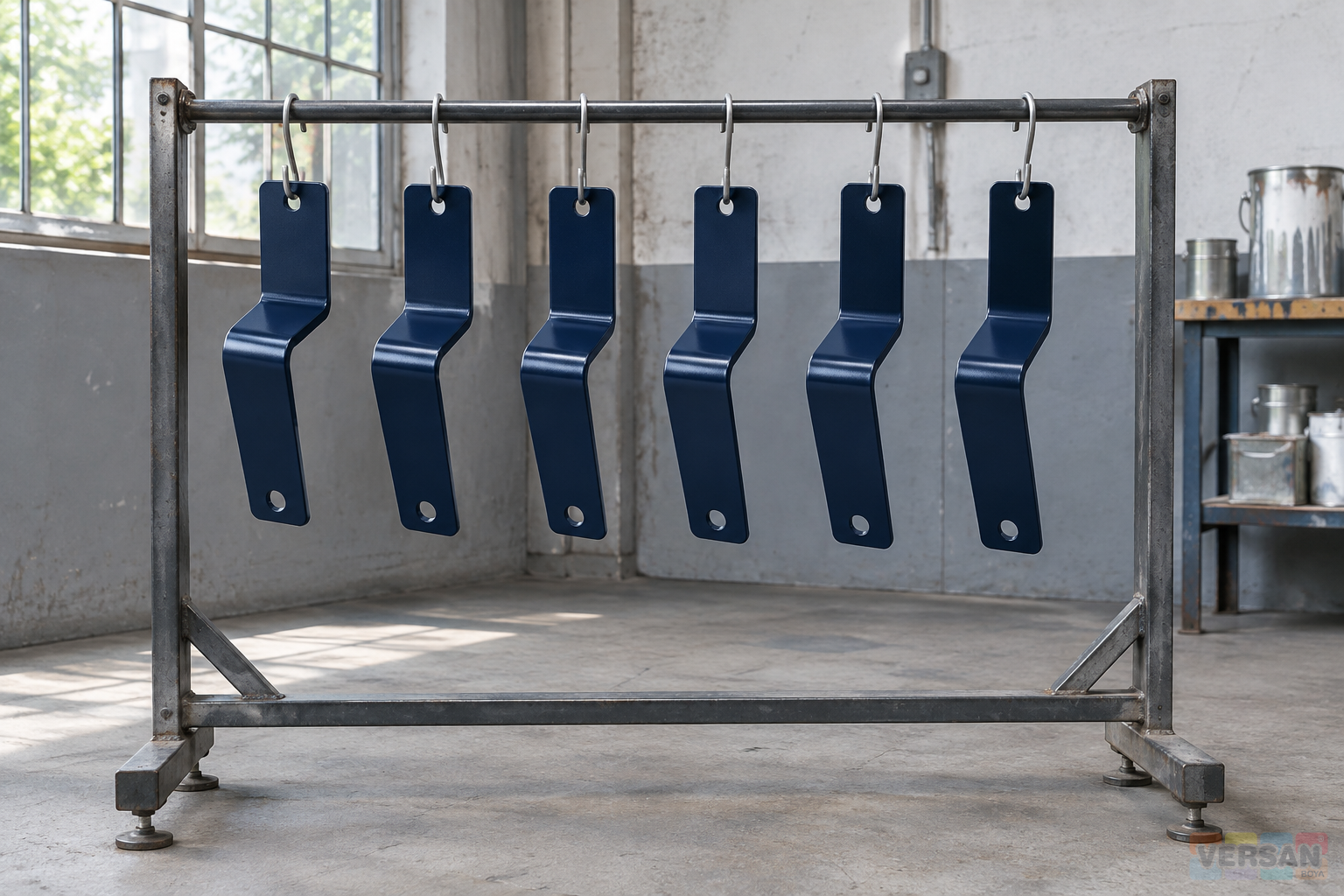
A quick-drying painted component can have an even broad face and still raise a question at the small point where its hanger touches the metal. A support impression, an intentionally protected area and later handling damage should not be assigned the same cause simply because they look similar. When discussing quick-drying industrial paint, the useful objective is to identify those locations and their assessment before the production sequence is complete. This article provides a qualitative recording approach. It is not a fixture design, a lifting plan, a handling approval or a universal tolerance for marks on painted parts.
The fixture question is also different from the spray-settings question. A surface accessible to the coating and the small area physically occupied by a hook do not have identical exposure during application. Nevertheless, the presence of a mark does not establish its cause. The sequence of contact needs investigation. The article on spray quality with quick-drying paint discusses separate issues such as runs and dry spray. Here the focus is narrower: where the component is supported, when that contact occurs, and how its appearance is related to the component's agreed use and inspection conditions.
Identify function and visible surfaces first
An external enclosure face, the edge of a fixing hole and a mating surface hidden after assembly may have different appearance expectations. Those differences should be stated rather than left to an operator's assumption. A drawing can identify visible areas, surfaces concealed in assembly and features that must remain protected. Record the drawing revision as well. A contact location acceptable under an earlier arrangement may become exposed when the assembly changes. This surface classification is a communication device, not a claim of compliance with an acceptance standard. It provides a common description before anyone decides what a particular mark means.
Visibility may include more than the normal final viewing direction. Areas seen during unpacking, installation or maintenance can also matter to the relevant party. Identify the use condition being assessed. The same question applies when discussing quick-drying matt industrial paint. A matt or gloss preference does not automatically establish whether a contact mark is acceptable. Surface appearance, function and assessment conditions need consideration together. Avoid assigning a universal permissible mark size or assuming that a hidden area has no protective requirement. Those questions need a project-specific decision supported by the applicable product and component information.
Record hangers, stops and temporary supports separately
The main hanger supporting a component and a small stop controlling its orientation have different roles. A temporary support used at a subsequent station adds another possible contact. A record containing only one hanger-point label may miss these distinctions. Describe the location, function and process stage of each relevant contact. A coating-stage hook can have a different identifier from a support on the inspection bench. When a new mark appears, the sequence can then be reviewed without automatically blaming the most conspicuous piece of equipment. The record should distinguish what was directly observed from what is only suspected.
A useful contact map does not require sophisticated software. An identified drawing, a marked photograph and a short sequence description can provide a practical start. However, such a map does not demonstrate mechanical suitability. Hanger geometry, load capacity and safe use remain matters for the appropriate specialist. Choosing a product from the industrial coatings range does not answer those questions. The coating record identifies the approved arrangement used for the observation. It does not authorise a change to that arrangement for cosmetic reasons. Any alternative needs to pass through the relevant equipment and production review before the new observation is treated as a valid comparison.
Connect observations before and after coating
A photograph or inspection note taken before painting can help interpret a later feature. An existing scratch, a burr around a hole or the boundary of a machined face can then be distinguished from something first noticed after application. Keep the component identifier, date and fixture reference together. Without that initial record, the origin of a later line may remain uncertain. That uncertainty should be acknowledged rather than replaced by a confident diagnosis. The record is a starting point for technical review, not proof that every visible difference was caused by the coating, the operator or the handling arrangement.
Post-coating observations can be linked to more than one stage: on the hanger, after release and at the next nominated inspection point. This shows when the feature was first noticed. It does not mean the component should be unnecessarily handled, turned or pressed merely to create a test. Observation must fit the approved sequence. If quick-drying industrial primer is under discussion, distinguish the primer-stage record from the topcoat-stage record. The same location viewed at different stages should retain its identity. A feature originating earlier in the process should not be described as newly created simply because the final inspector saw it for the first time.
Do not treat touch dry as approval for every contact
Touch-dry appearance is not a general approval for hanging pressure, stacking, assembly or any other contact. Jotun's Alkyd High Gloss QD technical data sheet distinguishes named drying states and relates the reported values to controlled conditions. Only that distinction is used here; its times and temperatures are not transferred to Nanomix products. The actual product, operation and current technical information require their own assessment. An improvised finger check cannot represent every later loading condition. Nor should a result obtained on a flat test panel be presented as proof for all contacts on a shaped production component.
Location, duration, movement and the condition of the contacting surface can also raise questions. This article supplies no numerical limit for them. Recording the conditions of a trial makes clear why observations made under different conditions are not automatically comparable. The earlier article on drying and readiness for handling explains the broader distinction. A fixture review addresses a specific point on a specific component during a defined stage. Keeping that question narrow prevents a general drying description from acquiring an unsupported meaning about the entire handling chain, transport arrangement or assembly procedure.
Review the complete arrangement before moving a contact
Moving a hook to another hole may look like an easy way to move a visible mark. It can also change orientation, spacing or access to other surfaces. An authorised technical review is needed before a cosmetic objective changes the handling arrangement. First describe the existing fixture; then identify what an alternative would change. Give different arrangements different references rather than retaining one name for several configurations. That makes the evidence understandable and avoids the impression that the original review has automatically covered a new physical setup. Safety and equipment suitability remain independent requirements throughout this discussion.
Changing several variables at once makes a comparison difficult to interpret. If hook location, component orientation, coating system and observation stage all change, the resulting difference cannot confidently be assigned to one factor. A trial note can identify what remained the same and what was deliberately changed. An observation made within one alkyd coating arrangement should not be presented as another product family's result. A simple production comparison is not automatically a controlled laboratory experiment. It can still be useful when its scope is honestly stated and the reader can distinguish the observed result from an inference that needs further investigation.
Separate protected features from unintended marks
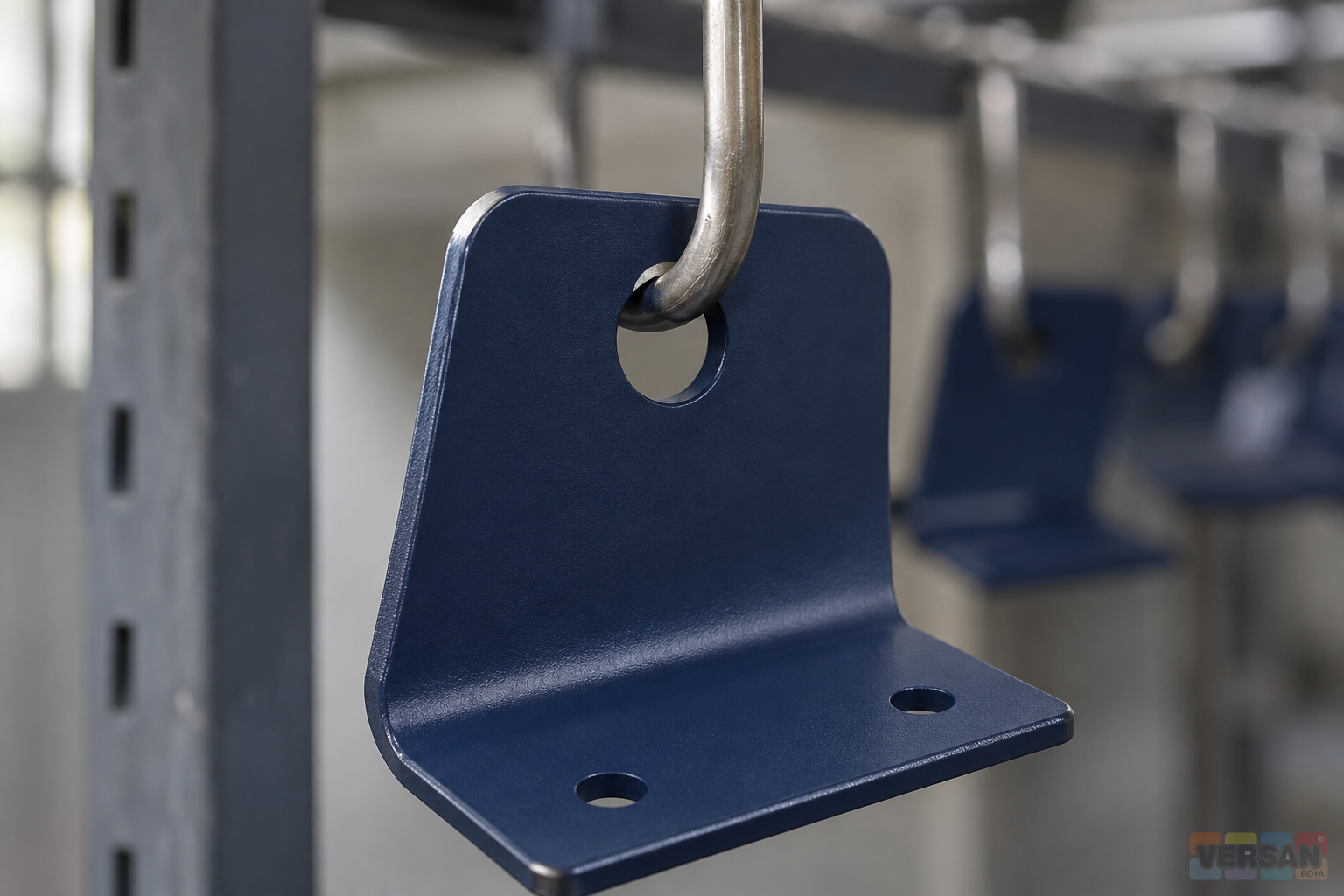
Some mating or machined areas may intentionally remain outside the coating boundary. An exposed metallic feature can therefore be a specified outcome rather than an accidental omission. Conversely, an accidental contact area should not be renamed a protected feature after the event. The original drawing, masking description and accepted boundary provide the basis for the distinction. A mark on a photograph needs an explanation of its status. A confirmed boundary and a feature still under investigation should not appear as equivalent approvals merely because they have both been highlighted by the same person in the same image.
Hole interiors and joint edges can be particularly easy to describe imprecisely. State whether the inspection concerns the complete surface or a nominated local area. Selecting an antirust primer does not establish that every exposed point is adequately protected. The area's function, exposure and project expectations require review by the relevant technical owner. There is no universal instruction here to leave every hole unpainted or to touch up every contact point. The value of the record is that it identifies the actual feature and connects it to a decision, instead of treating all small uncoated areas as the same condition.
Avoid an unverified material change as a shortcut
A visible hanger mark is not a sound reason to change dilution or add an arbitrary auxiliary product before the contact sequence is understood. First establish how the component was supported and when the mark was noticed. Current pairing and use information are needed when discussing quick-drying industrial thinner. The accepted Nanomix archive distinguishes thinner groups; it does not prescribe a hanger-mark remedy. Knowing a product name does not justify guessing its quantity, assuming compatibility or treating a different thinner as an interchangeable adjustment. Product advice and fixture observation should retain their separate evidence and decision routes.
When opening a technical enquiry about thinners and auxiliary products, provide the product identifier, information version and observed condition. If a material change is proposed, record it separately from a fixture change. Combining them without a record weakens interpretation of the next trial. A satisfactory appearance on one trial component is also not automatic approval for unrestricted series production. State who reviewed the result, which conditions it represents and which questions remain open. The aim is to avoid converting a limited cosmetic observation into an unsupported application recipe that appears to have broader technical authority than the evidence actually provides.
Keep different coating systems distinct
An observation made with a quick-drying industrial paint should not simply be transferred to another system. Single-component acrylic topcoat, polyurethane gloss topcoat and stoving paint involve separate product and process assessments. The links identify subjects for technical enquiries; they do not claim interchangeability or identical fixture behaviour. When the component moves to another system, review what the previous trial actually covered. A familiar shape or colour does not make the earlier record sufficient for a different application, drying or subsequent-operation sequence.
A primer change deserves the same care. The fact that the topcoat appears similar does not demonstrate that the complete system has remained equivalent. Another job involving epoxy primer needs current system advice rather than an assumption that the same hook will yield the same result. Record primer and topcoat identifiers separately where relevant. Hempel's general guidance distinguishes preparation, application and inspection topics. That broad structure helps identify missing questions in the file. It does not establish a product-specific result, handling interval or allowable contact condition for any of the Nanomix products linked in this article.
Make appearance observations understandable
A very close photograph and a distant overall image communicate different things. One may exaggerate the prominence of a small feature, while the other may make its location impossible to identify. Keeping an overall view beside a local view is often a clearer record than using either alone. Note the component position, observation stage and lighting direction sufficiently for the discussion. This article defines no standard illuminance or viewing distance. Where formal visual acceptance conditions are required, the project needs to identify them through the appropriate process. An attractive photograph is not a substitute for agreed inspection conditions.
Image editing should not invent detail, hide an observed feature or make a colour appear to be a measurement. Even a non-measurement record needs a clear connection to the component and stage shown. Where several samples exist, selecting only the best-looking one can obscure the reason for the trial. Explain the sample selection when it matters to the decision. The objective is to provide useful information to a reviewer, not to present a successful production claim. A limited but accurately identified observation is more valuable than a dramatic image whose relationship to the actual process is uncertain or undocumented.
Treat any touch-up as a separate decision
A contact review may lead to a discussion about local correction. Its method needs assessment against the coating system, surface condition and required appearance. Applying the same paint to every mark is not a universal solution. Identify the proposed area, the information that needs confirmation and how the result will be reviewed. Keep the trial decision bounded. A result on one small area of one component should not silently become acceptance for an entire production batch. Where technical advice is needed, the record should preserve the actual question rather than describing a repair method as already approved.
If a correction is made, retain the original observation. Link the earlier image, the action performed and the later review. The initial condition can then be understood if the same point is discussed again. If no correction is required, record the basis for that decision too. The aim is not to maximise touch-up work. It is to make an appropriate appearance and function decision traceable. A deliberately protected area, an accepted hanger location and a feature awaiting investigation are different outcomes. Naming them clearly helps the next team understand whether it is receiving an instruction, an accepted condition or an unresolved question.
Match the physical sample to its records
The identity of a trial component should not depend solely on a folder name. If several samples share a drawing, establish which photographs belong to each one. Any physical identification method must be suitable for the component and approved process; this article recommends no particular adhesive, marker or label. An example code, observation sequence and fixture reference can be recorded together. A local photograph should not accidentally be paired with an overall image of another sample. This modest control prevents confusion about whether an acceptable broad face and an unusual contact area belong to the same physical object.
The recipient needs to locate the basis for the earlier review. Images left only in a messaging conversation can lose their sequence or supporting explanation. Use the authorised filing location and carry the same sample reference into the notes. If an explanation changes, preserve the earlier image and add the revised interpretation rather than silently replacing the record. This does not improve coating performance by itself. It helps prevent a conclusion about one sample being applied to another. Where the evidence remains insufficient, specify the additional image or information required instead of giving a more definite answer than the record supports.
Recheck open points before series production
A trial may approve one hanger position while leaving the subsequent stacking arrangement unexamined. Its result should not then be described as approval of the full handling chain. The production team needs to know the boundaries of the decision and the point at which a further review is required. A larger or heavier version of the component also needs appropriate consideration rather than automatic reliance on the earlier fixture review. The relevant specialist continues to assess safe handling suitability. The coating observation record remains one part of the information, not the authority for every equipment or production decision.
A hypothetical bracket illustrates the issue. Its hanger contact is initially located at the edge of a hole concealed during assembly. A later design revision leaves that hole visible. The previous appearance decision needs review because the use condition changed; that fact alone does not establish a coating failure. If a new mark appears in production, compare the fixture condition, position, recorded process and later contacts without guessing the cause. Preserve the earlier decision and add the new observation. Managing contact points well means that the arrangement, conditions and appearance expectations are understandable, allowing the next technical conversation to begin with a specific component and a clear question.