
A freshly painted component that no longer marks under brief touch is not automatically ready for packaging and transport. A short contact, assembly pressure, stacking load and repeated movement during delivery are different demands. A reliable production process defines readiness for each stage separately and releases a component on the basis of verified condition, rather than the clock alone.
Fast drying is an important reason for considering quick-drying industrial paint. However, rapid surface drying and the ability to withstand every subsequent operation are different assessments. Film build, component geometry, application, environment and transport arrangements all matter. This guide therefore concentrates on a traceable progression from touch-drying assessment to dispatch release instead of prescribing one universal waiting time. The current instructions for the actual selected product remain the governing reference throughout that progression.
1. Name the drying stages clearly
Dust-free condition, touch drying, readiness for assembly and full drying do not describe the same state. Check how each term is defined in the relevant product document, including its test conditions. Brief light contact with a film is different from the effect of a fixing, support pad or assembly tool. Using the word dry as a common approval for every production decision can allow unresolved stages to disappear from the release process. A simple label is useful only when its meaning is understood.
The job traveller should distinguish the approval states. Permission for controlled handling is not permission for stacking. Dispatch readiness is not automatically confirmation of chemical resistance or full service performance. Our guide to quick-drying paint explains the general system terminology. A production decision needs the actual product document and a check appropriate to the actual component. Connecting those two prevents different teams from interpreting the same drying label differently and clarifies who is responsible for authorising the next operation.
2. Use the document for the correct product
Products described as rapid or quick drying do not all share one formulation or one drying behaviour. Technical information prepared for a quick-drying industrial topcoat cannot automatically be transferred to every similarly named product and application. Colour, finish, coat build-up and thinning can change the assessment. If the selected material is a quick-drying matt industrial paint, record that exact identity and its relevant current documentation rather than relying on a generic family description.
The website's archival catalogue distinguishes touch drying, assembly drying and full drying in its rapid topcoat section. That distinction is useful, but the reference conditions are not a dispatch guarantee for every present-day workshop component. Check the product name and conditions in the archive against the current information for the material being purchased. A similar family name alone does not establish an exact product match, so this article assigns no universal minute or hour value to all rapid paints. Confirming the product code, batch and process conditions with the technical team turns family-level information into a more defensible production decision.
3. Assess the slowest relevant area of the component
A flat coupon may appear ready while an internal corner, weld area or return face on the actual component remains different. Areas with excessive coating build should not be assumed to behave like thin, exposed areas. If the whole component is being released, checking only the most accessible and fastest-drying surface can create false confidence. The inspection plan should include difficult areas and the contact points that will receive pressure in the next operation. The selected locations need a reason that can be explained.
Where a representative coupon is used, connect its preparation, coat build-up and application time to the production component, and state what it does not represent. A coupon cannot reproduce every geometric effect on a complex part. When the component type changes, review the previous waiting and inspection arrangement instead of copying it without consideration. A thin sheet-metal cover and a substantial frame with enclosed sections may need different handling assessments. Application personnel control the film build, while quality personnel assess whether the inspection locations and sample arrangement provide a useful representation of the job.
4. Record the conditions where the part actually waits
Air temperature, substrate temperature, relative humidity and the ventilation arrangement belong in the application record. Parts coated in the morning and parts coated later in a cooler environment may not follow the same timetable. Metal brought from storage can have a different temperature from the surrounding air. Moving a component from the application booth into a holding area may change its conditions again. Recording only the booth reading does not explain the environment in which the part spends its drying period.
The official scope of ASTM D1640/D1640M covers stages of organic-coating film formation under controlled temperature and humidity, with procedures also addressing prevailing shop or field conditions. This supports treating a drying result as condition-dependent rather than as an isolated number. The response of a particular product still requires its own technical information. If conditions change, do not automatically extend an earlier successful trial into approval for the new batch. Record the change, repeat the relevant assessment and connect the release decision to the current component. Naming a standard is not evidence that the stated test method has actually been performed.
5. Treat primer and thinner as part of the same process
The topcoat condition cannot be considered independently of the preceding coat. In a system using quick-drying industrial primer, verify the overcoating conditions against the relevant product instructions. Passing a topcoat touch-drying check does not resolve every question about an insufficiently prepared underlying coat. If an antirust primer or synthetic primer is proposed for maintenance work, assess system compatibility and overcoating requirements separately rather than treating the primer category as sufficient confirmation.
Use the specified auxiliary, such as quick-drying industrial thinner, at the conditions established in the current instructions. Adding more thinner is not a general remedy for drying difficulties. An alternative solvent, excessive coating build or an uncertain underlying coat may not be reliably managed simply by increasing the waiting period. Keep the selection and use of thinner products in the process record. If a problem occurs, the investigation then begins with what was actually applied. Changes should follow authorised technical review, not an informal adjustment made to meet a dispatch deadline.
6. Keep touch assessment distinct from dispatch approval
Pressing a finger randomly onto the surface is not a defined standard test. Establish the inspection method, location and acceptance criteria before production. Where practical, use an appropriate representative area or sample that avoids damaging the visible delivered finish. The record should identify the drying stage being assessed. A statement such as no mark can be interpreted differently across shifts when the pressure, duration and type of contact are not defined. Consistency depends on a shared method, not merely a repeated phrase.
When the result is acceptable, authorise only the next operation covered by that assessment. Controlled repositioning may be permissible while direct stacking or close packaging remains unapproved. Show this distinction through understandable production statuses. Our article on quick-drying industrial coating process efficiency discusses flow management; here that flow is connected to separate readiness decisions. Production speed comes from knowing which operation can safely proceed and under what conditions. It should not depend on skipping the checks that distinguish one approval stage from another.
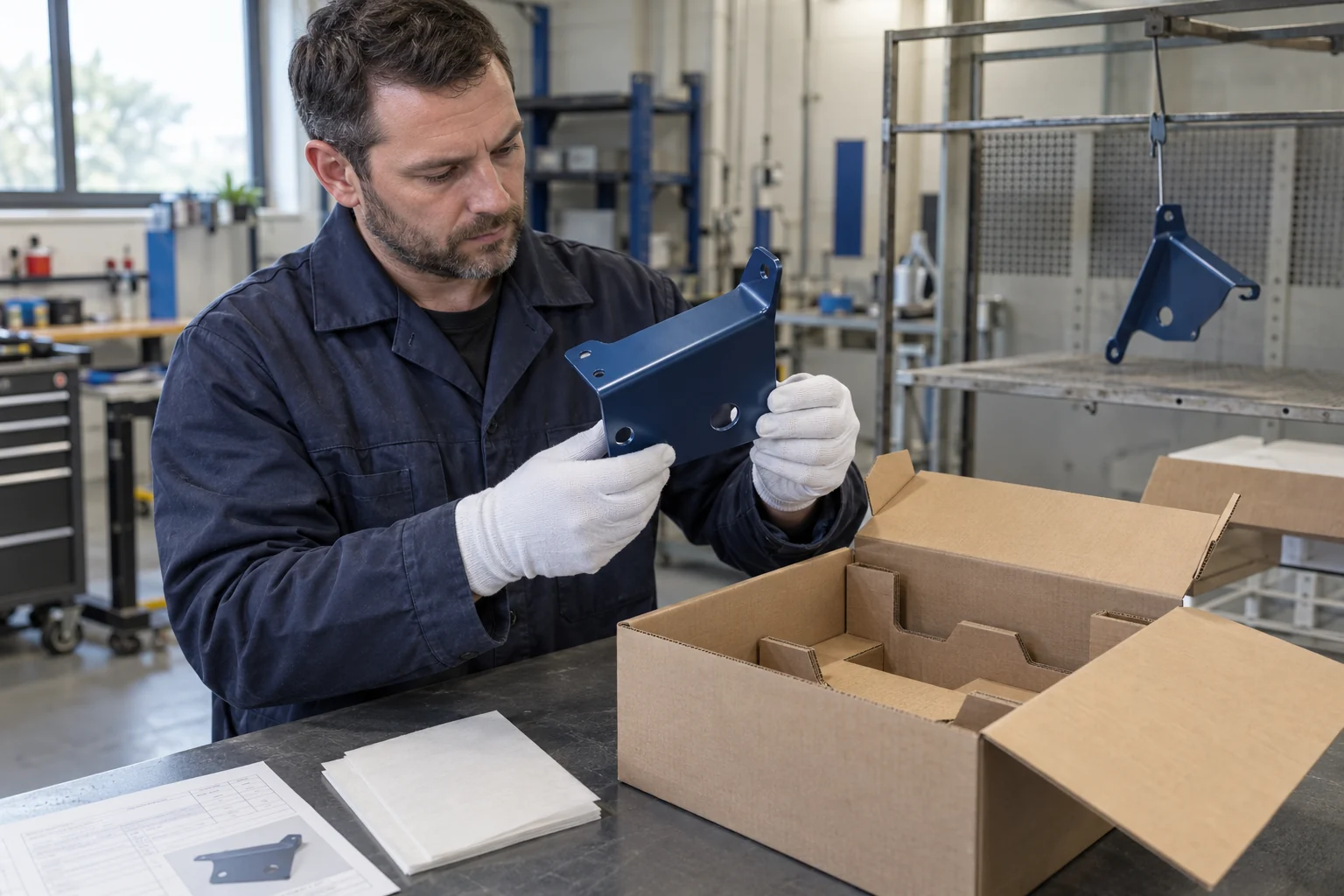
7. Design handling contact points before painting
Decide how the component will be supported and moved before applying the coating. An appropriate carrier, hanger or approved unpainted contact point can reduce unnecessary pressure on a developing film. Mechanical safety, load capacity and component geometry must be assessed separately. This guide does not specify lifting equipment or safe working loads. Production and safety personnel should use their approved handling procedures. An arrangement that protects the coating does not remove the mechanical safety requirements associated with moving the component.
A handling trial should represent the actual movement direction and contact locations. Glove cleanliness, support texture and sliding contact can affect the finish. If one approved arrangement leaves no unacceptable mark, record the result for that arrangement. A different carrier or grip position does not automatically receive the same approval. The variety of components found in industrial coating applications makes early planning valuable. Identify protected surfaces and intended support points in the production instructions, rather than leaving operators to improvise a way of holding the part after it has been painted.
8. Assess assembly pressure as a separate demand
Assembly can introduce concentrated pressure and friction beyond brief manual contact. A fixing, gasket, clamp or support platen interacts with the coating in its own way. A sample check that does not represent the assembly arrangement may miss those effects. Identify the loaded locations and the appearance requirements in the production instruction. Plan the assembly sequence to protect the finish while preserving the mechanical procedures required for the actual component. Coating-readiness decisions must not substitute for the engineering requirements of the joint.
For a critical operation, conduct an appropriate representative assembly trial and record the contact location, action and environmental conditions alongside the result. A pressure mark may indicate that assembly started too early or that the support arrangement needs review. Investigate those conditions before automatically attributing the problem to paint quality. A single successful example does not prove that components with different film build or different application conditions are also ready. Set inspection frequency through the organisation's process and risk assessment. Useful release criteria describe the operation being allowed, rather than making a broad statement that the paint is simply dry.
9. Consider stacking pressure and contact duration together
Stacking involves contact duration and load distribution as well as contact itself. The weight of the upper parts, the size of the supports and movement within the package can challenge the coating. Surfaces that separate after a brief contact may mark or adhere during a longer loaded contact. Touch-drying approval should therefore not automatically become stacking approval. ISO 9117-2 defines a pressure-test scope for assessing whether a coating, after a specified drying period, resists damage when surfaces are held in contact under pressure.
An informal workshop trial must not be presented as full compliance with that standard. Where a specified standard test is required, the complete method and competent assessment need separate provision. For practical production checks, use representative supports and the planned stacking arrangement while preserving the approved safety and surface-protection procedures. With alkyd coating systems, a successful handling assessment for one part is not automatic release of an entire stacked package. Recording load, time, temperature and contact arrangement makes the trial a useful reference for a subsequent genuinely comparable job.
10. Test the packaging material against the actual finish
Mechanical protection is only one part of packaging selection. Prolonged contact with a separator, cardboard, foam or another support material may affect appearance. Pressure, surface texture and movement can combine to produce particular contact marks. Assess compatibility with the actual coated surface in an appropriate representative trial. A successful result with one packaging material should not automatically approve a newly introduced material. The trial should reflect the actual contact positions and holding conditions, rather than using a convenient arrangement unrelated to the dispatch package.
After unpacking the trial, examine the surface against the approved appearance reference. A RAL colour reference assists colour description, but does not define acceptable packaging marks, gloss differences or texture changes. Record the appearance criteria and approved sample separately. Tighter packaging is not always better protection; the support arrangement needs to suit the product and component shape. If the trial fails, investigate the material, contact points, load and film condition together instead of automatically prescribing a longer wait. Controlled changes help distinguish the factors responsible for the result.
11. State what the dispatch check actually authorises
Dispatch approval should relate to a defined handling and packaging arrangement. Record application completion, holding conditions, inspection time, the authorised reviewer and any limitations. An approaching delivery deadline is not evidence of readiness. If an approved packaging arrangement is subsequently changed, review the release basis. A clear job record prevents sales and logistics personnel from interpreting the word dry as an unrestricted approval for full service. The practical instruction should remain understandable to the people who will handle the package.
Readiness for dispatch does not automatically approve chemical cleaning, outdoor exposure or heavy service after delivery. Establish the required entry-into-service conditions from the manufacturer instructions and the project definition separately. Our article on machine coating production speed and assembly balance explains the role of subsequent operations in product selection. Tell logistics personnel how the finish should be protected and which contacts must be avoided. If acceleration is needed, consider an appropriate technically reviewed process change. An undocumented reduction in waiting time is not a controlled improvement.
12. Investigate the cause of marks or blocking
A transport mark may have causes beyond an insufficient waiting period. Investigate film build, underlying-coat condition, thinner selection, substrate temperature and local packaging pressure. When comparing a failed part with a successful part from the same day, consider all of those records together. Where did the package press? Which part of the coating was affected? Where was the component held? These questions provide a stronger corrective basis than choosing a new waiting time without examining what actually happened.
Record differences between the failed and accepted examples. Changing several variables at once makes it difficult to identify which adjustment produced improvement. Carry out a technically accepted controlled trial and transfer the accepted correction into the permanent instruction. Our guide to alkyd coating drying, wrinkling and film thickness discusses related film problems in more detail. If damage has occurred, assess repair or reapplication separately. Covering a mark does not resolve its original cause. An accepted repair method and renewed inspection are needed before the affected component returns to the release process.
13. Keep shift records brief and consistent
Overly long production forms often become incomplete. Keep the record concise but sufficient for the decision: product and batch, component or work-order reference, application completion, environment, relevant film information, the next permitted operation and the inspection result. Assign responsibility for each approval stage. At shift handover, communicate the component's status as well as its location. The incoming team should not have to guess when the waiting period began or which operation the previous inspection actually covered.
Traceability should allow a questionable part or batch to be identified without automatically treating all work as identical. If components sharing the same application conditions can be found, the review can address the appropriate scope. Awaiting inspection, failed inspection and released work should have different statuses. These records also help future product selection by showing where the actual line becomes constrained. When requesting technical support, supply the relevant conditions alongside photographs. That provides a more specific basis for investigation than asking the technical team to infer the whole process from the appearance of a damaged surface.
A successful coupon cannot approve different holding conditions
In an illustrative case, a flat sample from the same work order waits on an open rack while some components are held in a more enclosed area. When the sample passes its check, the difference in holding conditions still needs consideration. The result describes that sample, rather than automatically explaining every component stored elsewhere. The quality reviewer reassesses representation, checks the relevant locations and records the changed holding arrangement. This is not a measured customer case or a reported product result; it illustrates why a representative check must remain connected to actual production conditions.
Similarly, a packaging trial for a short internal transfer may not represent a longer external delivery with different conditions. Consider the intended mechanical movement, time in the package and handling at arrival. Rather than inventing a universal load or trial duration, the responsible teams should plan an assessment that represents the actual dispatch arrangement. A changed carrier or packaging design should trigger review of that plan. The scope of a previous positive result must not gradually expand beyond what was assessed.
Record application completion and inspection time separately. Inspection does not restart the original waiting period, but repair or reapplication affecting the result requires its own relevant record. An earlier release should not automatically cover a newly touched-up area. State the repair scope, material and inspection requirements. Logistics personnel need to see the latest relevant operation, especially when a visible surface receives a final correction shortly before dispatch. A clear record reconnects quality approval and the delivery plan without creating unnecessary complexity.
14. Include handling and packaging requirements in the enquiry
A useful enquiry includes more than the product, colour and quantity. Describe the component type, primer system, application method, holding area, assembly sequence and dispatch arrangement. A quick-drying paint quotation request supported by this information connects the technical review to the real production requirement. If a short cycle is essential, explain it at the beginning so that the product and process can be considered together. Do not satisfy a delivery expectation by assigning an unverified readiness claim to the coating.
A controlled process answers four questions clearly: which drying stage was assessed, under what conditions, which next operation was authorised, and who approved it? With those answers recorded, drying and transport readiness are less likely to be confused. Quick-drying paint can support production flow when the system and application are appropriate. The meaningful benefit is that the finish survives the next operation. Separate decision points for touching, assembly, stacking and packaging help avoid unnecessary waiting while also preventing a component that is not yet ready from entering an unsuitable dispatch arrangement.
- Nanomix catalogue archive, rapid topcoat section: distinguishes touch, assembly and full drying. Confirm the current product document and actual application conditions separately.
- ASTM D1640/D1640M-14(2022), official scope: assessment of organic-coating drying and film formation under stated conditions.
- ISO 9117-1:2009, official scope: determination of through-dry condition under defined conditions.
- ISO 9117-2:2010, official scope: pressure test for stackability. This article does not claim a completed standard test, product certification or a universal dispatch time.