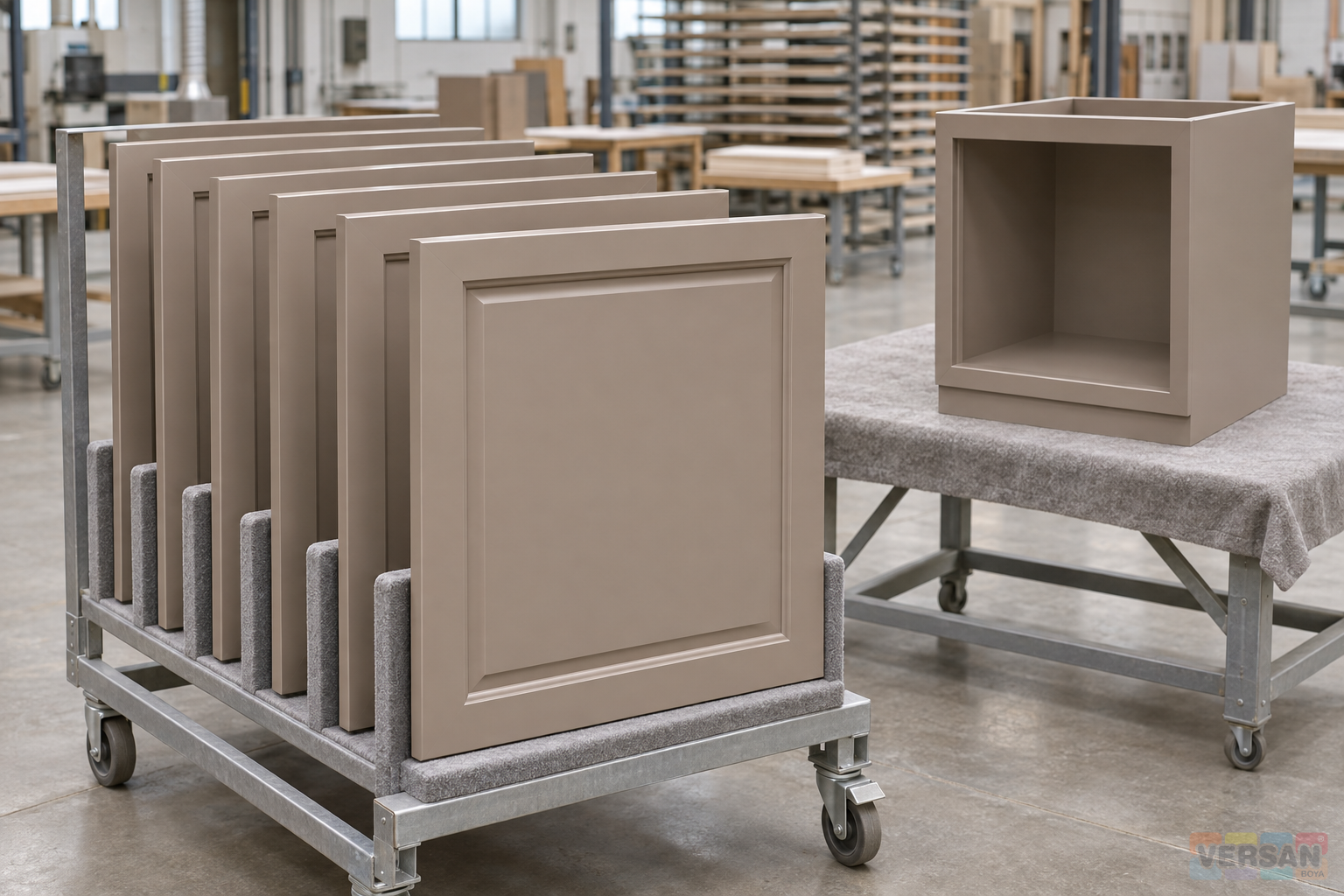
Cabinet doors, end panels and cabinet bodies can carry the same colour code and still fail to match at installation. A hinge drilled on the opposite side, a panel cut to an earlier drawing or an exposed side finished in another run can make individually acceptable pieces unusable together. A reliable production record should answer two questions: where does this component belong, and which finishing operations did it actually pass through? Keeping those answers separate makes it easier to resolve a problem without holding every similar item in the workshop.
Errors tend to appear when parts leave their original positions. A door goes to a different bench for inspection; a trolley is split because the booth is full; a replacement is put beside the good parts after the evening shift. Recording those transitions makes the chain of identity more useful than simply printing a job number on every trolley. The approach below can start with a small set of paper cards. A scanning system may reduce typing later, provided the underlying identifiers and handovers already work.
Define the matched set before cutting
A sales order identifies the job. It often does not tell an operator which door goes on which opening. Assign a set identity to each unit or adjacent group that must arrive together. List the expected body, door positions, exposed sides, fillers and other visible components against the current drawing. Give each component a stable identity that is distinct from the name of the finish. If the drawing changes, preserve a readable link to the previous revision and flag the parts that need a new decision.
Consider two cabinets of the same overall size in one run. One has a door that hinges on the left and an exposed right end; the other hinges on the right and meets a filler panel. A trolley card that says two doors and two cabinets can be correct by count and wrong by assignment. A set card showing the opening, installation view and visible face lets the next person make the match without guessing. It also gives packing a usable manifest when the body and fronts must travel in separate cartons.
Keep part, material lot and application group separate
A part ID identifies a physical item. A material lot identifies supplied coating material. An application group identifies the parts processed together at a particular operation. One door may pass through several material lots across its coating layers, and a single lot may be used on several application groups. These links are worth storing as separate fields. Combining them into one changing identifier makes it difficult to follow a part after repair or to find all the sets affected by a material issue.
The GS1 Global Traceability Standard distinguishes significant events from the information that describes them. A furniture workshop can adapt that idea to the steps it actually needs to reconstruct: receipt into finishing, coating application, hold, rework, set acceptance and packing. Record the affected component or controlled group, the stage, time, location, responsible role and outcome. Keep the event and its links even when the visible status changes. This is a practical use of the framework; it is not a claim of GS1 conformity or a requirement to purchase a specific barcode system.
Give orientation a consistent reference
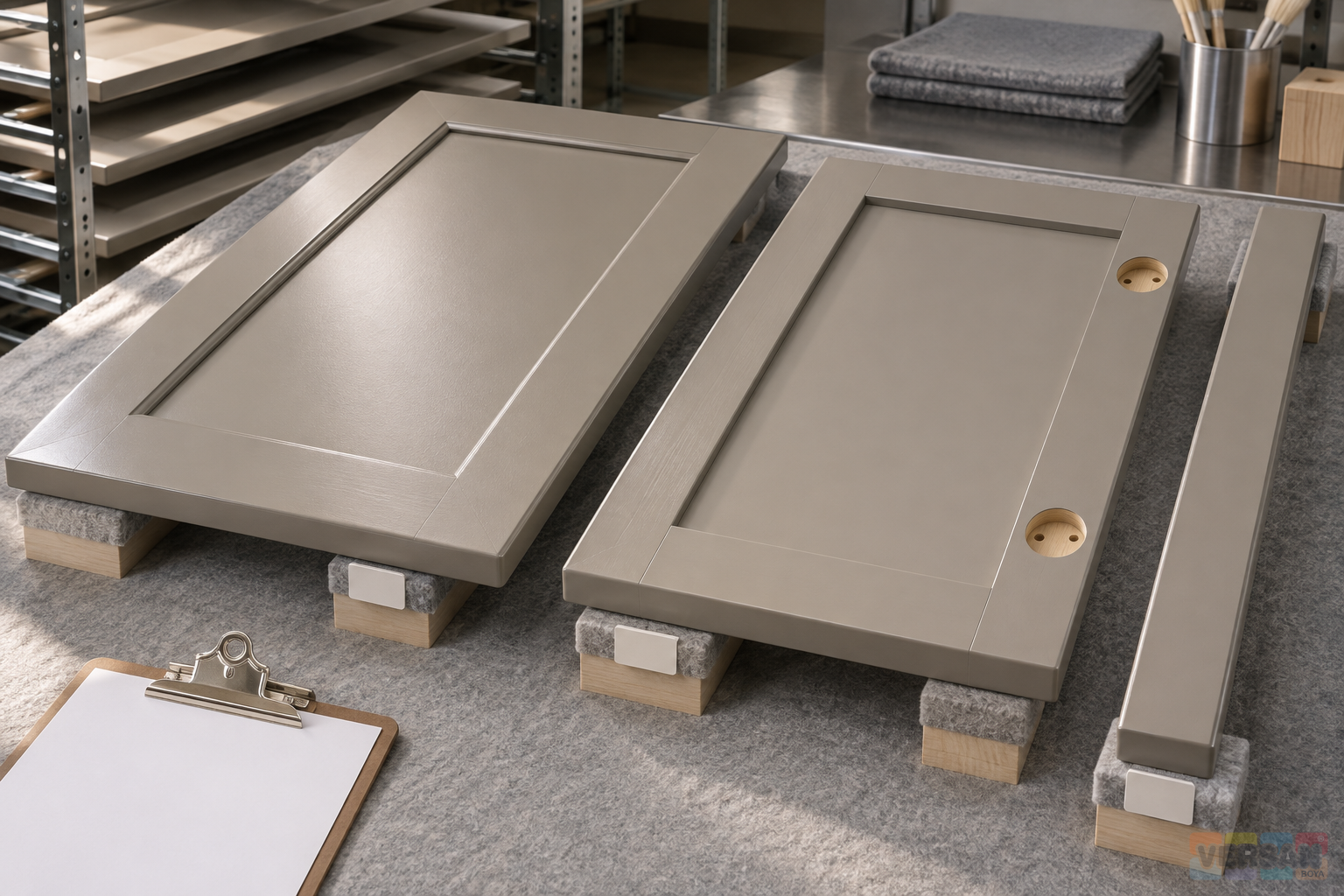
Write left and right from a stated view, preferably the installed front where that suits the drawing. Add a top edge marker and indicate the hinge side and exposed face. Use the same convention on the drawing, trolley card, inspection sheet and packing list. A door placed face down on a bench should be easy to identify with reference to the drawing even though the viewer is now looking from the opposite side. If the system relies on a single worn letter, it fails at exactly the point it is needed.
On a surface with directional grain or a planned visual sequence, a correct individual door orientation is only part of the check. Set the neighbouring components in order and verify where their top and leading edges will sit once installed. A separate guide to cabinet door edges and joints deals with inspection of those surfaces. The set record is responsible for preserving the identity and position of each inspected piece through the remaining moves.
Attach identity to the carrier or a suitable hidden location
Select the location and type of identifier before the first set enters finishing. A slot card, carrier tag or approved location on a concealed face may work, depending on how the part moves and which surfaces are coated. Where an identifier touches a component, assess it on a sample for residue, marking, interference with coating and legibility through the process. Agree when it will be removed and what takes over as the reference after removal. Keep markers and loose cards away from finished faces that could be damaged by contact.
A rack is a valid reference only while its slots remain assigned and traceable. If a door is taken out for inspection, its identity must travel with it. When parts move to a new rack, verify both the source and destination slots before removing the old card. If a label cannot be read, hold the part until the drawing and credible movement or application records establish its identity. Matching by colour or width alone can move an uncertain component into a set that was otherwise ready to ship.
Record the approved coating system and the actual materials
The furniture coatings range and NanoMix furniture varnish selection provide an overview when deciding which product documents to consult. The archived catalogue sheets describe distinct polyurethane and acrylic lacquer families and list different finishes. Use the current technical and safety documents for the exact product and approved system. A historical catalogue entry or a shared term such as matt does not establish compatibility or equivalence between products.
The polyurethane varnish family includes separate pages for silk matt polyurethane varnish, matt polyurethane varnish and gloss polyurethane varnish. When a polyurethane system is specified, the job record should identify the exact product, approved system revision and the actual lots used at the relevant steps. A general finish name cannot show which material was consumed on a particular run or which other sets shared that material.
Likewise, the acrylic varnish family has distinct pages for silk matt acrylic varnish, matt acrylic varnish and gloss acrylic varnish. Matt nitrocellulose paint and gloss nitrocellulose paint belong to a different product group. These references are for identifying products and documents; they do not authorize changing a system on a live order. If a replacement requires a different system, route the change through the appropriate technical review and retain both the earlier and the later records.
Make handover a physical check
At shift change, report which set is at which station, which slots are occupied and which parts have been held. Keep the quantity alongside the list of expected positions. Ten doors on a rack do not tell the next shift whether a door from the adjacent job replaced a missing one. A short comparison of the manifest with the physical rack is faster and more reliable than reconstructing movements from memory after the parts are packed.
For an initial trial, use only fields that drive decisions: part, set, drawing revision, slot, processing step, application group, material reference and state. Keep one authoritative record, with a portable card or screen for the operator. If using paper, file closed records so a past order and its application groups can be retrieved. If using a digital system, try a real handover with adjacent racks carrying lookalike components. Confirm what happens when a code scans correctly but belongs to another set. A successful scan is useful only when the system also validates the intended association.
Manage a lot change or production break deliberately
Record the transition when a new lot, application group or drawing revision starts. For a set crossing that boundary, identify the specific visible surfaces that must be compared before packing. Hold the proposed combination for review when required by the job. Distinct lots do not automatically mean a visible difference, and a common lot does not rule out differences in substrate, preparation or application history. The record makes the comparison purposeful; it does not substitute for the comparison.
Use the agreed sample and viewing conditions. Compare neighbouring components in their installed orientations, since a horizontal panel and vertical front may reflect light differently. The furniture finish sample approval guide explains how to document the reference for colour, texture and sheen. On the set record, note which parts were examined, the reference used and the specific combinations released. If only one exposed side is questionable, retain its identification while the remaining parts stay in their controlled positions.
Preserve the history when a component is repaired or replaced
When a part goes on hold, add the reason, the assessment and the eventual disposition to its history. If the same physical part is reworked, retain its ID and link the rework event and new application group to it. If a new component is made, give it a new ID and link it to the position and part it replaces. Remove the superseded part from the released inventory so that it cannot later be selected simply because its dimensions look right.
Imagine a cabinet due to ship with two matching doors. The second door is separated after an edge impact. The good first door can remain individually accepted, but the set must stay incomplete until a replacement is evaluated. When the new door reaches inspection, first confirm the opening and hinge side, then check its coating record and appearance beside the accepted parts. Record the new match and preserve the original hold history. This makes a later service request possible without assuming the complete set followed a single route through finishing.
Hold unidentified and surplus parts outside ready stock
Provide a clearly marked holding location for pieces that have lost their identity. Give each an investigation reference, location and discovery time. Compare the relevant physical details with the order drawings and recorded rack movements; if more than one match remains possible, leave the part on hold. The temporary reference helps prevent the piece from disappearing during investigation. It is not a shipment identity.
Surplus parts can pose a similar problem. A good-looking spare panel is suitable for a later job only after its dimensions, orientation, coating reference and documented history are checked for that job. Any agreement or warranty constraint that affects substitution also belongs in that decision. Document the person or role making the decision and what the spare is approved for. Keep surplus stock separate from a completed set until it has a new, verified assignment.
Check identity and finish as separate acceptance decisions
Lay out the parts in installation order where practical. Start with the set identity and verify each expected position, exposed edge, hinge direction and quantity. Then compare the finish and inspect condition against the agreed reference. It should be possible to accept an undamaged surface while recording that the component is in the wrong set, or to accept the identity while holding the finish for review. The final furniture varnish inspection guide can help structure the visual acceptance portion.
Retain the identities examined, the comparison reference, any exceptions and the resulting action. Photographs are useful for documenting arrangement or damage, but exposure and screen differences make them unsuitable as the sole proof of a colour match. When taking a photograph, link it to the component and record its orientation. A dated photo of unidentified cabinet fronts may illustrate a problem without proving which shipment or set it came from.
Carry the set into the packing and shipment record
Assign each carton an identity and connect it to its actual contents. If one set spans two boxes, show both the set identity and the box sequence. The installation team should be able to find the correct opening and orientation without seeing the workshop's entire production history. Material and application records can stay in the internal file, linked to the packing manifest for later retrieval. Recheck the physical contents when a released set moves to a separate packing area, where a final mix-up can otherwise pass unnoticed.
If a box is opened again, add an opening event and record the new contents before it closes. Do not overwrite the earlier packed state; that would conceal when a component was swapped. At dispatch, confirm that all expected cartons are present, or record an explicitly agreed partial delivery. A carton count alone will not show whether two boxes from the same set were replaced by two boxes from different ones. The same manifest should support a targeted search if one shipment is later queried.
Pilot the controls with two lookalike sets
Choose a job with two similar units passing through finishing on the same shift. Ask another person to locate the correct opening for a loose door, list the sets touched by a selected lot and trace a replacement back to its predecessor. Run the exercise once with a simulated missing card or split rack. Look for the exact step where identity becomes uncertain. Add a single field, position marker or check at that handover and repeat the exercise before expanding the system.
Use the pilot to track unresolved identities and incomplete sets found before packing. Finding more exceptions initially may mean the new check is detecting problems previously hidden. Examine a few records to see which move caused the issue and whether operators could resolve it without calling colleagues. Add scanning, more rack divisions or better work instructions where those observations show a need. This keeps the record useful to the people performing the work.
A set is ready for dispatch when the components can be identified in their installation positions, the accepted finish and relevant coating history are retrievable, and the packed contents match the agreed set. Keep each result visible. If one is missing, put the set on hold with a clear reason and a next action. The same chain will help when a service team needs to identify the correct drawing, finish reference and predecessor to make a replacement after installation.