
Approving a furniture coating sample involves more than choosing an attractive panel. Two surfaces carrying the same colour reference can create different impressions under different lighting, on different substrates or when viewed from another direction. Designers, purchasers and production teams may use identical words while expecting different results. Once manufacturing starts, those differences can become expensive disagreements about what was actually approved. A useful sample approval therefore identifies the furniture component, coating system, appearance target, assessment conditions and production release decision together.
This guide sets out a practical approval file for furniture paint and varnish systems. It does not prescribe universal colour tolerances, gloss limits or application recipes. Current product technical data and safety information govern application. The purpose here is to make the acceptance decision understandable and repeatable. The examples describe proposed working methods; they are not claims about tests conducted for a particular customer, a certified production process or measurements made by Versan Boya.
1. Define the component covered by the approval
Begin with the furniture component rather than simply writing the name of a coating family. A flat cabinet door, routed door, table surface and solid timber edge do not present identical appearance questions. State whether the front, edges, grooves, reverse and assembled junctions belong to the assessment. Acceptance of a flat board does not automatically approve the way the same finish appears in a deep recess. The sample should represent the details that matter to the actual order.
When considering Polyurethane Matt Topcoat, the word matt is only the beginning of the brief. Record visible surfaces, intended lighting, location and maintenance expectations separately. Identify who prepared the panel and which drawing or order it represents. Also state whether the decision concerns appearance alone or includes separately documented performance tests. This avoids turning a visual approval into an unsupported claim that every property of the finished component has been verified.
2. Keep the sample substrate identifiable
MDF, solid wood and veneered board should not be treated as interchangeable sample substrates. Identify the board supplier, thickness, selected face, veneer type and grain direction where relevant. In a transparent finish, the colour and pattern of the underlying wood contribute to the final appearance. If production changes to another substrate, assess whether the approved panel remains representative. A small confirmation trial is more informative than assuming that an unchanged coating name guarantees an unchanged result.
A surface prepared with Polyurethane Primer depends on its preparation as well as its topcoat. Note edge absorption, sanding direction and the appearance of filled areas. A coloured paper reference or a phone image cannot describe these conditions. Keeping a small unfinished substrate sample with the finished panel gives later reviewers a useful comparison. Link both to the same approval identifier, and make the material specification accessible to receiving inspection so that the intended board reaches production.
3. Connect the colour code to a physical reference
A colour code helps communicate a target, but it does not describe every aspect of a furniture surface. Identify the colour system and the physical reference used, including the condition of the reference. A worn, dirty or altered card creates an avoidable uncertainty. If a designer supplies a bespoke sample, state which face is authoritative and whether the decision also considers neighbouring materials. A cabinet front may be judged beside a worktop or timber trim rather than as an isolated colour.
For Polyurethane Semi-Matt Topcoat, keep colour and gloss as separate approval fields. The colour may be accepted while a sheen trial is still open. Phone photographs can help identify samples and share preliminary impressions, but cameras and displays should not silently replace physical assessment. Mark remote selections as preliminary when that is their status. The final record should explain exactly which physical sample superseded the image and when that decision became effective.
4. Agree on lighting and viewing conditions
Comparisons made under unrelated workshop lamps can produce conflicting opinions. Record the light source, surrounding colours and the position of the panels. The published scope of ISO 3668 addresses visual comparison of paint films against a reference under artificial lighting in a standard booth. This supports defining the assessment environment; it does not mean that the procedure in this article constitutes a full standard test or that a sample has been certified to it.
A trial using Two-Component Acrylic Topcoat should be assessed alongside alternatives under the same agreed conditions. Position comparable panels together with consistent orientation, then make an additional observation under the intended installation lighting if required. Record differences between those observations instead of declaring that one person must be wrong. When resolving a disagreement, first keep the lamp, background and viewing arrangement stable. Otherwise the discussion may change several variables while trying to explain only one.
5. Describe gloss beyond a product adjective
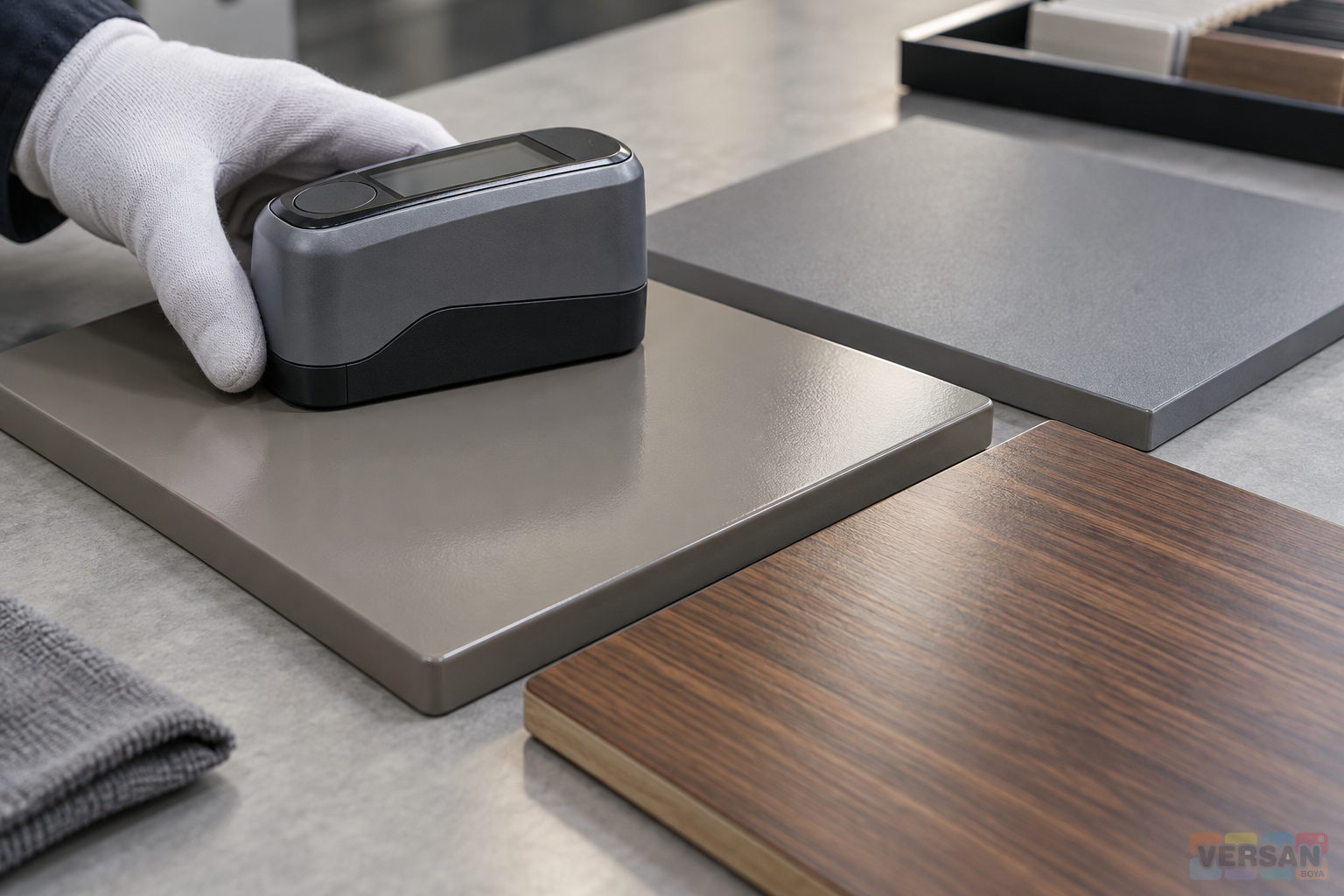
Matt, silk matt, semi-matt and gloss are useful commercial descriptions. They do not, by themselves, complete an acceptance specification. If instrumental gloss is required, define the measurement method, geometry, measurement locations and sample age. ASTM D523 covers specular gloss measurements for nonmetallic specimens using specified geometries. Its existence does not supply a universal acceptance limit for every piece of furniture. The project target and tolerance need a technically appropriate agreement between the parties.
With a transparent Polyurethane Silk Matt Varnish, the timber beneath remains part of what the viewer sees. Do not report a gloss reading from a narrow profile where the instrument cannot be positioned correctly. A representative flat coupon, agreed visual boundary sample or another suitable method may be needed for those areas. Distinguish measured areas from visually assessed areas in the record. A number collected at one location does not establish uniform appearance across every edge, curve and direction.
6. Separate intended texture from a defect
Texture can be a desired design characteristic or an unwanted surface irregularity. Open-grain wood, a filled closed surface, a slight surface structure and a smooth topcoat should be described separately. Dust inclusions, runs, craters and conspicuous sanding marks should not disappear into the general word texture. Give observations a location and distinguish the desired finish from the features that require correction. This helps the workshop understand whether it is trying to reproduce an effect or remove a defect.
When reviewing Acrylic Silk Matt Varnish, agree on viewing distance and direction as part of the assessment. A close photograph is useful for locating a detail, but it does not replace the overall impression at normal viewing distance. A physical target and a separately identified unacceptable boundary sample can make the discussion more concrete. Photographs without consistent magnification and lighting should remain supporting records rather than becoming the sole, unexplained acceptance rule.
7. Record how the approved panel was produced
An attractive topcoat is insufficient if the production team cannot identify the system that produced it. Record filler, primer, intermediate preparation and finish product identities separately. Include batch references, preparation dates and the application method. Link current technical documents instead of recording unmeasured workshop additions as a reliable recipe. If a preparation step was omitted or performed differently from the intended production method, disclose that difference before asking someone to approve the result.
The site's archived information for Polyurethane Gloss Varnish provides context about its furniture and wood application family and preparation. An archival catalogue is not an unrestricted replacement for the current technical data for the product being supplied. Keep the approved appearance linked to the actual coating build and current instructions. Similar visual results do not justify transferring mixing, thinning or waiting instructions from another coating family. Appearance approval and correct material preparation remain related but distinct responsibilities.
8. Define assessment age and sample handling
A freshly applied film and a panel conditioned for acceptance are not necessarily comparable. Record the end of application, the holding environment and the assessment time. Follow the relevant product instructions for drying and curing stages; a surface that feels dry does not automatically demonstrate final appearance or readiness for every service condition. Consider how the sample is packed and transported as well. Contact pressure, wrapping materials and accidental contamination can alter the area intended for comparison.
A Nitrocellulose Semi-Matt Paint panel and a panel using another system should not be assumed to be at an equivalent stage simply because both were made on the same day. Schedule a suitable review point for each system. Protect reference surfaces during storage without applying an unapproved polish or protective substance to the acceptance area. When a package is opened, note any marking or cleaning that could influence the observation. A damaged sample should not silently become the standard for sound production.
9. Discuss the boundaries as well as the target
Agreement on a preferred panel is the starting point. The teams also need to understand when a production difference becomes unacceptable. Colour, gloss and texture may require different boundary approaches. Rather than borrowing a generic tolerance, relate the decision to the product, substrate, design sensitivity and available measurement method. If boundary panels are used, label them distinctly from the target. Two physically different examples circulating under the same name make later acceptance unnecessarily difficult.
When selecting Acrylic Matt Varnish, the appearance a designer prefers and the variation the order can accept are different questions. Replace an unexplained approved stamp with a reference to the applicable criteria. Do not invent a numerical result where no measurement was taken. Where the decision was visual, name the reference and conditions. If one criterion remains unresolved, identify the approval as partial and avoid treating it as permission to release the entire production order.
10. Confirm the laboratory result on the real part
A carefully finished coupon may not represent a large cabinet door, routed recess or long edge under production conditions. Plan an initial production trial to establish whether the approved system can be reproduced on the actual component. Observe orientation, application access, handling and placement. State the trial's purpose in advance. Changing the coating, substrate and application approach together makes it difficult to determine which change explains the outcome. Keep the trial small enough to learn from before extending it across the order.
When a solution from the Furniture Varnish family is assessed, retain the first-piece record alongside the approved panel. The applicator and quality reviewer should know which regions need examination. If the trial fails, investigate before repeating the same result at scale. The article on polyurethane colour and gloss control from sample to production provides broader process context. This approval file adds the specific furniture component, appearance boundaries and release responsibilities needed for the order.
11. Make approval authority explicit
Not everyone who views a panel has authority to release production. Identify responsibilities for design selection, purchasing, application and quality acceptance. Use separate decision fields for preliminary appearance selection, technical review and production release. A positive comment in a messaging group should not accidentally become the final acceptance document. Record the decision date, component and effective revision together. If a reviewer can approve colour but not performance requirements, make that scope visible to the people receiving the file.
A proposed change to a system component, including Polyurethane Thinner, should trigger a technically informed decision about further trials. Similar packaging or a similar product name does not establish equivalence. Create a new revision rather than silently editing the record of an earlier approval. Assign a responsible person and response date to unresolved questions. Finally, make the effective version easy to find at the point of work, so that an obsolete attachment does not guide a new production batch.
12. Connect the reference panel to production records
Archiving a panel means retaining its identity and condition, not merely placing it on a shelf. The physical identifier should match the digital file. A reviewer should be able to locate the order, drawing, substrate, colour target, coating build and approval decision from that identifier. Choose a marking method that does not damage the appearance area. Assign responsibility for checking reference condition and replacing damaged references through an authorised process rather than continuing to compare production against a scratched or contaminated panel.
Samples of Nitrocellulose Varnish or other families must remain separated from unrelated projects. Record which reference was used when checking a new production lot. For general appearance choices, the guide to matt, silk matt and gloss furniture varnishes offers context. An approval identifier is more specific than a product family description: it connects a particular accepted surface to a particular order and states the conditions under which that approval remains valid.
13. Resolve disagreements one variable at a time
If production is judged different, begin by confirming that the correct reference is being used. Compare substrate, coating build, product identity, assessment age, lighting and viewing direction. Calling a panel darker does not prove that pigment is the cause. Changing every material before defining the appearance difference can increase cost while removing the evidence needed to understand it. Keep the observations linked to locations, times and photographs that show both the reference and the questioned component where practical.
Where necessary, prepare a controlled comparison that changes one variable. Identify affected components and segregate material awaiting a decision from accepted production. If the issue includes cloudiness or unexpected loss of sheen, the guide to nitrocellulose paint blushing and gloss loss addresses a different diagnostic question. The approval file described here establishes the target against which the result is judged. Neither the initial observation nor an unverified explanation should be presented as a proven root cause or a completed warranty decision.
14. Close the file before releasing the order
A completed approval file allows another authorised person to understand the decision without relying on a private conversation. It includes the component and substrate definition, coating system, physical reference, colour target, gloss method, texture criteria, assessment conditions, revision and approval authority. Areas covered by numerical testing contain the relevant method and actual result. Areas not yet tested remain clearly open. The aim is traceable decision-making rather than a large collection of documents that repeat product names without explaining acceptance.
During the final review, production, design and quality should confirm that they are using the same effective reference. If two conflicting targets remain in the file, resolve the conflict rather than quietly choosing one. A recorded approval applies to its stated scope; a different substrate, component or system may need reassessment. This approach keeps sampling practical while making appearance expectations usable in the workshop. It also provides a clear route for future changes, so that improvements can be introduced without losing the record of what the customer originally accepted.