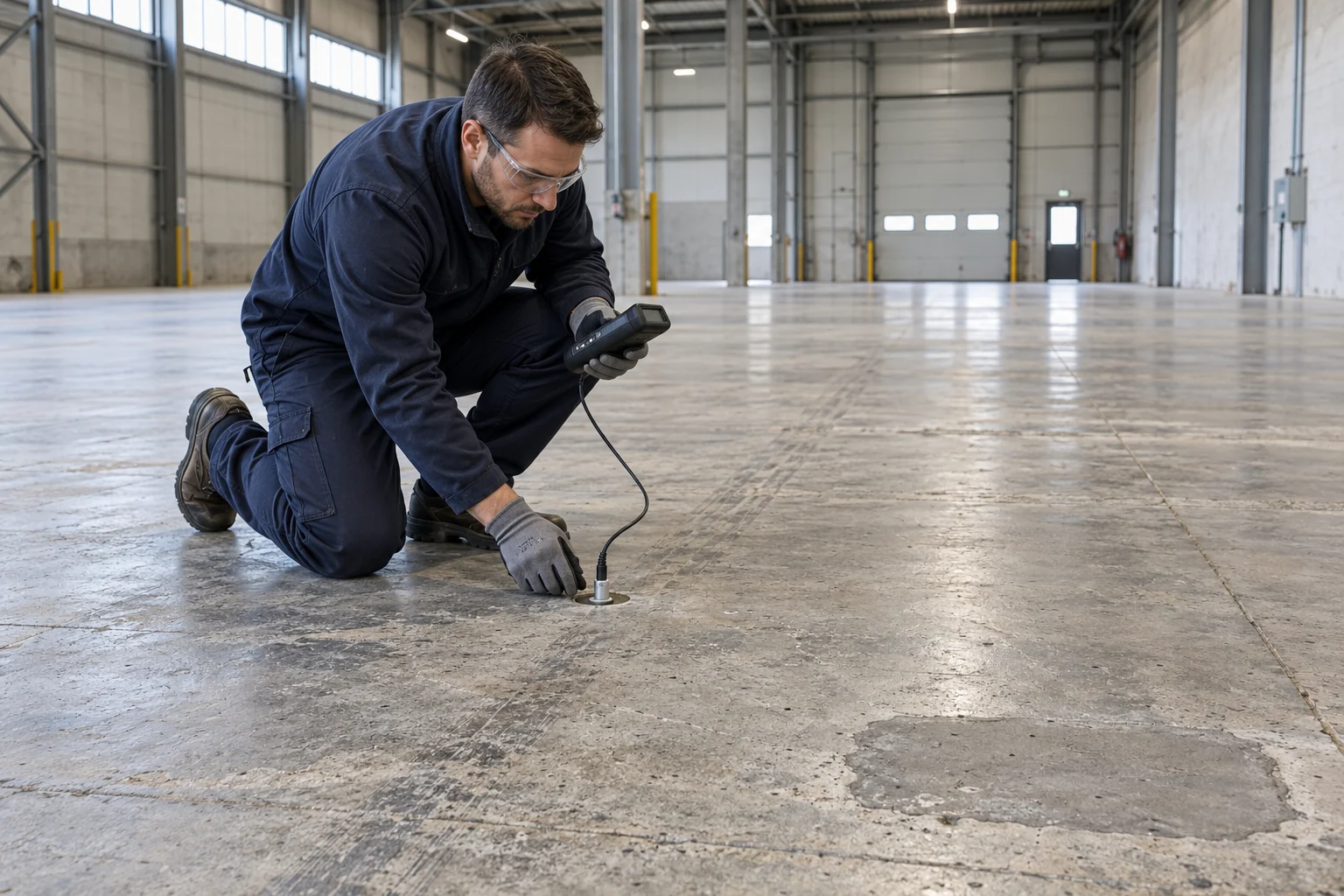
An existing concrete floor can often be considered for an epoxy coating, but its age alone cannot establish suitability. The decision depends on the supporting surface, moisture conditions, contamination, previous treatments and the way the premises will operate afterwards. A warehouse slab that appears serviceable may contain a weak surface layer or a history of oil exposure that is not obvious during a brief visit. The practical starting point is therefore a documented survey rather than an immediate product selection. Assess epoxy floor coatings and self-levelling options against the information collected from the actual floor, with unresolved questions carried forward explicitly into the trial and approval process.
Divide the survey into meaningful operating zones
Do not treat an entire factory floor as a single uniform substrate. The loading entrance, pedestrian aisle, production equipment area and washdown zone may have different exposure histories even when they were poured at the same time. Mark these areas on a simple plan and assign a reference to each one. Record approximate area, existing finish, visible deterioration, contamination and expected traffic. A forklift route has a different operational profile from a room used only by personnel. Where drainage is present, examine falls, ponding and the transition to gullies separately. This zoning gives subsequent observations a clear location and prevents a finding in one area from being applied casually to the whole building.
Ask the operator what the refurbishment is intended to achieve. Reducing dust, improving cleanability, resisting particular spillages and renewing appearance are distinct objectives. A coating sufficient for one objective may not be suitable for another. Review the industrial coatings range only after the intended duty has been described. Include working hours, equipment that cannot be moved, hygiene requirements, temporary access arrangements and the current cleaning regime. Establish whether the building can be taken out of operation or whether the work must proceed in sections. A survey that produces only an area measurement leaves these operational constraints unresolved and makes later comparisons between quotations unnecessarily difficult.
Investigate previous treatments and contamination
The history of a concrete floor is often more informative than its approximate age. Curing compounds, surface hardeners, sealers, earlier coatings, adhesives and maintenance chemicals may influence the preparation method. Ask the maintenance team for previous application records, purchase documents and photographs of recurring defects. If the material cannot be identified, record it as unknown rather than assigning a likely chemistry and presenting that assumption as fact. Repeated blistering or peeling should not automatically be attributed to poor application of the previous paint. Moisture, local contamination and the integrity of the supporting layer also deserve investigation before another system is specified.
A clean-looking surface is not sufficient evidence that oil contamination has been removed from concrete. Consider the possible depth of contamination, any staining that returns after cleaning and the behaviour of the prepared area. Residues left by a cleaning product can create a further compatibility question. For this reason, place a representative trial in the affected zone rather than in the easiest, cleanest corner. Products such as the Epoxyer concrete-floor primer should be assessed against the manufacturer's substrate requirements and the intended system. A primer is not a substitute for establishing whether the concrete is sufficiently sound and appropriately prepared. Cleaning and preparation must remain identifiable operations in the specification.
Separate moisture-testing methods from acceptance limits
A dry appearance at the surface does not establish the absence of moisture within a slab. Investigate whether there is a moisture barrier beneath the floor, whether flooding or service leaks have occurred and how nearby entrances, exterior walls and washdown activities affect particular zones. Test locations should reflect that history. ASTM F2170 addresses determination of relative humidity in concrete floor slabs using in-situ probes. Naming the method does not, by itself, establish an acceptance limit for a particular coating. Record the method, instrument, location, date and conditions, then compare the findings with the current requirements of the selected system rather than with an assumed universal value.
Do not place readings from different instruments in one table as though they necessarily express the same property on the same scale. A comparative screening measurement is not automatically equivalent to a result obtained using a specified test method. Additional investigation may be necessary in suspect areas; the project team should determine the testing plan and interpretation with suitable technical input. An unresolved source of water can make a coating decision premature. Likewise, a product described as moisture tolerant should not be treated as suitable under every possible condition. For the broader relationship between moisture, loading and reopening, consult the epoxy flooring planning guide alongside the project-specific survey.
Check the supporting layer and the result of preparation
The performance of a coating is constrained by the layer supporting it. Selecting a well-flowing material does not resolve a dusty, friable or delaminated concrete surface. Identify weak material, laitance, remaining adhesive and previous patch repairs. Choose mechanical preparation with regard to the concrete condition and the requirements of the proposed system. Insufficient preparation may leave weak or contaminated material behind, while unnecessarily aggressive treatment may introduce greater surface loss and a need for additional repairs. Specify the required outcome as well as the name of the preparation process. Inspect and photograph the prepared condition before accepting it for the next stage.
Where testing of surface integrity or adhesion is required, agree the method and acceptance criteria in the project documents. A numerical result should be considered alongside the location of failure: within concrete, within an existing layer or between coats. A favourable result at one point does not establish the condition of every zone with a different history. An epoxy topcoat and an Epoxyer floor coating should not be assumed to have interchangeable functions or application thicknesses. Select the primer and subsequent layers through the survey findings, the scope of the product information and the required technical confirmation.
Treat cracks, joints and levels as separate design questions
Covering a crack is different from resolving the condition that produced it. Record crack locations, continuity, edge condition and evidence of movement. Where structural assessment is needed, complete the relevant engineering review before finalising the coating detail. A movement joint should not automatically be bridged by a continuous rigid coating. Describe how joints will continue through the refurbished system, how damaged edges will be repaired and how traffic will interact with the resulting detail. A simple marked drawing can make these requirements much clearer than a general instruction to repair cracks. The desire for a visually continuous finish should not override the movement requirements of the floor.
Depressions, level changes and drainage falls are also more than a paint-selection problem. The term self-levelling describes application behaviour within a defined system; it does not mean that the material will correct every geometric defect without limits. Where a designed fall must remain, include it in the selection and application brief. Repair material, primer and coating need an appropriate compatibility assessment. The epoxy floor coating guide explains why the supporting concrete, repair work and coating layers should be regarded as separate responsibilities. Define who accepts each stage so that a later defect does not become an argument about an unrecorded assumption.
Decide whether the existing coating can remain
An existing coating should not be retained solely because it is difficult to scratch off during a site visit. Investigate its chemistry where possible, adhesion, thickness, moisture history and compatibility with the proposed materials. If it is to remain, obtain technical confirmation of the preparation and any intermediate layer required. Removing only visibly loose patches does not establish that the remainder is dependable. A floor repaired at different times may contain several coating systems, and the trials should reflect those variations. When the previous material is unidentified, keep the uncertainty visible. A satisfactory small trial cannot justify an unconditional service-life promise for an entire floor.
If removal is required, the scope should define the acceptable condition after removal, including whether any residual material may remain. The applicator needs to understand what the instruction means in observable and, where appropriate, testable terms. Inspect the surface again after preparation because previously hidden voids, repairs and weak patches may become apparent. This second review can change the material estimate and the sequence originally proposed. The article on investigating epoxy adhesion loss and planning repairs provides a useful framework for considering why replacing only the upper coat may leave the cause of a failure unresolved. Update the survey file when new evidence emerges.
Compare systems against the actual operating duty
Consider appearance, traffic, cleaning, chemical exposure and repairability together. An operator seeking a consistent decorative finish may have different priorities from a production area exposed to wet cleaning. Slip behaviour cannot be inferred solely from a glossy or matt appearance; it must be considered in the relevant service conditions and through any project testing that is required. Chemical suitability likewise needs more than the name of a chemical. Concentration where relevant, temperature, contact pattern, duration and cleaning practice can all affect the technical enquiry. Do not assume that all epoxy products provide the same performance or suit the same duty without confirmation for the intended system.
Describe alternatives as complete layer arrangements rather than isolated container prices. State the preparation, primer, subsequent layers, intended finish and release conditions for each option. Comparing the available product range is more useful when these responsibilities are visible. A RAL colour reference can establish the starting colour, but a screen image is not a physical approval sample. Include texture and the result of the proposed cleaning regime in the trial assessment. If an alternative appears to require less preparation, identify the technical basis for that conclusion rather than treating the saving as self-evident. The concrete paint guide also helps distinguish a general surface finish from a specified floor system.
Run the trial area as a small controlled project
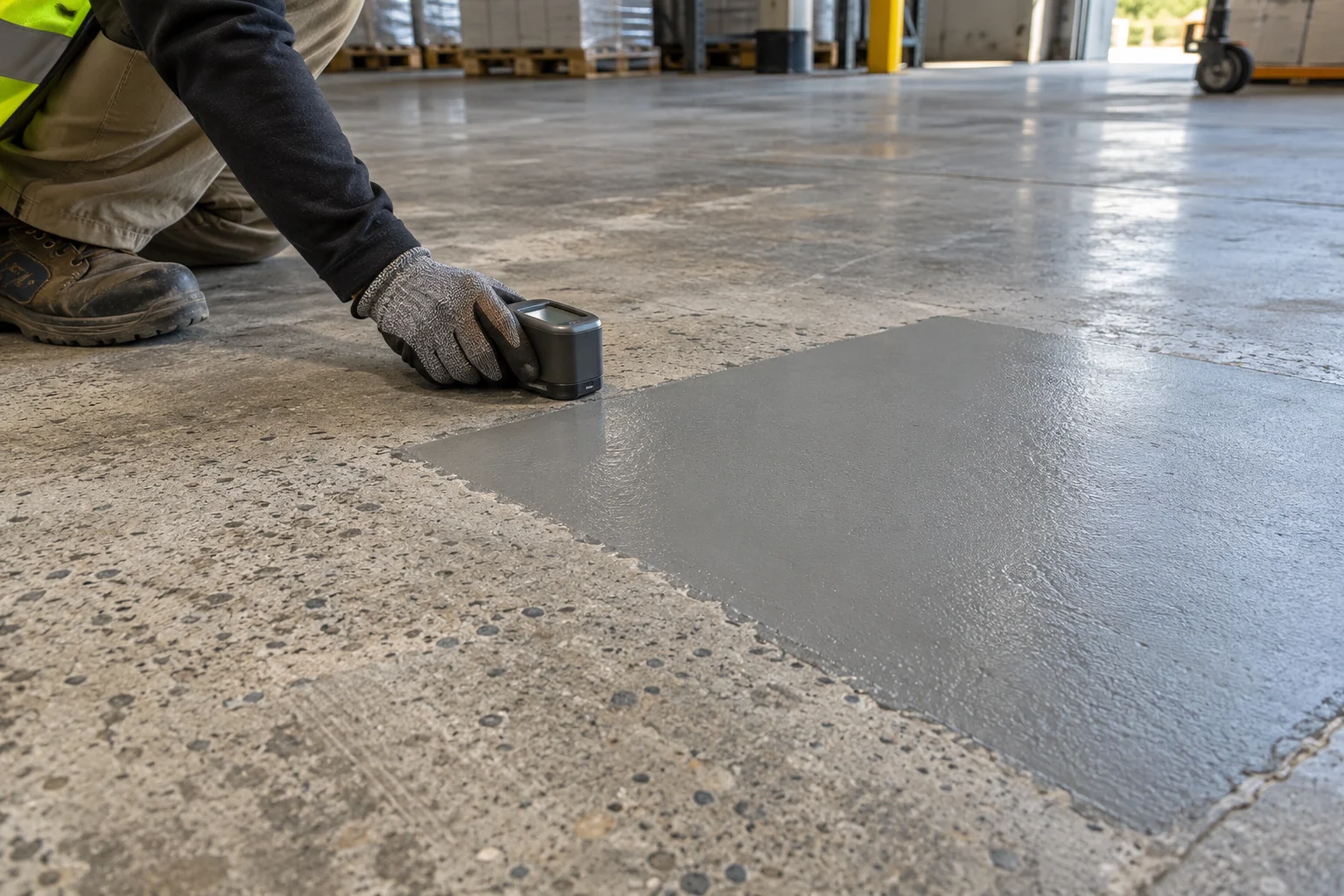
A trial is not simply a small quantity of paint applied to an available corner. Record the chosen location, preparation, product codes, batches, mixing method and application time. It should represent the real floor rather than a particularly favourable patch. Separate trials may be needed where substrates or previous treatments differ. Before starting, agree which questions the client, applicator and technical adviser expect the trial to answer. These may concern compatibility, preparation quality, texture, appearance, cleaning or a defined property requiring testing. For each question, identify the inspection stage, the evidence to be collected and the person authorised to make the decision.
Do not close trial approval with a general statement that the colour looks satisfactory. Record the lighting, viewing conditions, inspection age and timing of any agreed tests. An assessment made before the required cure may be misleading. Where a property requires a test, agree the method and criterion beforehand; an attractive photograph is not a substitute for the specified evidence. The approved trial must also be reproducible on the full floor. If its preparation equipment or application method differs from what will actually be available, it may demonstrate a result that the main works cannot reliably reproduce. Resolve such differences before turning the trial into a production reference.
Plan packs, mixing and access together
For a two-component system, pack selection is more than a calculation of total kilograms. Confirm the pairing of components, whether the mixing ratio is by mass or volume and the permitted working period after mixing from the applicable product information. Dividing a larger set for small areas requires suitable measuring arrangements and the manufacturer's instructions; a ratio from another epoxy material should not be transferred. Epoxy thinner is a separate auxiliary product, and its presence in a catalogue does not establish that every flooring system can be diluted. In particular, distinguish dilution instructions from equipment-cleaning instructions when considering solvent-free or self-levelling materials.
Coordinate the sectioning of the floor with mixing, carrying and application so that uncontrolled waiting does not develop between stages. Ventilation, dust management, chemical controls and personal protection should follow the safety data sheets and the assessment of the actual work. Agree movement of equipment and temporary access with the operator before starting. Adding the survey plan, photographs, quantities and operating restrictions to a quotation request creates a more useful enquiry than submitting an area alone. Finalise pack quantities against the agreed layer arrangement and verified product consumption. A theoretical area calculation is not, on its own, a complete purchasing quantity because preparation, application and local repairs still need to be accounted for.
Define reopening and the maintenance record
Touch drying, pedestrian access, forklift use and the start of chemical cleaning are different release stages. Assess each against the chosen system and the actual conditions during application and cure. A programme that groups them under one drying time may allow the floor to be loaded prematurely. At handover, collect product identities, treated areas, batches, actual application dates and the results of any agreed checks. Knowing only the final product name may not be enough for a future repair: the primer and preparation record matter as well. Identify who authorises reopening and what evidence supports that decision so that an operational deadline does not replace a technical release criterion.
The maintenance plan should address cleaning chemicals, machine cleaning, spills and local repair. Dragging sharp loads across a new finish or using an unconfirmed aggressive cleaner can affect its appearance and condition. Include the operator's actual cleaning arrangement in the trial review where appropriate. If a problem appears later, record its location, date and service history before changing the system. Use the technical contact channel to clarify applicable product documents; a general article cannot replace a site assessment. The coatings terminology glossary can help the purchasing, maintenance and application teams describe the same issues consistently within the enquiry and handover records.
Produce three distinct survey decisions
The survey should provide more than an undifferentiated suitable or unsuitable verdict. One group of zones may have sufficient information to proceed to a trial after the agreed preparation. Another may require further moisture investigation, identification of an existing coating or local repairs. A third may need the coating decision deferred because water ingress, movement or a supporting-surface problem remains unresolved. This distinction allows different areas of the same project to progress at different rates without forcing all of them through one assumption. For each decision, record the reason, the required next action and the person responsible for closing it. Product selection then follows evidence rather than urgency.
As an illustrative planning arrangement, a warehouse might contain a dry-looking central area, a suspect entrance zone and an oil-affected machine base. These can be documented separately, with trials progressing in one area while investigations continue elsewhere. This is a decision example, not a claim about a completed customer project or a demonstrated product performance. Prepare the budget and sequence using the same zoning. Before seeking a final quotation, use the epoxy coating enquiry information guide to check what remains open. Keep revisions traceable and do not issue a definitive application commitment while the required measurements, technical confirmation or trial decisions are outstanding.
Questions commonly raised during refurbishment surveys
Must old concrete always be removed?
No. The decision concerns the actual surface and supporting condition, rather than age alone. A sound older slab may be considered with suitable preparation and a verified system. Weak layers, contamination or structural concerns can require a different treatment in particular areas. Base removal decisions on the survey, any necessary tests and appropriate technical review instead of applying one rule to all older floors.
Is one moisture reading sufficient?
Areas with different histories and environmental conditions may not be represented by a single location. Design the test plan around the floor, the risks and the selected method. Interpret results against the conditions for the proposed system. A named test method does not establish one acceptance limit that can be used for every epoxy product.
Can the main works start when the trial looks good?
Appearance is only one approval item. Consider preparation, compatibility, cure and any specified testing as well. The trial should represent the actual floor and be reproducible using the main application process. Without a recorded scope, a colour preference may be mistaken for full technical acceptance. Close the outstanding questions before authorising the wider application.
Will a self-levelling layer correct all cracks and falls?
That description is not an unlimited levelling or crack-bridging guarantee. Thickness, preparation and product scope remain important. Movement joints, active cracks and required drainage falls need their own details. Complete necessary repairs and engineering review before assuming that the coating can resolve every defect in the floor.