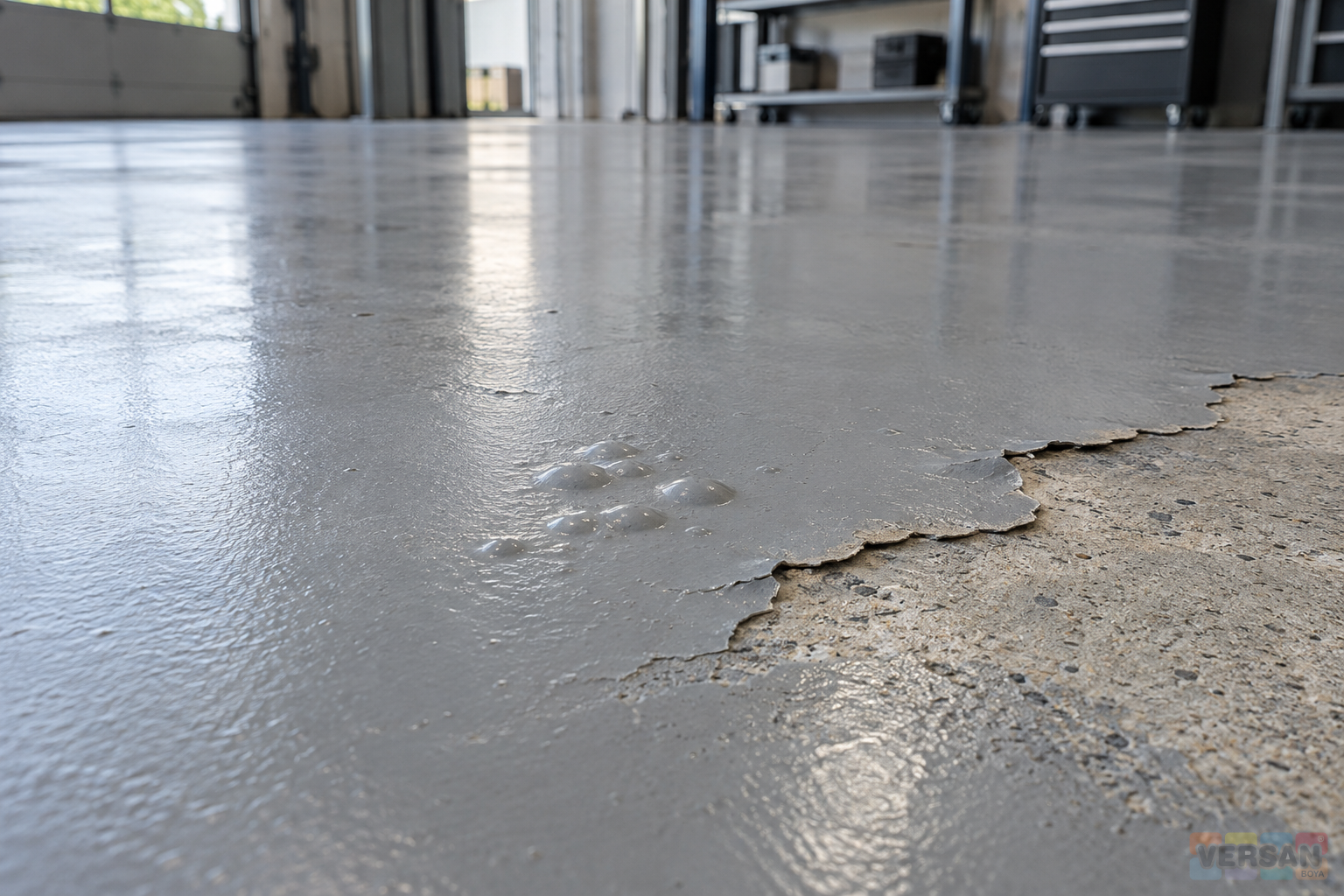
Record blisters and peeling as different observations
A blister in an epoxy-coated floor does not, by itself, identify the repair that should follow. A raised but closed film, a peeling edge and a coating fragment carrying pieces of concrete present different questions. The useful starting point is to describe what can be seen and preserve evidence before cleaning or removal changes it. Record whether the damage occurs at an isolated spot, along a traffic route, near a wall or across several areas. Two surfaces of the same colour may have different installation and maintenance histories. This guide provides an investigation framework for existing damaged floors; it is not a remote diagnosis or a universal recipe for repairing every epoxy system.
The initial discussion should connect the exact coating identity with the way the floor is used and the service conditions expected after repair. The name epoxy self-levelling coating does not establish the complete build-up of an existing floor. A relatively thin finish and a thicker flooring system may need different investigation even when their visible defects look similar. Rather than starting only with the total floor area, prepare a simple location plan. Keep general photographs taken before scraping as well as close views of individual defects. A photograph that cannot later be located on the floor is much less useful when a second team arrives to inspect it.
Map the damage and establish the service history
A floor plan can identify entrances, external walls, joints, drains, machinery supports and heavily used routes. Give each damaged area a short reference that connects its photographs, inspection results and eventual maintenance decision. A line of repeated defects should not be merged into a general category of scattered spots. Ask when the problem was first noticed, how the area is cleaned, whether spillages occurred and whether operating conditions changed recently. These questions organise possible explanations; they do not prove any particular cause. A date remembered by an operator and a date written on an application record are different evidence sources. If they disagree, preserve both and request clarification rather than selecting the more convenient account.
The published guide to assessing existing concrete and arranging a trial can help identify the documents that should have supported the original work. However, a floor that has been used and damaged must also be assessed in its current condition. Local touch-ups, maintenance materials and changes in equipment may have altered the original situation. Selection from the industrial coatings range should therefore use current service information. For example, a storage area subsequently converted into a wash-down area may no longer represent the conditions described in the first quotation. Record the nature and timing of that change so it can be considered alongside the damage pattern.
Identify the plane of separation
What remains beneath a detached fragment is often more informative than the colour of its upper face. Has separation occurred between concrete and the first coating, between two coating layers or within the concrete itself? An overhead photograph may not answer that question. A technical supervisor should define where and how controlled inspection openings are made, rather than allowing random removal across the floor. If a fragment is retained for further examination, identify its location and orientation. A dusty-looking underside is a recordable observation, but it does not automatically prove inadequate cleaning during the original application. Consider it together with installation records and any appropriately specified testing.
The role of an epoxy primer differs from that of the final surface coating. Establishing which layer has detached is therefore important before deciding that changing the finish will solve the problem. Do not invent an intermediate layer simply because one would normally be expected. A previous repair may have introduced a different material, and an incomplete file should remain visibly incomplete until further evidence is available. If thickness or adhesion testing is requested, agree the method, sampling locations and acceptance criteria first. Also plan how the resulting test openings will be repaired. New damage created during the investigation should not be reported as part of the original defect.
Separate concrete moisture from water on the surface
A floor that appears dry does not necessarily provide sufficient evidence about moisture within the concrete. Wash water, plumbing leakage, water entering from outside and conditions within the slab should be considered separately. Moisture records need to identify the method, measurement locations, time and operating condition of the floor. Results from different methods should not be substituted for one another as though they measured exactly the same property. Sika's flooring guidance identifies moisture-related blistering as a distinct concern. That supports investigating moisture where relevant; it does not establish that every blister has this cause or that any one material can solve all damp-floor situations.
Instead of applying one reading to an entire building, a supervisor may specify measurements in damaged areas and suitable comparison areas. Assess the results against the method and limits required for the proposed system. A moisture percentage taken from another manufacturer's product sheet must not become a Nanomix application limit without technical confirmation. Likewise, selecting an epoxy binder or an additional intermediate material does not replace investigation of the slab. When the system requirements or earlier measurements are uncertain, obtain clarification. An unknown entry is useful because it shows a real information gap. Replacing it with an assumed number creates an appearance of certainty that the investigation has not earned.
Distinguish raised blisters from open pinholes
A closed swelling, an open pinhole and air emerging during application are not identical observations. Establish when the feature appeared: during installation, in the first period after application or only after service began. If the timing is approximate, say so. A Sika epoxy primer sheet explains that air release from porous substrates during rising temperatures can form pinholes, and that unclosed holes may be associated with blistering in a later layer. This is a product-specific warning describing a mechanism worth considering. It is not a rule that diagnoses an existing floor from a photograph, nor permission to transfer that product's repair materials to a different coating system.
Where available, compare the original air, substrate and material conditions with the application sequence. Recording air temperature alone does not show that the floor had the same temperature. Link the conditions to the actual layer times and products. For an epoxy topcoat, investigate the instructions applicable to the exact product used. A waiting-time table for a different epoxy is not a sound basis for declaring that the original work was defective. Missing records should not be recreated as precise historical readings. Explain instead how the uncertainty affects the present decision and what additional inspection, documentation or trial could reduce it.
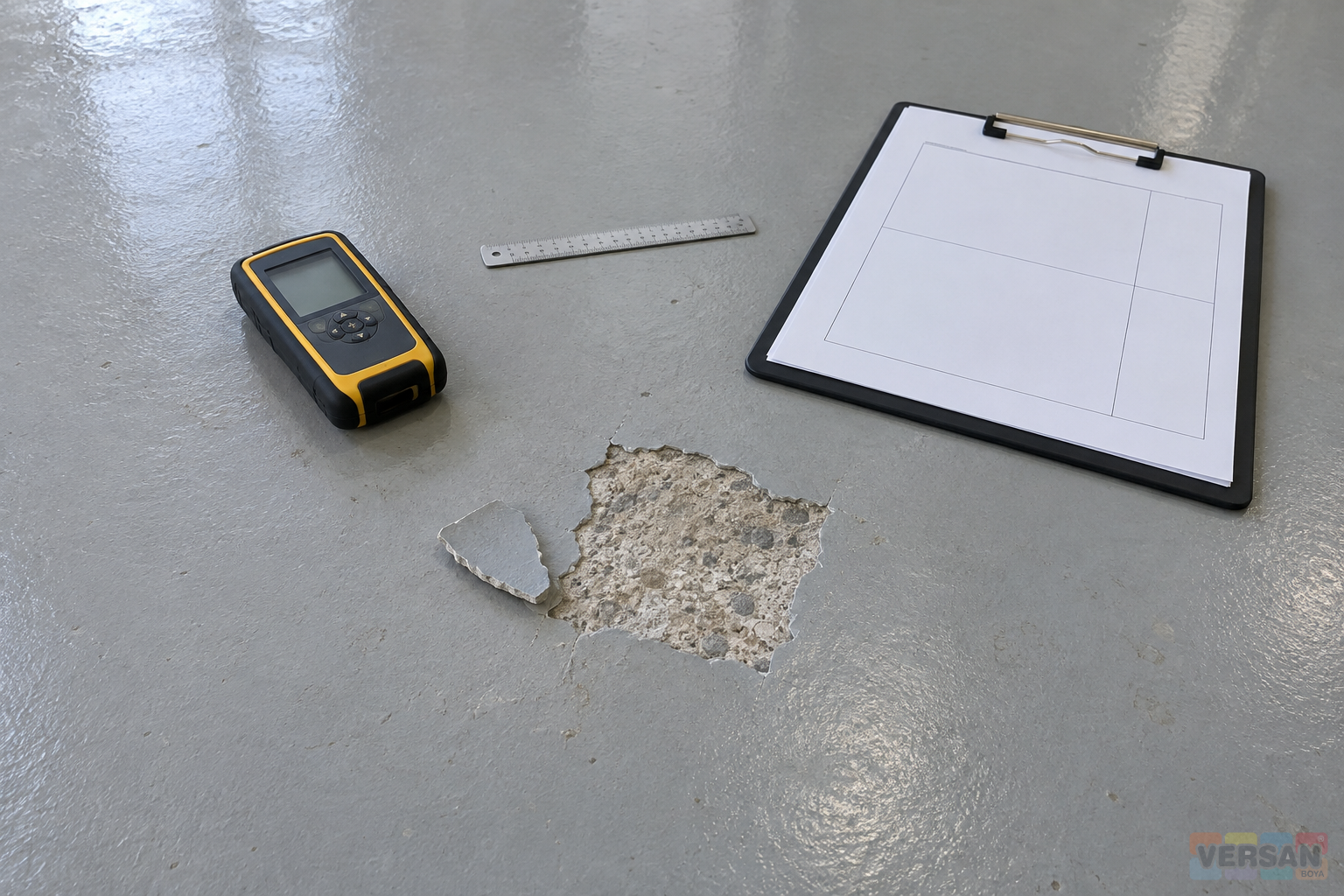
Find the component, mixing and application records
The correct product name does not fully describe an application unless the components, batch identities and preparation method are also known. Confirm whether a mixing instruction is based on mass or volume, which components belong together and what use limits apply. Purchasing documents, container photographs and shift records may help reconstruct the evidence. A container found in a store does not prove that its contents were applied to the damaged area. If several mixes were prepared during the same day, or work stopped and restarted, establish which areas correspond to those events. The objective is to distinguish verified facts from assumptions, rather than quickly assign responsibility to a person or supplier.
When discussing epoxy thinner, ask separately about the amount, addition stage and intended purpose. Thinning an application mix and cleaning equipment are different operations. Similar names in the thinners and auxiliaries range do not make all materials interchangeable. If an unsuitable auxiliary is suspected, preserve the actual product identity and available sample before drawing conclusions. The new repair should have a defined mixing location, recording responsibility and suitable measuring method. Preparing only a small repair quantity does not remove the need for a controlled process. A small unrecorded addition can still leave the investigation unable to explain what was applied.
Investigate contamination and the cleaning history
Evidence of oil, cleaning residue or another process material also raises a timing question: when did it reach the surface? Contamination before coating and a later spillage on the finished floor are not the same finding. Request the cleaning procedure, actual product names and the dates of relevant changes. One person's recollection should not be expanded into a complete maintenance history. Similarly, a stain should not automatically be treated as a purely cosmetic issue. Assess its location, the condition of surrounding coating and the service exposure. If laboratory examination is needed, define where the sample will be collected, how it will be preserved and which question the examination is expected to answer.
Covering the floor with a clear epoxy coating would not, on its own, demonstrate that underlying contamination or separation had been resolved. Consider any additional coating only within a technically confirmed system. Separate cleaning, removal of weak material and substrate correction in the repair scope, so each operation has a clear purpose. If the investigation identifies a structural crack, joint movement or a plumbing issue, obtain the relevant specialist assessment. A coating quotation should not silently absorb responsibility for unrelated building or service defects. Everyone involved should know which decision remains outstanding, who must provide it and whether further coating work depends on that decision.
Justify local repair or wider renewal
A small visible defect does not prove that all surrounding coating can remain. Equally, several blisters do not automatically justify removing an entire floor. Base the scope on damage distribution, separation plane, substrate evidence, the condition of retained layers and the intended service. Define a stop-and-review process if an inspection opening reveals more extensive separation than expected. The applicator should not retain weak material merely to stay within an initial area allowance. At the same time, a wider scope should not be added without documenting the reason and obtaining the appropriate project decision. Technical necessity and its cost implications need to remain visible to the people accepting the work.
If traffic markings or work-zone lines must be renewed after the repair, treat road marking paint as a separate compatibility question. Its name alone does not approve application over the existing epoxy. Its own technical confirmation and trial may be required. This distinction keeps floor repair and marking work understandable even when both appear in one quotation. The guide to floor survey findings and quotation scope can help organise the commercial discussion. However, comparing prices cannot decide which existing layers are sound enough to retain. That remains a technical assessment supported by the investigation.
Design the repair trial around a clear question
A controlled trial should do more than show that a fresh patch looks attractive. Before work starts, state whether the trial is assessing the preparation method, application of the proposed system over retained coating or the expected appearance. Select a location that represents the actual work. A successful patch in an unrelated corner does not automatically approve the damaged area. Record materials, preparation steps, conditions and the agreed assessment time. Define who will interpret the result and what happens if it is unacceptable. Without this structure, a trial can become another undocumented coating layer rather than useful evidence for a repair decision.
The current product range can support a discussion of options, but the presence of a material in a catalogue is not approval for a damaged floor. Describe both the new system and the old layers that will remain. If preparation alternatives are compared, identify the areas clearly and avoid changing several variables without a record. Assess the trial at the agreed stage, rather than relying only on its appearance immediately after application. An acceptance statement should explain the observations or measurements supporting it. Different teams can then understand what has been accepted and which questions, such as wider substrate condition or long-term service exposure, remain outside the trial's scope.
Plan return to service and subsequent observation
A surface that feels dry may not yet be ready for heavy traffic or the intended cleaning process. Release the repaired floor according to the current system instructions and actual application conditions. Pedestrian access, equipment movement and chemical cleaning may involve different requirements. Establish which areas the operator may use and connect temporary protection and access arrangements to the repair programme. Later observations can use the original defect references so changes are compared at the same locations. If another problem appears, reopen the evidence file before simply applying more coating. Consider whether service conditions, cleaning practices or the extent of the original defect have changed.
The epoxy adhesion-loss investigation guide provides a related framework for repair and acceptance records. Keep the initial condition, verified findings, unresolved uncertainties, applied system and limits of acceptance together in the handover file. A useful technical enquiry includes the floor plan, general and close photographs, known product identities, measurement methods and expected use. This allows the discussion to address the actual surface rather than only the quantity of paint required. Distinguishing blistering from peeling is the beginning of a disciplined decision process: each later action should be traceable to evidence, an agreed requirement and a person authorised to accept the result.
Keep observations, explanations and decisions separate
An investigation report benefits from three distinct fields: the observation, the possible explanation under investigation and the authorised decision. Repeated blisters near a wall are an observation. Different moisture or water conditions in that area are a possibility to investigate. Specifying a measurement or putting a repair on hold is a decision. Combining all three in one sentence can make an unmeasured cause appear established. Purchasing and operating teams need to understand this distinction too. The strength of the wording should match the evidence: a feature that suggests a possibility is not the same as a cause that has been demonstrated.
Give each open question a next action and an owner. If further slab measurements are needed, identify who will carry them out, what area they cover and which decision depends on them. If a supplier record is needed to identify an old coating, show which part of the file remains open. This prevents an investigation becoming a series of visits that produce information without reaching decisions. A finding may deserve recording even if it does not change the repair, but the purpose of additional testing should remain clear. When new evidence changes an assumption, retain the earlier record and explain the change rather than silently rewriting the history.
Check the sequence against a warehouse example
Consider a warehouse with two damage patterns. This is an explanatory scenario, not a claim about an actual customer project. Near the entrance, coating is peeling from an edge; farther inside, small blisters are scattered across another zone. Give the zones separate references rather than treating both as a single generic repair. Review traffic and cleaning history in one zone and the relevant application and environmental records in the other. Compare the separation planes in controlled openings. Different findings may justify different trials or repair scopes. Being in the same building does not establish that both areas have the same cause.
The outcome does not necessarily require two different products. The same system may ultimately be confirmed for both areas; the important point is the evidence supporting that decision. If the operator needs the entrance reopened first, plan the work stages and temporary routes accordingly. Work in the outstanding area should not recontaminate the completed one. Separate acceptance and release dates may be appropriate. A simple marked plan and a short decision summary can be more useful than many unorganised photographs. The reader should immediately see what is complete, what remains uncertain and which information is still required.
Prepare a concise and consistent technical enquiry
The first technical discussion does not require an entire history pasted into a long message chain. A one-page summary can connect area references, observed features, first-noticed dates, known materials and use conditions. Attach photographs and measurement reports using the same references. Highlight unknown product identities or dates so the technical team can ask focused questions. The file should help determine what evidence is needed for a decision, rather than begin with an asserted cause that the investigation is then expected to defend. Clear organisation makes the information easier to review without removing the uncertainties it contains.
At quotation stage, distinguish confirmed work from uncertainty about areas not yet opened. Explain how additional weak material would be measured, who could approve a scope change and how an outstanding decision affects progress. This is neither unlimited authority to extend the work nor an assurance that all uninspected coating is sound. It provides an agreed route for continuing when new evidence appears. Records and trials may not remove every uncertainty, but they can show what remains unknown and the limits within which the repair decision is valid.