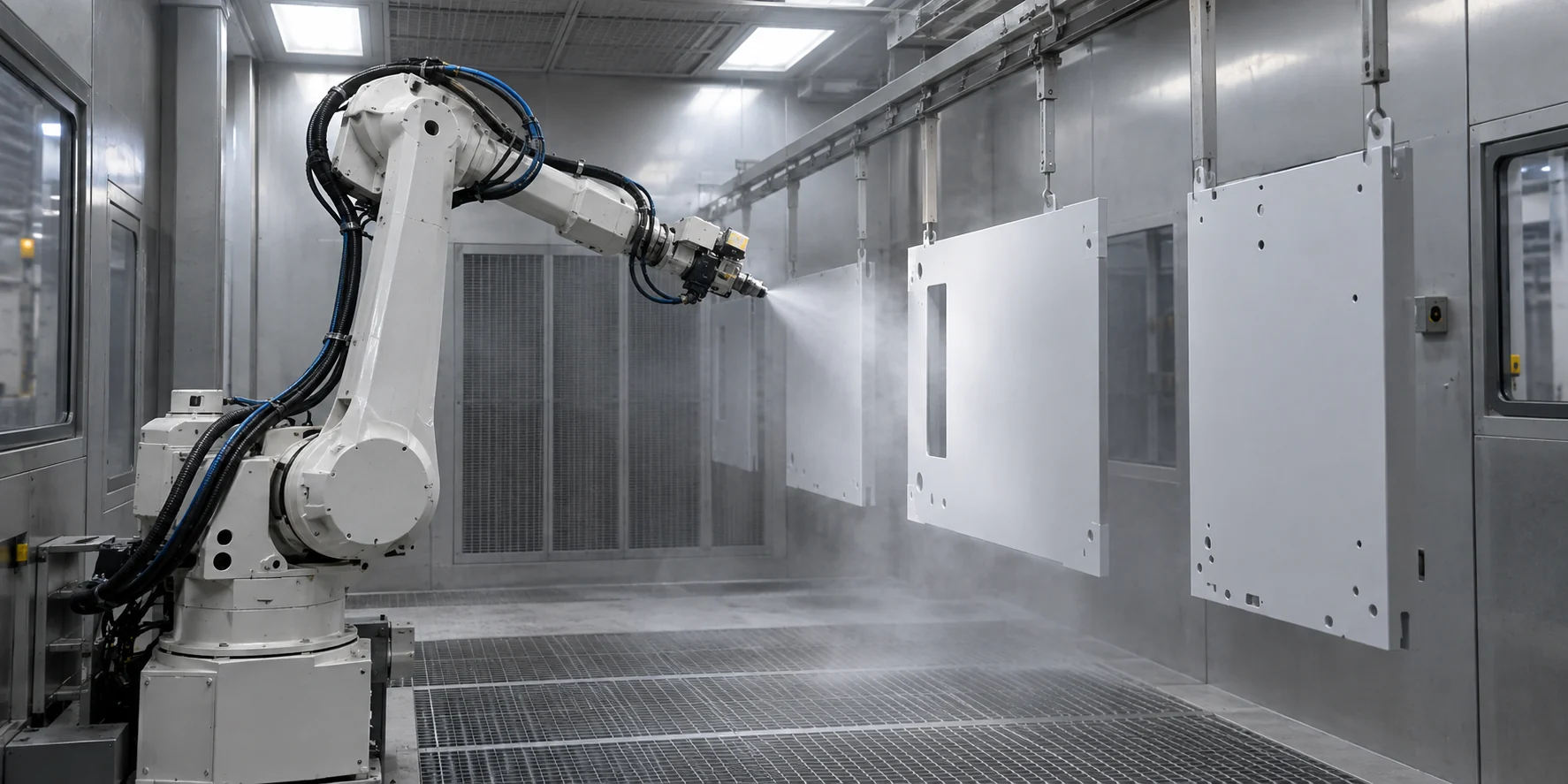
When comparing coating technologies, look beyond the description on the container. Preparation, application, drying, cleaning and rework data together reveal a product's actual effect on the production line.
Consider low-VOC targets for industrial coatings alongside the production process
In metal manufacturing, paint selection balances appearance, corrosion protection, production speed and operating cost. When a move to a water-based or high-solids system is considered, that balance must be reassessed. Lower volatile organic compound content is an important selection criterion; on its own, however, it does not show that the line will run faster, energy use will fall or the same performance will be achieved on every surface.
This technical assessment focuses on the questions to ask before considering technology names. What component is being painted, what is the current defect rate, where does drying create a bottleneck, and what does the operation want to improve? Keep the answers together when researching industrial coating product groups. This extends quotation comparisons beyond the price of a container and brings preparation, application, drying, cleaning and rework into view together.
Are water-based and high-solids paints the same thing?
Water-based means that water is used as the principal carrier in the formulation. The product may nevertheless contain co-solvents and other ingredients. PPG's explanation of coating technologies makes this distinction clear. A water-based label therefore does not mean zero VOC or the elimination of all workplace risks. The product's technical data sheet and safety data sheet should be reviewed together.
High solids, by contrast, describes the proportion of material that forms a film after drying or curing. A comparison must specify whether that proportion is given by volume or by weight. Jotun's example of a high-volume-solids topcoat shows how this approach can be used to reduce VOC content per litre. However, this property of one product cannot be generalised to every coating in another resin family. As the two concepts convey different information, they should be recorded in separate columns within the same product assessment.
What information makes a VOC comparison meaningful?
The value on a product container and the value for the ready-to-apply mixture may not represent the same conditions. For two-component products, check the mixture composition, thinner used and calculation basis stated in the technical documentation. Without knowing the operation's actual consumption, it is difficult to draw a firm conclusion about the overall process impact from a per-litre value alone. Directly comparing consumption on two lines can also be misleading when component geometry and target film structure differ.
The EPA guidance on surface coating calculations supports considering coating consumption, solids content, film thickness and application efficiency together. This provides a basis for a useful comparison file: track paint per accepted component, added thinner, cleaning consumption and the number of repainted components separately. This does not replace a facility emissions calculation; it is a working framework that identifies missing data. Current legal obligations should be assessed separately by qualified specialists.
Drying, humidity and air movement in water-based systems
Successful film formation in a water-based coating depends on keeping application and drying conditions within the product's permitted range. Monitor ambient temperature, component temperature, relative humidity and air movement together. Hempel's technical guide to water-based coatings explains the relationship between film formation and climatic conditions. Its limits are not universal application values that can be transferred to another manufacturer's product.
A single successful result in summer may not represent winter production. Trial records should also include shift time, component type and drying area. The operation should not assess climate-control needs by looking only at the spray booth; holding areas, intermediate coating stages and storage before dispatch should also be considered. Trials without equipment changes may provide useful baseline data, but final performance decisions should not be made until the conditions required by the new product have been verified with the manufacturer.
The relationship between high solids, film thickness and thinning
The intended film from a high-solids product must be achieved under the correct application conditions. Product flow behaviour, equipment and component shape are part of the trial plan. Changing only the product while retaining the same application habits may not immediately deliver the expected appearance or consumption. The behaviour of a thinned mixture should not be assumed to be identical in every respect to the data for the product in its container.
Thinner selection and quantity must be based on the manufacturer's technical documentation. When reviewing the thinner product group, remember that compatibility is not determined by the solvent name alone. Arbitrarily adding water to a water-based product or thinner to a solvent-based product prevents the comparison from remaining a measurable trial. Link the prepared mixture, coated area and film checks to the same work order. This makes it possible to investigate whether a change in material quantity comes from different thinning, component count or process settings.
Why are transfer efficiency and waste as important as product selection?
Not all sprayed paint reaches the component. Transfer efficiency expresses how much of the coating solids used remain on the target surface. The EPA guide to surface coating operations explains how component shape, equipment, applicator and air movement affect this result. It is therefore unsurprising for the same product to have different consumption on two lines; attributing the difference solely to paint quality would be an incomplete assessment.
The trial can record hanging arrangements, blind spots, overspray and touch-up areas. A component accepted first time and one accepted after being painted twice are different outcomes. Any extra labour needed to correct the first-pass appearance should also be included in the cost. If a process currently using an industrial rapid-drying paint is compared with a new technology, define the same target quality criteria for both applications. This link does not classify the product as low-VOC or high-solids.
How should energy consumption and line capacity be compared?
Shorter drying time may increase capacity in some processes, but the overall energy result for the facility must be measured separately. Ovens, ventilation, humidity control, holding areas and rework are all part of the same assessment. One machine operating for less time does not automatically account for additional demand from other equipment. Results should therefore be recorded relative to the quantity of accepted production.
Covestro's announcement on water-based resin developments shows that drying and production efficiency are distinct formulation development objectives. Manufacturer results for a particular resin do not mean that all water-based coatings will deliver the same benefit. The right approach for an operation is to measure the existing line's consumption and collect the same records during sample production with the candidate system. Making downtime, waiting and pre-dispatch damage visible gives purchasing decisions a stronger evidence base.
Maintain compatibility between primer, topcoat and substrate
When considering a change to a new topcoat, do not assume that the primer and surface preparation can remain unchanged. Metal type, existing pretreatment and outdoor exposure affect the whole system. Covestro's explanation of water-based binder technologies shows that different resin and crosslinker combinations are developed for different application objectives. The resin family name alone does not describe every performance characteristic.
For example, review epoxy primer and epoxy topcoat information together; likewise, request a compatible system recommendation for an acrylic primer and two-component acrylic topcoat. These product links show existing catalogue families. This technology assessment does not claim that the listed products are water-based or high-solids. Such a classification can be made only from the relevant product's current technical data.
Include cleaning, waste and storage in the transition plan
Cleaning procedures must also be reviewed when changing products. In a system that can be cleaned with water, the resulting mixture should not be assumed to be ordinary clean water. Paint residues, filters, packaging and cleaning liquids should be handled through the facility's relevant management processes. This assessment should be carried out by a qualified team using the selected product's safety data sheet and the facility's conditions.
Hempel's technical notes state that freezing and storage conditions require specific attention for water-based products. The location of containers can be recorded from arrival at the facility to the time of use. Considering purchase quantities, shelf life and consumption per shift together makes opened product and unused mixture more visible. Warehouse, maintenance and application teams should use a shared work plan so that a product performing well in a short trial can be managed consistently in regular production.
From pilot trial to purchasing decision
Consider, for example, a company manufacturing machine bodies for outdoor use. Even if the only objective is to reduce VOC content, testing must establish whether existing appearance requirements and protection needs are maintained. If the aim is to increase capacity, unloading from hangers and packing should be examined alongside drying. Compare candidate systems on the same component family; results obtained at different thicknesses or against different acceptance criteria should not be treated as equivalent.
- Baseline record: current consumption, defect types, rework and waiting times.
- Trial record: surface preparation, products, environmental conditions and application setup.
- Acceptance record: appearance, film checks and performance assessments appropriate to the project.
- Operating record: energy, cleaning, waste, storage and regular supply requirements.
A quotation request prepared with this information produces more comparable results than asking only for the "price of water-based paint". Share current line and product information with Versan Boya to clarify which technical data are needed. The final decision should be based on verified system suitability and documented trial results rather than general assumptions about a product class.
Questions about water-based and high-solids industrial coatings
Are water-based industrial paints solvent-free?
This cannot be concluded for every product. The formulation may contain co-solvents. VOC content and component assessments should be based on current technical documentation and the safety data sheet.
Does high solids content guarantee lower paint consumption?
No. Target film thickness, transfer efficiency, surface geometry, application losses and rework affect total consumption. The actual result must be measured in a trial with the same quality target.
Can a transition be made without any changes to the existing line?
Some systems may use existing equipment, but suitability cannot be assumed. Material feed, application, drying, cleaning and storage conditions must be checked together.
Does a low-VOC label alone describe environmental performance?
It is not sufficient on its own. Energy, material consumption, waste, maintenance and service conditions must also be included in the assessment. Claims of quantified benefits should be supported by product and facility data.
Technical sources
This article is an editorial technical assessment prepared on 24 September 2026. The sources explain general principles; in practice, the current technical data sheet for the selected product and the project specification take precedence.
- PPG — Waterborne and Powder Coatings
- Jotun — Hardtop Optima example of high volume solids
- US EPA — Large Appliance Surface Coating, AP-42
- Hempel — Water Borne Coatings Technical Guideline
- US EPA — Estimating Air Emissions from Surface Coating Operations
- Covestro — Waterborne Coating Solutions
- Covestro — Waterborne coatings and paint technology
- Hempel — Explanatory Notes and Storage Conditions