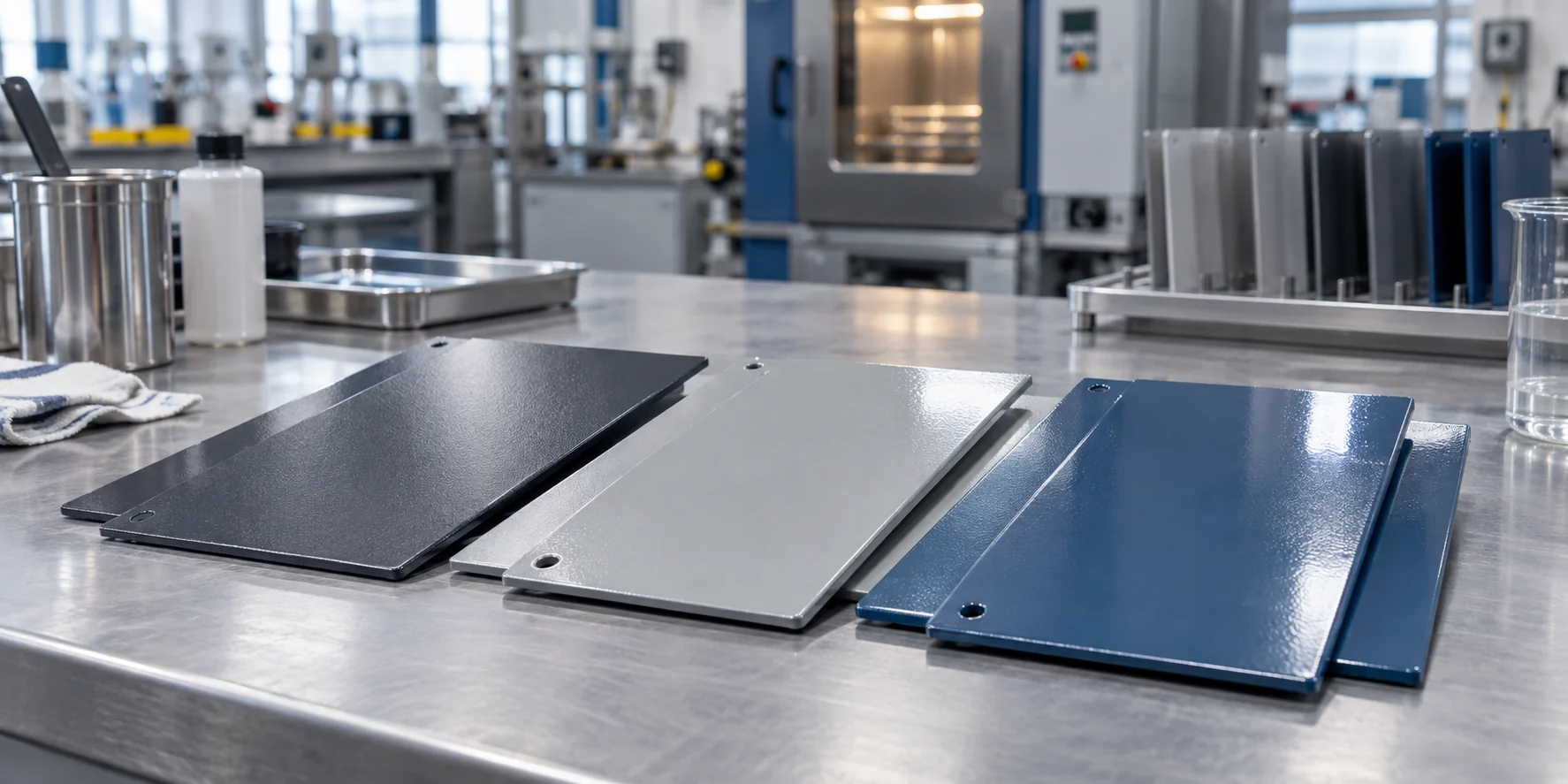
The right coating system is determined by assessing the metal to be protected, its service environment, the desired appearance and production capabilities together. When comparing resin families, purchasing, application and quality teams need answers to the same technical questions.
Begin industrial coating selection with a technical definition
A machine body, an outdoor steel structure and production equipment washed with cleaning chemicals may be painted the same colour, yet require different coating systems. The first decision in industrial coating selection concerns the duty of the surface to be protected, not the name on the paint container. A purchase request that asks only for "durable industrial paint" can leave the technical team and applicator working to different expectations.
This technical article is an original decision guide prepared on 24 September 2026 to assess epoxy, polyurethane, acrylic and alkyd/rapid-drying options. Its purpose is not to rank resin families in an absolute order of performance, but to narrow down candidate systems by asking the right questions. When reviewing industrial coating solutions, record substrate material, previous coating, exposure, appearance requirements and production schedule together.
- Is the substrate new carbon steel, galvanised steel, aluminium or an already coated component?
- Where will the component operate, and how will it be exposed to water, sunlight or cleaning agents?
- Is the acceptance criterion appearance alone, or a defined protective coating system?
Look beyond the distinction between indoor and outdoor environments
An indoor environment does not necessarily mean mild conditions. An enclosed production area may involve condensation, frequent washing or process splashes. Outdoors, sunlight, precipitation, accumulated dirt and the way the surface retains water should be assessed together. Rather than assigning the same category to all equipment near the coast, or treating every surface inside a factory as equivalent, examine the component's actual operating location.
The environmental classification in ISO 12944-2 distinguishes atmospheric conditions from the exposure of structures immersed in water or buried in soil. This framework is not an automatic certificate of suitability for a paint brand. The category and system to be used on the project must be defined separately.
A practical starting point is to collect photographs from the surface's location, process information and the cleaning plan. For chemical contact, record the substance, concentration, temperature and contact duration. Intermittent splashing and continuous immersion are different requirements. This turns a broad expectation such as "chemical resistance" into a specific technical request that a manufacturer can answer.
What role should an epoxy coating fulfil?
The term epoxy describes a broad product family spanning primers, topcoats and different applications. During selection, clearly state the coating's role in the system: is it the first coat providing adhesion to the substrate, an intermediate coat contributing to the overall protection, or the directly visible topcoat? Nanomix Epoxy Primer and Nanomix Epoxy Topcoat should therefore not be treated as interchangeable entries in an assessment.
Appearance requirements become particularly important outdoors. A general note in Jotun's technical data sheet states that epoxy-based topcoats may chalk under sunlight and weather exposure. Selecting an epoxy solely on its initial gloss is therefore inappropriate.
When evaluating an epoxy candidate, request product-specific suitability for the relevant chemical, the recommended primer, recoating interval and commissioning requirements. Test results for another epoxy cannot be transferred to the selected product. Changes in surface colour or gloss should also not be treated as the same measure as protective performance.
Define appearance requirements for a polyurethane topcoat
When assessing polyurethane systems, consider the product's chemical structure together with its intended application. Not every polyurethane behaves identically outdoors. For example, International's description of Interthane 990 explains aliphatic polyurethane chemistry and long-term aesthetic protection for a specific product. This statement cannot be generalised to mean that all polyurethane coatings perform identically.
When assessing Nanomix Polyurethane Gloss Topcoat, compatibility with the project primer and outdoor performance expectations must likewise be checked against current technical information. The description "gloss topcoat" does not by itself demonstrate a particular corrosion category or chemical resistance level.
To make appearance acceptance clearer, specify the required gloss, the lighting under which the sample will be assessed and a reference surface in addition to the colour code. Weld marks, surface waviness and different substrates can affect the sample's appearance. Approving a representative panel prepared with the same primer and application method before ordering provides a clearer basis for a decision than relying only on a catalogue colour.
Understand the product differences behind the acrylic label
When assessing acrylic coatings, single-component, two-component, water-based and solvent-based options should not be confused. The same family name does not mean identical mixing requirements or application behaviour. The presence of separate products for different duties and substrates within International's acrylic product family illustrates why the product description must be read beyond the resin name.
When comparing locally available products, assess the hardener, recommended thinner, application method and condition of the previous coat separately for a candidate such as Nanomix Acrylic Two-Component Gloss Topcoat. Numerical data in the technical data sheet should be interpreted in the context of their measurement conditions.
A useful method for purchasing teams is to request the same information from every candidate. If one product provides only touch-dry time and another provides full-cure information, the times should not be compared directly. Fill in missing information through technical discussion so that products can be compared on their answers to the same question.
Define speed correctly in alkyd and rapid-drying systems
Alkyd and rapid-drying products are often assessed in relation to production flow. However, "rapid" in a product name does not guarantee stacking after a specific number of minutes or fast dispatch under all conditions. Drying information must be matched to actual conditions and the film structure. The alkyd systems product group and Nanomix Industrial Rapid-Drying Paint can be reviewed in this context.
Broad assumptions about chemical contact should not be made from a family name either. The Interlac 665 technical data sheet explicitly states the chemical and solvent resistance limits of that alkyd product, along with restrictions under continuous condensation and immersion. This example shows why the service limitations of a candidate product must be requested.
In workshop planning, drying, handling, assembly, packing and putting into service are separate steps. Completion of one does not automatically permit the next. Selection focused on speed should begin by identifying which of these steps creates the production bottleneck.
Assess primer, topcoat and thinner together
Successful product selection involves more than approving a single container. Surface preparation, primer, any intermediate coat, topcoat and ancillary products must be defined together. Changing one coat does not mean that the remaining coats automatically stay suitable. Testing two topcoats of the same colour over different primers does not, on its own, validate the entire system either.
The project file should state which product will be applied over which coat, the waiting conditions between coats and the procedure to follow if the interval is exceeded. For maintenance work in which the existing paint will be retained, first assess the identity and soundness of the old coating. For an unknown surface, a small trial area can be planned as part of the technical approval.
Thinner selection also belongs in this file. Only an option approved in the product's technical data sheet should be selected from the thinners and ancillary products. Achieving the same application consistency with a different thinner does not demonstrate that system compatibility is maintained. Any uncertainty about mixing should be resolved before production begins.
Include actual production-line conditions in product selection
If a technically suitable coating requires conditions that the existing line cannot provide, the application plan must be revised. The component's temperature on entering the booth, the holding area after application, the time available for recoating and how large components are turned can all be discussed at the selection meeting. This puts the expected coating properties and the conditions the workshop can provide into the same document.
- Is the application equipment compatible with the selected product's recommended method?
- Is responsibility assigned for preparing and tracking the use of two-component mixtures?
- Is there a risk of dust, contact damage or condensation in the holding area for coated components?
- Will the same criteria be used for sample acceptance and production acceptance?
Answers to these questions establish application discipline independently of the product family. Trials on representative components and documented results are recommended before series production begins. The trial should assess not only appearance but also the repeatability and controllability of application.
Example decision scenario: a machine body and an outdoor chassis
Suppose a hypothetical manufacturer is producing a machine body for use in an enclosed workshop and a chassis for outdoor use as part of the same order. Requiring the same corporate colour for both components is not sufficient reason to use a single coating system. This example illustrates the decision process; it is not an application approval for any product.
For the machine body, first record cleaning frequency, the agent used and temperature. For the chassis, assess appearance requirements under sunlight, water accumulation, hard-to-reach joints and potential transport damage. Record surface preparation capabilities and the delivery schedule separately for both components.
The technical team then requests the same information for each candidate system: suitable substrate, coat structure, application window and product-specific guidance for the relevant exposure. An exterior topcoat takes priority for the chassis, where appearance matters most; documented suitability for chemical contact takes priority for the body. The final decision is made through representative application and the manufacturer's assessment; the process is not completed merely by selecting the word epoxy or polyurethane.
Information to include in a technical quotation request
For comparable quotations, surface area, component type, exposure, existing coating and desired appearance can be brought together in one short technical file. State whether application will take place in a workshop or on site, as well as colour, gloss and delivery date. For project-specific requirements, product suitability and current data sheets can be requested through the Versan Boya technical contact channel.
Clearly flag unanswered technical questions when evaluating quotations. Instead of filling undocumented properties with assumptions, obtain written clarification from the relevant parties before deciding. Such a file makes the basis of purchasing approval clear and gives the application team an actionable work specification, not just a product code.
Frequently asked questions about industrial coating selection
Can epoxy coatings be used outdoors?
It depends on the suitability of the product and system. Appearance requirements under sunlight need separate assessment; some systems require a suitable topcoat. The decision should not be based on the epoxy name alone.
Are polyurethane coatings resistant to every chemical?
No. The selected product's suitability must be verified for the chemical type, concentration, temperature and mode of contact. Data for one product cannot be transferred to another.
Is rapid-drying paint sufficient for same-day dispatch?
Dispatch must be assessed against the product's relevant drying data, actual conditions, film thickness and packaging method. The product name alone does not guarantee a timeframe.
Should the same system be used on every surface to achieve the same colour?
Not necessarily. Different substrates and service conditions may require different systems. A consistent appearance can be managed through jointly approved samples prepared with suitable systems.
Technical sources
This article is an editorial technical assessment prepared on 24 September 2026. The sources explain general principles; in practice, the current technical data sheet for the selected product and the project specification take precedence.