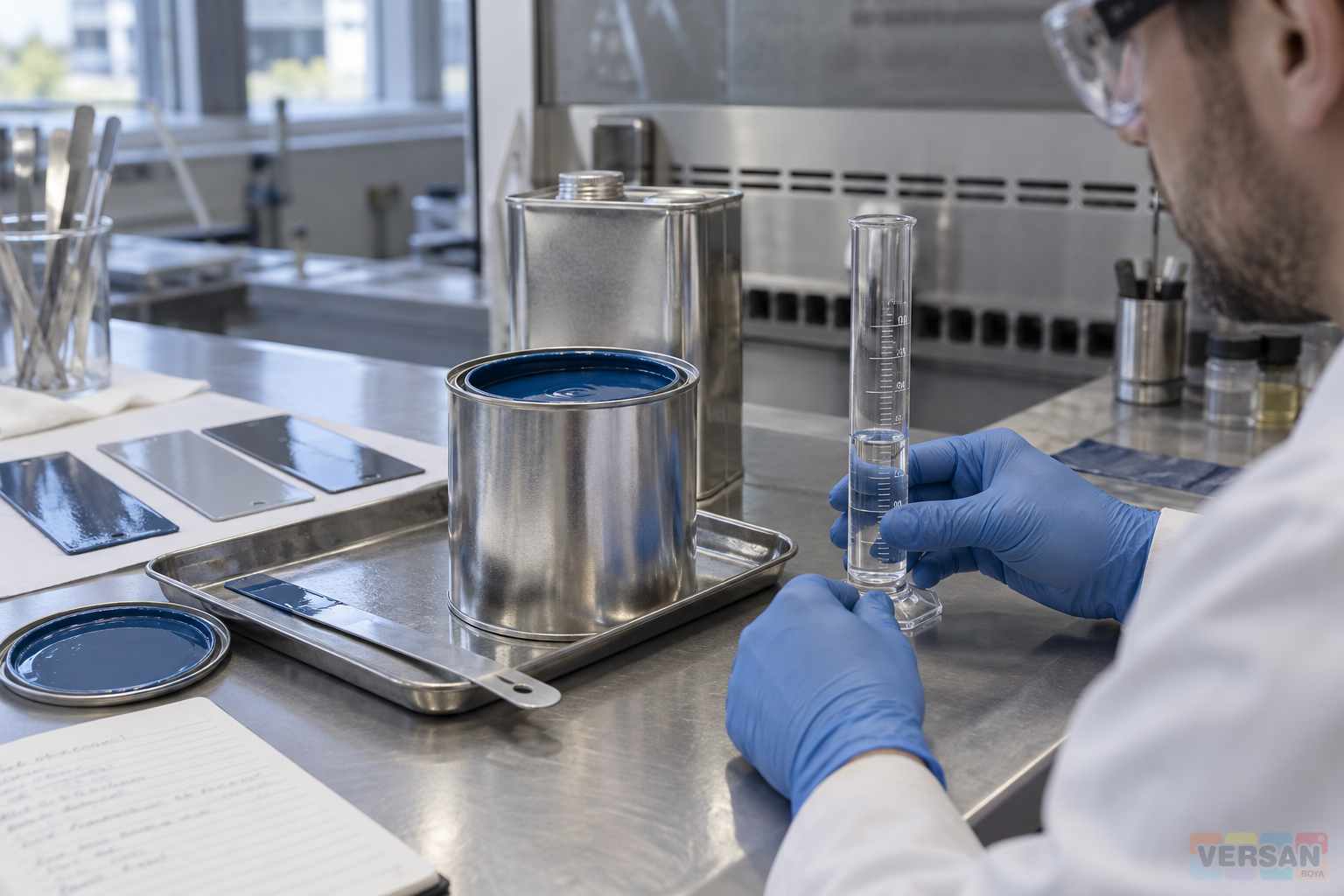
A synthetic enamel that leaves the brush easily does not automatically provide a smooth finish, adequate hiding and a reliable drying schedule. Thinner changes application behaviour while also changing the relationship between the volume of mixed material and the amount of paint deposited. The quantity of synthetic thinner should therefore be controlled through the product instructions and a recorded preparation method. Judging only the stream falling from a stirring stick leaves several important questions unanswered.
This guide explains how to assess an approved thinner addition without treating dilution as a universal cure for difficult application. It does not prescribe a solvent blend or a common reduction percentage for every alkyd coating. Maintenance steelwork, decorative joinery and workshop finishing can involve different substrates, tools and acceptance requirements. The current technical data sheet, container identification and safety data sheet establish the working limits. A trial then shows how the specified material behaves under the conditions of the particular job.
1. Identify the exact coating and approved thinner
A container described simply as synthetic thinner does not establish compatibility with every product carrying an alkyd or synthetic description. Record the coating name, code, colour or base, batch identification and proposed thinner together. The thinners and auxiliaries range contains products serving different purposes. Selecting a cleaning solvent because it appears less expensive than the specified reducer introduces an unverified change before the application assessment has even begun. The intended use must be clear at the preparation station.
The accepted Nanomix catalogue archive associates synthetic thinner with synthetic topcoats, primers and varnishes. That family description does not assign a single addition rate to every member of the group. When preparing synthetic topcoat, obtain the current instructions for that specific product and method. Our guide to choosing a suitable paint thinner addresses the initial product match. The following sections concern quantity control after that match has been established, rather than using a successful trial to justify an unspecified substitution.
2. Define what the percentage is calculated against
A reduction percentage is incomplete unless its reference quantity is known. An addition expressed against the starting paint volume differs from the thinner fraction of the final mixture. A volume instruction also cannot automatically be applied as the same percentage by mass. Paint and thinner cannot be assumed to have identical densities. The preparation record should identify the measurement basis, the measuring equipment and the calculation separately. This becomes particularly useful when operators move between container sizes or prepare only part of an original pack.
As an arithmetic example only, adding one hundred millilitres of liquid to one litre of paint represents ten percent of the starting paint volume. It is not ten percent of the resulting approximately one point one litres of mixture. This example is not a recommended recipe. The archived Nanomix premium synthetic topcoat page identifies volume in its English thinning heading. A figure from that archive must not be transferred to a differently named product or used without checking that the current application instructions still apply.
3. Assess the paint before making an addition
The material at the top of a stored container may not represent the whole contents. Judging a small sample taken immediately after opening can mistake incomplete mixing for a need to dilute. First homogenise the coating using the manufacturer's stated procedure, then assess its condition. Record any unexpected skin, lumps, foreign material or unusual separation. Such findings should be investigated rather than hidden through extra thinner. Keep the original identification attached to any sample retained for technical review so that the observation remains traceable.
Material temperature and the history of an open container provide context for a flow assessment. Two samples of the same product at different temperatures may feel different during manual application without requiring different approved recipes. A matt decorative synthetic paint also should not be judged solely against the immediate appearance of a gloss finish. The acceptable preparation belongs to the specific coating and application method. The intended sheen alone does not tell an operator how much solvent to add or whether a change is necessary.
4. Treat easy flow as one observation, not the whole result
A comfortable brush feel is useful information, but it does not establish film uniformity or sufficient hiding. Where viscosity is measured, record the method, instrument identity, sample temperature and measurement time. Results from different cup types or different sample conditions should not be pooled as if they were interchangeable. If the coating instructions do not specify a viscosity method, ask for clarification instead of importing a target from another paint. A number without its measurement conditions can create more confusion than a clearly described qualitative observation.
During a trial, observe brush loading, initial distribution and the texture left by the finishing stroke separately. For a product such as semi-matt synthetic topcoat, easy spreading and an accepted final appearance deserve separate entries. A panel can seem easier to coat while showing greater edge accumulation or a more visible underlying colour. An improvement in handling therefore should not be approved without reviewing those other results. The useful question is whether the complete application meets the agreed requirements.
5. Compare hiding on a consistent film and substrate
Adding thinner does not add pigment or binder to the original paint. Spreading the mixture very thinly over a larger area may leave the underlying colour more apparent. Conversely, a locally heavy application can appear to hide better during a quick inspection. These observations arise from different film conditions and cannot be compared directly. Keep the substrate colour, preparation, application tool and assessment time consistent when investigating a change in thinner quantity. Record where the comparison was made rather than relying on an unlabelled photograph.
Elcometer's wet film guidance explains that volume solids information is needed when relating wet thickness to an expected dry film. The original coating's figure should not be used unquestioningly for a reduced mixture. Without applicable technical data, avoid presenting a precise dry film calculation as a measured result. When comparing topcoat over synthetic primer, keep primer colour and surface condition comparable. Differences in the underlying preparation can otherwise be mistaken for an effect caused entirely by dilution.
6. Keep substrate preparation separate from dilution adjustment
Changing paint flow does not remove contamination or strengthen a loose previous coating. Metal preparation, primer selection and intercoat compatibility remain separate control points. In maintenance work involving an antirust primer, identify the treatment of corroded areas and the transition to sound existing paint. If topcoat spreads differently in one location, examine the local texture, preparation and cleanliness before adjusting the whole batch. A change made to every container is a poor response to a problem that has not yet been located.
The trial panel should therefore represent the intended work as closely as practical. A convenient piece of unrelated sheet metal may not reproduce the actual primer or preparation. A good result on a flat coupon also does not provide unrestricted approval for corners, welded details or narrow profiles. Products within the alkyd systems range serve different functions. Recording the tested substrate and layer arrangement helps the application team use a successful result within its proper limits instead of assuming that the product name alone defines the system.
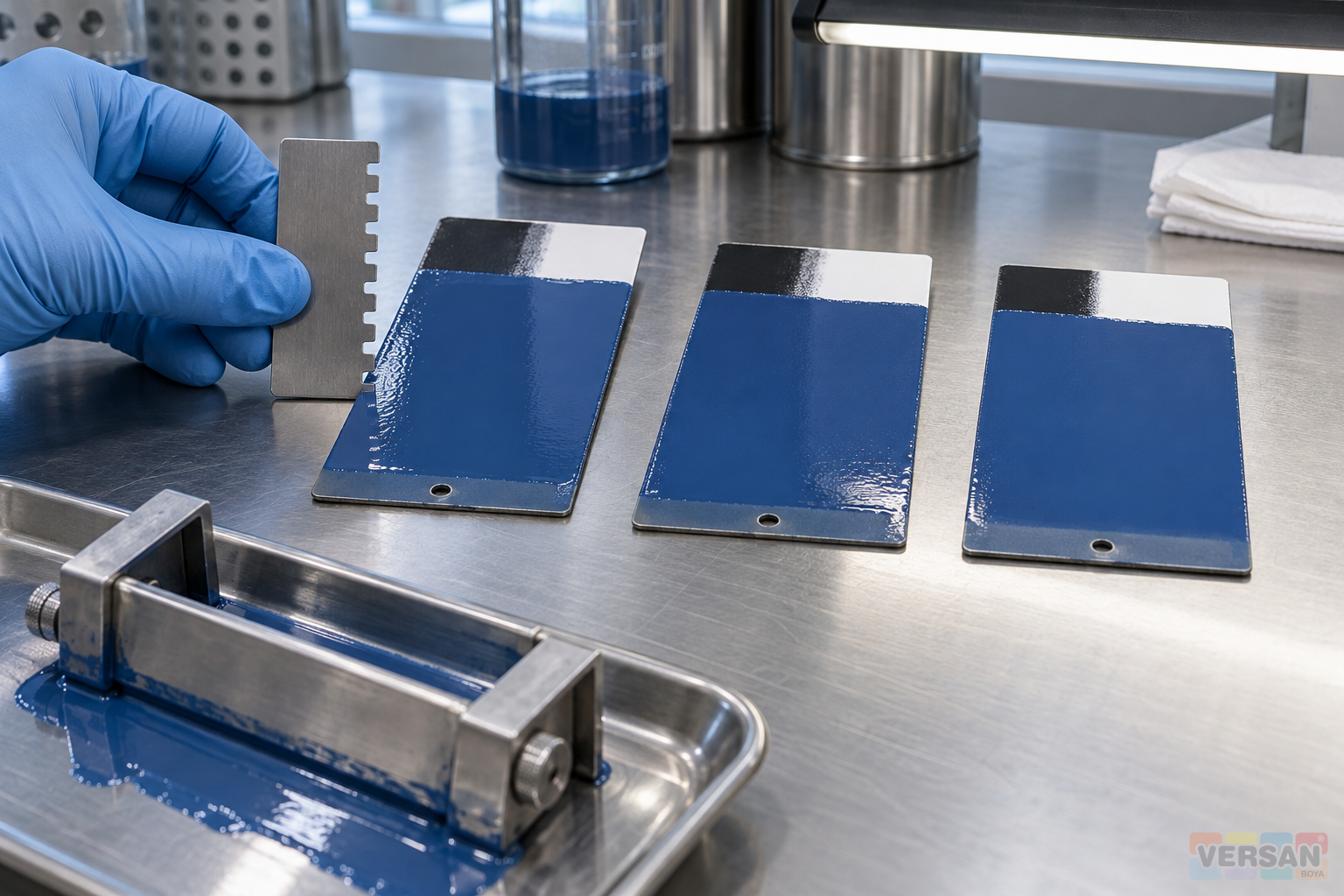
7. Separate evaporation, surface drying and readiness for work
There is no single universal rule by which adding more thinner makes every coating dry either faster or slower. Solvent loss is only part of the process; the resin system and actual film build also matter. Jotun's description of an oxidatively drying alkyd product illustrates why alkyd drying should not be reduced to liquid evaporation alone. This example from another manufacturer does not establish a time, temperature or performance value for a Nanomix product. Those values must come from the applicable product documentation.
A brief touch that leaves no visible mark does not establish readiness for stacking or assembly pressure. A reduction in noticeable solvent odour is likewise not a measured hardening result. Our article on drying versus readiness for handling explains why these decisions should be separated. The test sequence for the synthetic enamel being used must still follow its own instructions. Record appearance acceptance, permission to overcoat and release for handling as distinct decisions, with their relevant times and conditions.
8. Do not assume brush and spray preparation are identical
A product that permits more than one application method does not necessarily require the same preparation for every method. Brush contact with the substrate and material delivery through spray equipment involve different processes. When the method changes, review the relevant part of the technical instructions. Increasing dilution to make an old trial suit a new process is not a substitute for checking equipment suitability. A clearly named application method on the work order also helps prevent a leftover mixture from being reused for an unsuitable task.
If a revised production cycle calls for evaluating quick-drying industrial paint, treat that as a separate product selection. Adding more solvent to a conventional synthetic enamel does not turn it into a rapid coating. Similarly, the name quick-drying industrial thinner does not demonstrate suitability for an existing synthetic enamel. Each product must be considered within its approved pairing. A faster operation is useful only when the required finish and subsequent processing conditions are also satisfied.
9. Measure each addition and maintain a running total
Start the preparation record with the initial paint quantity and the authorised measurement basis. If reduction is required, make measured additions within the manufacturer's limits and follow the specified mixing and checking procedure. If the result remains unsuitable, investigate the cause rather than exceeding the limit to obtain a preferred feel. Keep the first addition and later adjustments visible in one total. Recording only the last small addition understates the actual reduction and can cause a later batch to be prepared against an incorrect example.
Do not estimate the remaining paint quantity from the apparent level in an irregular container. Use an appropriate method supported by the preparation system. Any material carried over in an intermediate pot needs its own identity and suitability check. Sherwin-Williams' application guidance similarly directs users to the product data for the permitted reducer and reduction limit. This is a general control principle, not permission to apply another manufacturer's thinner recommendation to the present coating. An uncertain mixture should not share the release status of a fully documented preparation.
10. Change one variable in a small, documented comparison
A useful comparison identifies which change produced which result. If thinner quantity, brush, primer and operator all change together, the effect cannot readily be separated. Prepare a reference panel using the approved existing process first. Then vary only the factor being investigated, within its authorised limits. Documenting comparable assessment conditions provides a sound basis for deciding whether a larger trial is justified. Give each panel a unique identity so that photographs, mixture records and final observations cannot be accidentally assigned to the wrong sample.
For each panel, retain the starting amount, total addition, application time, substrate preparation, tool and outcome. Assess ease of application, visibility of the underlying colour, surface uniformity, edge accumulation and readiness for the next operation in separate fields. If one improves while another deteriorates, the result needs further review. A single combined score should not conceal the trade-off. Define the acceptance criteria before the trial, so that approval does not depend on selecting only the most favourable observation afterwards.
11. Include cleaning residues in the preparation review
An accurately measured thinner addition does not guarantee an accurately known mixture if liquid remains in the pot or equipment from cleaning. Tools used with cleaning thinner should return to production through the approved cleaning and drying procedure. A visually clean surface alone does not establish that the previous liquid has been removed. Add a short, separate equipment release check to the preparation record. Otherwise, controlled additions and uncontrolled carryover can exist in the same operation without anyone recognising the discrepancy.
Keep containers closed when not in use and avoid working from unidentified vessels. Ventilation, ignition control and personal protection for solvent work should follow the applicable safety data sheet and workplace assessment. These provisions should not be altered simply to change paint flow. The record approach described in our thinner storage and container traceability guide should extend to the preparation point. Correct purchasing is only part of the control: the correct material must remain linked to the correct container and work order.
12. Compare accepted output rather than mixed volume
A larger volume of reduced material does not necessarily produce a proportional increase in accepted finished area. An additional coat for hiding, rework, waiting or rejection can change the overall result. Compare material consumption against work completed to a defined standard instead of relying only on the price per litre of mixed liquid. No assumed saving percentage is needed. The calculation should use comparable substrates and acceptance requirements, with the relevant material and process records. Otherwise, two apparently attractive figures may describe different jobs.
The product range helps identify the coating, primer and auxiliary products together. Tell purchasing which job and product pairing were assessed, rather than reporting only that the thinner quantity changed. If a sample has been accepted, retain the scope of that approval. Decide in advance what must be checked again when the colour, substrate or application method changes. A successful coupon is evidence for its recorded conditions; it does not provide an unlimited guarantee for every future production batch.
13. Turn the outcome into a clear application record
A useful release statement identifies the coating and thinner, the substrate, the recorded method and conditions, and the criteria the trial met. It also states which next operation is permitted and when the relevant check was made. If the result is unacceptable, do not write only too much thinner. Describe the observation, the reference used and the unresolved question. This gives technical support a focused information set and reduces the likelihood of repeatedly starting the same uncertain trial without learning from earlier work.
Consider a hypothetical shift comparison: one team accepts the brush feel while the following team reports inadequate hiding. Before changing the mixture, compare initial quantities, addition totals, substrate condition, brush loading and application times. Where information is missing, retain that uncertainty rather than filling the gaps from memory. The next trial should be designed to produce the missing evidence. Quantity control is valuable because it makes the application explainable, not because it creates a fixed percentage that can be used indefinitely without review.
A second example concerns a partially used container returned after a break. The operator may remember the first addition but not a later adjustment. Estimating another addition from that incomplete history compounds the uncertainty. Identify the container, preserve its actual recorded history and obtain a decision through the established procedure before further use. Separating uncertain material from an approved preparation is a practical way to protect the comparison. It also avoids treating an undocumented mixture as the reference for tomorrow's work.
The objective is not to make synthetic enamel as fluid as possible. It is to achieve the required application behaviour, hiding and subsequent processing readiness together, using the approved product combination under defined conditions. A sound preparation record connects those outcomes to measured additions and an identifiable trial. When the method is repeated, the team can explain what stayed the same, what changed and why the result was accepted. That is more useful than a remembered splash of thinner or an isolated photograph of a glossy panel.
Technical sources and scope
- Nanomix synthetic coatings catalogue archive, page 12: product family, preparation and documented measurement basis.
- Nanomix thinners catalogue archive, page 42: synthetic thinner application family.
- Elcometer — Wet Film Wheels: wet film and volume solids relationship.
- Jotun — Alkydprimer: an example of an oxidatively drying alkyd coating.
- Sherwin-Williams — Paint Application FAQs: product-specific limits on reduction.