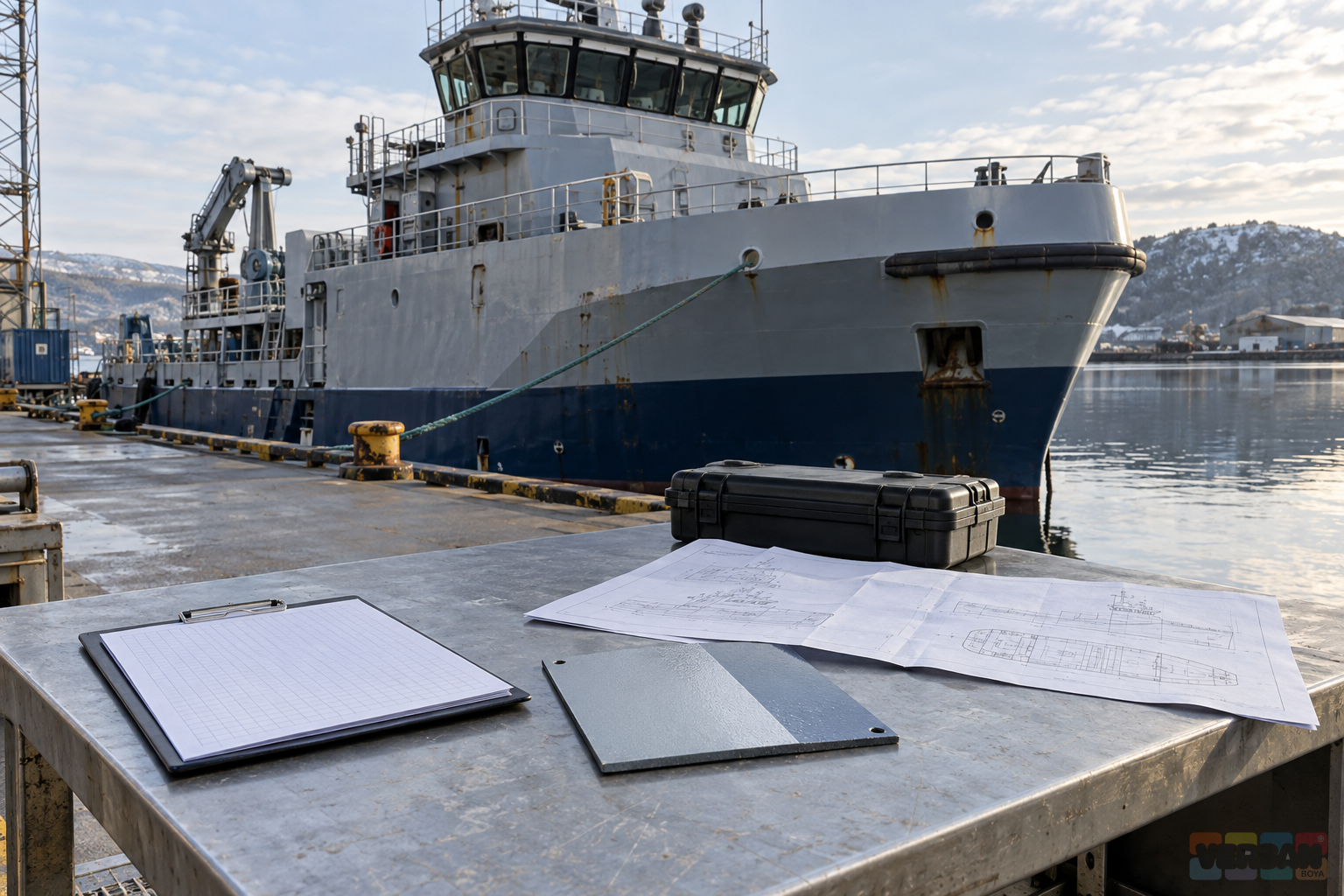
Ship coating quotations based only on surface area and colour often price different jobs. One supplier may assume that the existing coating remains, while another includes more extensive preparation. One price may cover materials alone and another may include inspection or application services. A comparable enquiry therefore begins with a technical file that describes the location, exposure and existing system concerned. The vessel should not disappear into one generic line item. Price becomes meaningful when the boundaries and assumptions behind it can be understood.
The file is not intended to make the purchasing team responsible for every coating design decision. It carries consistent information between the operator, maintenance staff, applicator, coating manufacturer and any relevant project inspection parties. The marine coatings range can start a product discussion, but a listing does not establish suitability for every vessel zone or possession of a particular approval. The proposed system and the conditions for its use need a separate, written assessment linked to the actual project.
This article proposes an information and document-control process before quotation. It does not design a coating system for a particular vessel, specify film thickness or prescribe coat numbers. Its central purpose is to distinguish confirmed information, missing information and the people responsible for decisions. Recording that an area has not been measured or that the old paint is unidentified is more useful than filling the gap with an assumption. Firm scope and items requiring later confirmation can then be separated openly.
Identify the working zone as precisely as the vessel
Begin with a project name, vessel or equipment identifier, requester and work location. Give each zone included in the enquiry a consistent reference. A section of port-side hull and a sun-exposed superstructure face should not become indistinguishable within the same record. Link photographs, area calculations, coating history and quotation lines to that reference. This reduces reliance on phrases such as “that section” during discussions between people who may not have visited the vessel together. Mark excluded areas just as clearly as included ones.
Overall photographs establish location; close views describe condition. Every detailed photograph should remain traceable to its zone. A lack of access must not be interpreted as evidence of sound coating. Record why an area could not be inspected and when a further check is expected. Surfaces behind equipment due for removal are an example of scope that may remain uncertain at enquiry stage. Giving that uncertainty its own record helps manage any additional work found later without pretending that the surface was inspected beforehand.
The previous article on zoned ship coating maintenance explains why decks, hull sides and superstructure require distinct consideration. In the quotation file, add the information status of each zone. Distinguish measured areas, estimates and areas awaiting access. If one total contains several confidence levels, do not present it as an entirely confirmed quantity. Suppliers can price more consistently when they can see which measurements are established and which are provisional.
Describe exposure through service conditions
The phrase “marine environment” is not sufficiently precise on its own. Associate relevant conditions with each zone: continuous seawater contact, splashing, salt-laden atmosphere, sunlight, chemical contact or pedestrian traffic, for example. These are questions for a suitability assessment rather than an automatic product selection chart. An immersed surface and a working deck cannot simply be assumed to have the same coating requirements. If the exposure description is uncertain, resolving it should be a prominent question in the technical enquiry.
Record intended operational changes as well as present use. A zone may have a different cleaning regime, equipment layout or service function after maintenance. The past experience of an existing coating cannot automatically be transferred to changed conditions. Requesting the same material solely because it was used previously can overlook that difference. Identify who supplied the service information and when it was confirmed. If operations and maintenance teams give conflicting descriptions, resolve the inconsistency within the project rather than sending incompatible assumptions to different bidders.
Similar product families may appear in both the industrial coatings range and marine enquiries. Category overlap does not create approval or service equivalence. A description covering general metalwork is not a substitute for evidence addressing a particular tank, cargo or continuous immersion condition. Keep products under investigation, products proposed by the supplier and products approved for the project in separate states. Otherwise an informal catalogue link shared at the beginning of a discussion can quietly become an unsupported final specification.
Investigate the existing system as a layer history
Bring together available product identities, application dates, maintenance records and layer information. An old purchasing invoice may be helpful, but the location where that material was applied still needs confirmation. Repairs on the same vessel may have been completed at different times with different products. Adjacent areas of the same colour need not have identical chemistry or preparation histories. If documentary evidence and surface observations do not agree, retain both as distinct records instead of choosing the more convenient account without explanation.
The existing system description should extend beyond the name of the visible topcoat. Where known, record primer, intermediate coating, finish and earlier local repairs separately. Do not invent missing layers. The relevant technical parties can decide whether sampling or further investigation is required. A compatibility opinion should state the information on which it relies. A favourable observation from one uncertain location does not justify treating all the vessel's remaining surfaces as equivalent. Define the area to which each piece of evidence actually relates.
Epoxy primer, epoxy topcoat and epoxy shop primer identify different functional categories. A shared family name does not prove that every combination or application over an existing film is suitable. The quotation should describe the proposed system as a whole, connecting preparation, supporting materials and intercoat conditions with current manufacturer information. The presence of shop primer is not evidence that all later preparation requirements have already been satisfied.
Separate condition observations from measurement results
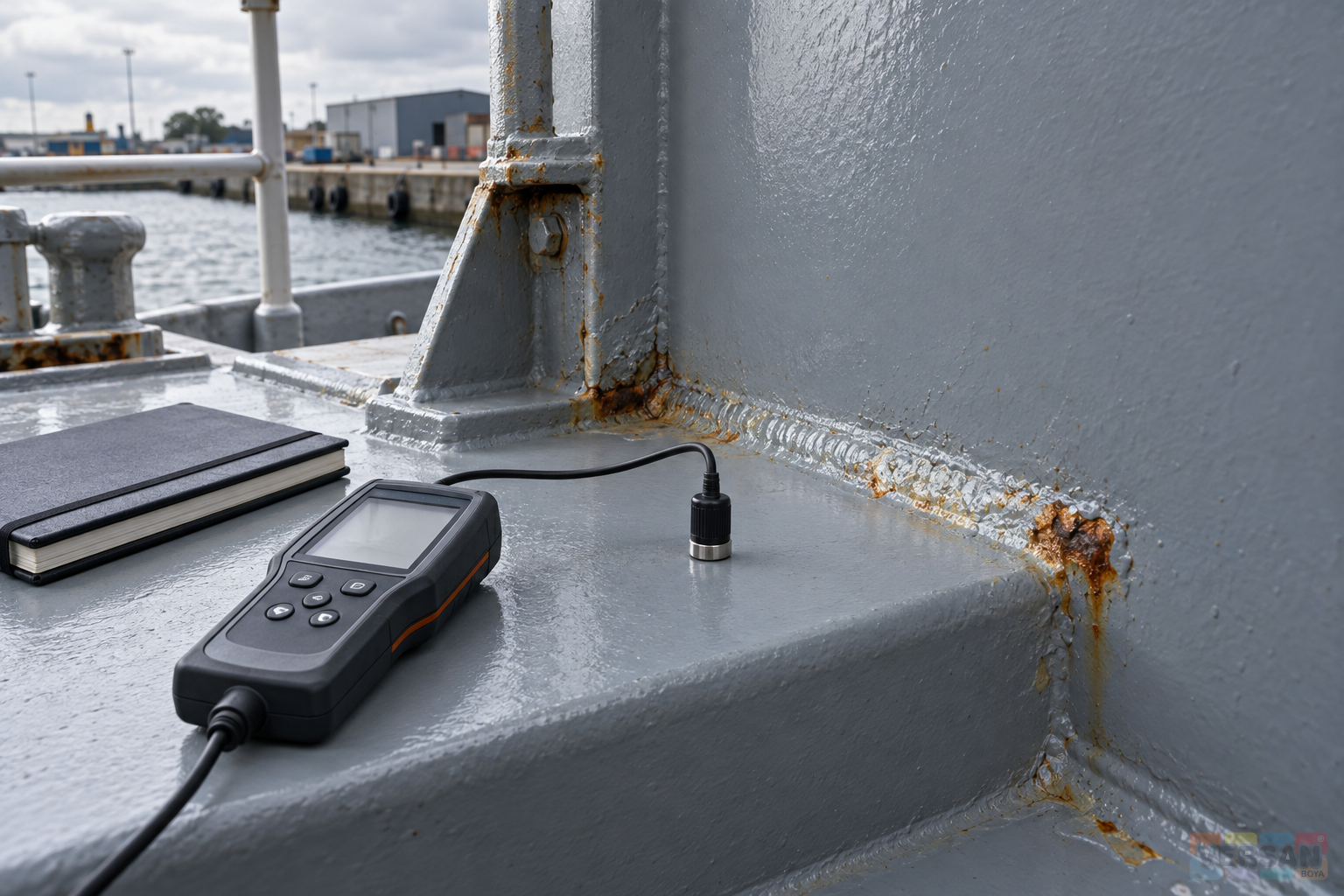
Visible rusting, blistering, worn edges and film loss are observations. Record each against a location and date. If measurements exist, retain the method, instrument identification, measurement locations and result file separately. An instrument appearing in a photograph is not proof that a valid result has been obtained. Do not add values when there is no corresponding record. Equally, a number should not trigger an automatic application decision before the project has established the relevant method and criteria for interpreting it.
For area calculations, distinguish apparently intact coating, damaged coating and surfaces awaiting access. If the proportion requiring local preparation is not established, do not conceal that uncertainty inside an apparently firm material quantity. The enquiry can state how preparation scope will be confirmed and what findings would require a quotation revision. The purpose is not to inflate or suppress cost. It is to let bidders work from the same assumptions rather than each privately interpreting what an unknown surface condition is likely to mean.
Visual appearance alone does not resolve every question about salts, contamination or preparation. Required inspections and acceptance methods should come from the project specification and current manufacturer instructions. The guide to salt contamination, corrosion and preparation on marine steel examines these as separate considerations. For the quotation file, identify which checks are already available, which are required before work and how their findings could affect scope. That makes the uncertainty manageable without fabricating a test result.
Read catalogues, data sheets and approvals differently
Archived catalogues contain product introductions and historical information. A current technical data sheet, safety data sheet, project system recommendation and special approval are different documents. Maintain a list showing document name, revision or date, relevant product and the question each document answers. Possessing a PDF of unknown currency does not establish that the technical decision uses current information. Ask the supplier explicitly which documents need updating, and associate the reply with the quotation revision that depends on it.
When investigating polyurethane primer or gloss polyurethane topcoat, confirm the exact product identity and intended use. A polyurethane archive page on this site also describes furniture applications; it should not be treated as a suitability declaration for every ship zone. These links make the technical enquiry more specific, but they do not provide marine approval. Obtain the correct current documents for the particular product actually proposed for the project.
IMO Resolution MSC.215(82) addresses protective coatings for specified dedicated seawater ballast tanks and double-side skin spaces of bulk carriers, including the coating technical file within that scope. Its name should not be attached to every ship maintenance job or catalogue product as a general compliance label. Establish project applicability and required evidence with the responsible technical parties. Linking the resolution does not prove that a proposed product is approved, or that its selection meets the requirements of a particular vessel.
Make programme and access part of the technical enquiry
Describe the work location, access arrangements, intended outage and expected return to service. Programme pressure does not remove the current product's application or service-entry requirements. The supplier needs to understand the actual work window, not merely a request for something that dries quickly. Where several trades share a zone, identify the dependencies affecting the coating work. The enquiry need not settle every detail of the final programme, but it should expose information that could prevent the proposed system from being applied as intended.
Read materials for mixing, thinning, application and equipment cleaning as separate requirements. The names epoxy thinner and polyurethane thinner suggest supporting roles, but not interchangeability. Require the quotation to identify the approved auxiliaries for the proposed system and explain their purpose. Combining preparation or cleaning materials with the coating thinner in one ambiguous line item creates an avoidable source of confusion during purchasing and application. Do not derive a substitution from a general solvent family name.
Allocate responsibilities for equipment removal, protection, temporary closure of routes, access provision and waste handling as relevant to the work. These are scope descriptions, not coating performance claims. For example, scaffolding assigned to the buyer in one bid and the contractor in another can produce very different totals around the same paint quantity. A price comparison that ignores those allocations cannot establish a meaningful cost advantage. Keep responsibility information alongside the affected zone so that technical and commercial discussions use the same boundary.
Separate appearance objectives and different substrates
Assign colour, sheen and appearance objectives to the appropriate zone. A colour reference, sample identifier and intended viewing conditions can help. Semi-matt polyurethane topcoat and matt polyurethane topcoat provide different appearance categories for an enquiry, not evidence of a particular marine service approval. Treat appearance acceptance and technical system suitability as separate decisions. Meeting one objective does not automatically demonstrate that the other has been addressed or that a proposed product belongs in the intended zone.
If timber components are included, investigate them independently rather than incorporating them into steel coating quantities. A yacht varnish enquiry needs information about the wood and its use. The preparation information collected for steel is not an adequate timber specification. Identify aluminium and other substrates separately where they occur. The aim of the file is not to force different requirements into one product line. It is to let the supplier answer the correct technical question for each actual surface.
State the purpose of any requested sample: colour approval, appearance evaluation or demonstration of a proposed application sequence, for example. An attractive sample is not proof of long-term performance or a special approval. Link the sample identifier, system, substrate, preparation and observation time to the enquiry. If a sample is subsequently remade using different materials, keep the conditions of the earlier approval understandable. A new result should not silently replace an older document while retaining an approval that referred to a different construction.
Compare bids against a shared assumption table
A comparison table can show each zone's area basis, preparation scope, proposed system, inspection work, exclusions and uncertainties side by side. Identify the source of technical data used for material quantities and who supplied any allowance assumptions. This article does not recommend a standard coverage or wastage percentage. Quantities justified in different ways need to be brought to the same units and scope before one offer is labelled cheaper or more expensive. Otherwise the apparent saving may simply reflect work or material that another bidder included.
An alternative proposal requires more than a similar chemistry name. State which specification requirement is addressed by which evidence, identify deviations and name the party responsible for evaluating them. A supplier's use of “equivalent” should not make purchasing approval automatic. The guide to specifications, equivalence and acceptance develops that distinction. The comparison outcome should describe the assumptions and limits of the selection, rather than recording only a preferred brand or an unexplained commercial ranking.
Agree a commercial method for unresolved items. If accessible area, additional preparation or an access arrangement remains provisional, explain how later findings may affect price and programme. Such provisions do not transform an incomplete survey into a completed one; they identify when the quotation needs revision. Keeping conditional items visible is preferable to leaving both parties to argue later about whether unforeseen work was included. Technical and commercial teams can then refer to the same version when the scope becomes clearer.
Continue document control after the order
Placing an order does not close the technical file. Transfer the approved quotation revision, system recommendation, current document list and agreed changes to the application team under consistent identifiers. If material, preparation or programme changes during the work, record the decision and its basis. An oral change hidden behind an unchanged PDF makes later interpretation difficult. Document control is therefore not simply an archiving exercise. It is a practical way to ensure that the people carrying out the work receive the information on which approval was based.
At handover, add what was actually completed in each zone, product identities, genuine inspection records and outstanding items. Do not mark an unmeasured property as acceptable or a missing record as complete. Future maintenance may begin with this file, so readable relationships between zones, document revisions and decisions matter more than a large page count. Keep original observations and authorised changes traceable. A compact but coherent record can be more useful than an extensive collection of disconnected catalogue pages and unnamed photographs.
A strong ship coating quotation file connects exposure, existing coating evidence, observed condition and document requirements. The initial enquiry can contain a zone map, photographs, known material history, work window and questions awaiting technical replies. Final product selection and acceptance criteria then follow the project assessment based on that information. This process supports comparison of bids that describe the same work, show their limits and remain traceable after purchase. It gives the price a defined technical context instead of asking a number to conceal unresolved decisions.
Technical sources and their scope
- Nanomix archived epoxy primer and topcoat catalogue: product family information, not current marine application approval.
- Nanomix polyurethane topcoat archive: demonstrates why intended use and document scope require review.
- IMO MSC.215(82): the coating technical file within its stated ballast and double-side-skin scope, not a universal ship maintenance specification.