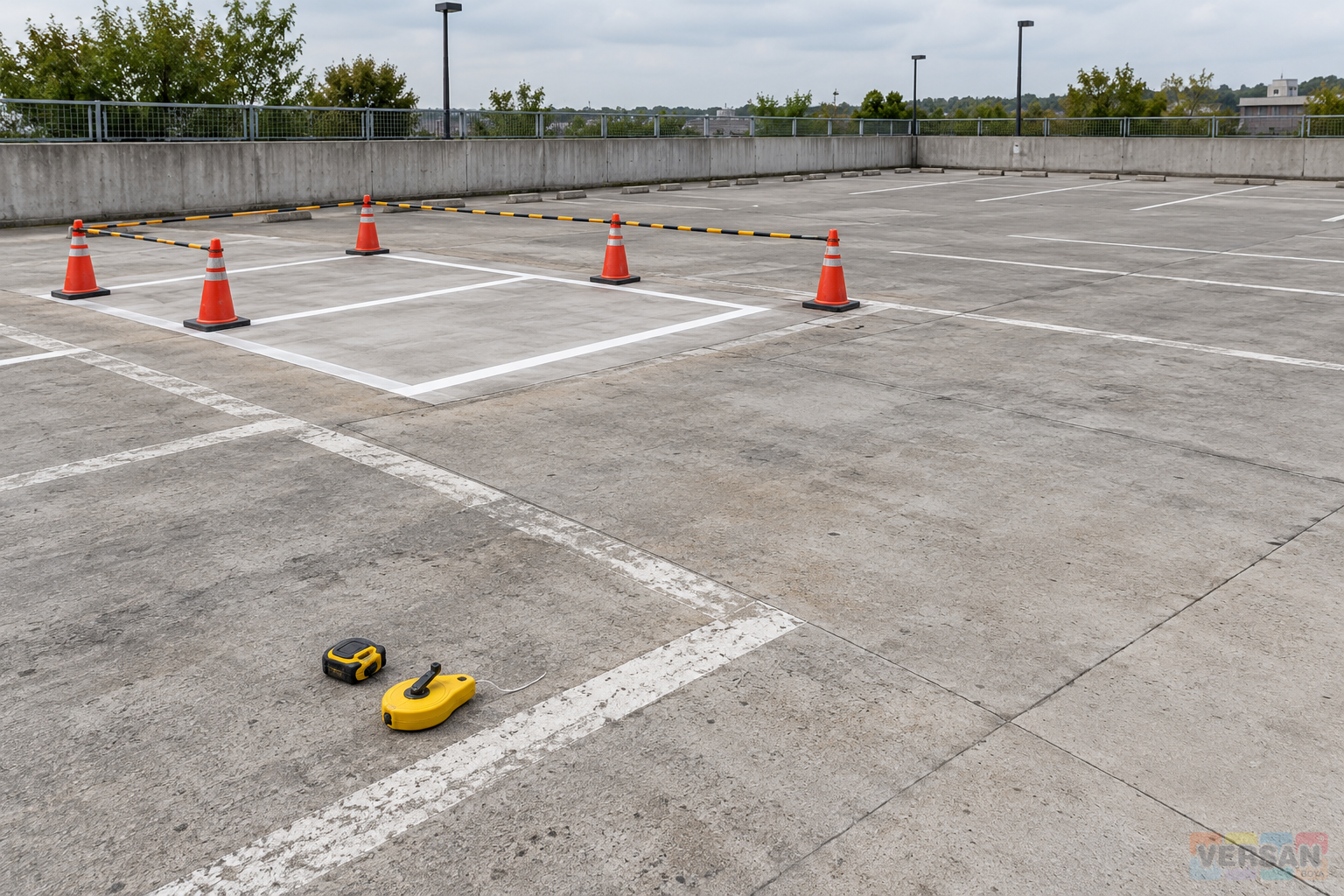
A parking line renewal quotation can look simple when it is reduced to a paint price and a length of white line. In practice, two offers for the same car park may describe substantially different work. One contractor may assume that the existing markings remain sound, that all vehicles will be removed together and that the area can stay closed until release. Another may include removal, local repairs and several separate visits. Comparing the headline totals without comparing those assumptions can therefore produce a misleading purchasing decision.
This guide connects the selection of road marking paint with survey information, preparation and work phasing. It does not provide a current selling price, a universal spreading rate or a guaranteed reopening time. The quantities and sequence examples are hypothetical planning tools, rather than records of an actual customer project. Use the earlier guide to measuring lines, symbols and painted areas for the geometry, then use the following framework to establish what a complete renewal quotation should actually include.
1. Start with an agreed scope drawing
Prepare one drawing that distinguishes markings to retain, markings to renew, markings to remove and new markings to introduce. Parking bay boundaries, directional arrows, pedestrian connections and special-use areas should have separate identifiers. Repainting a line in its current position is a different task from changing a parking layout. If the layout is changing, identify who has authority to approve it before obtaining a final quotation. The painting team should not be expected to resolve circulation design decisions informally while application is already taking place.
Give the drawing a date and revision number, and attach it to each request for quotation. If an instruction changes, the revised drawing should show what changed rather than leaving several contradictory copies in circulation. Old markings can remain confusing even after new ones are added nearby. Their removal or treatment must therefore be an explicit work item. Do not assume that covering an old line with a dark coating will make it permanently invisible on every substrate. A representative trial can help assess the proposed appearance, without replacing any required project approval.
2. Separate linear metres, painted area and item counts
A line length becomes a geometrical painted area only when its width is also known. A hypothetical group totalling one hundred metres at a width of ten centimetres occupies ten square metres for one complete geometrical coverage. That arithmetic says nothing about the required film thickness, number of applications, product consumption or losses. A quotation priced per linear metre should state the line width and the operations included. Otherwise, two apparently identical rates may refer to different amounts of work and cannot be compared reliably.
Symbols and lettering need their own measurement convention. The bounding rectangle of an arrow is not necessarily its actual painted area, while a unit rate may include a particular stencil size and setup operation. Kerb markings also differ from flat bay lines in both access and geometry. Align the commercial descriptions in the product range with the work items on the drawing. Keep net weight, net volume, line length and painted area in separate columns. A container weight alone does not establish how many metres of line can be completed.
3. Record the substrate and the existing coating separately
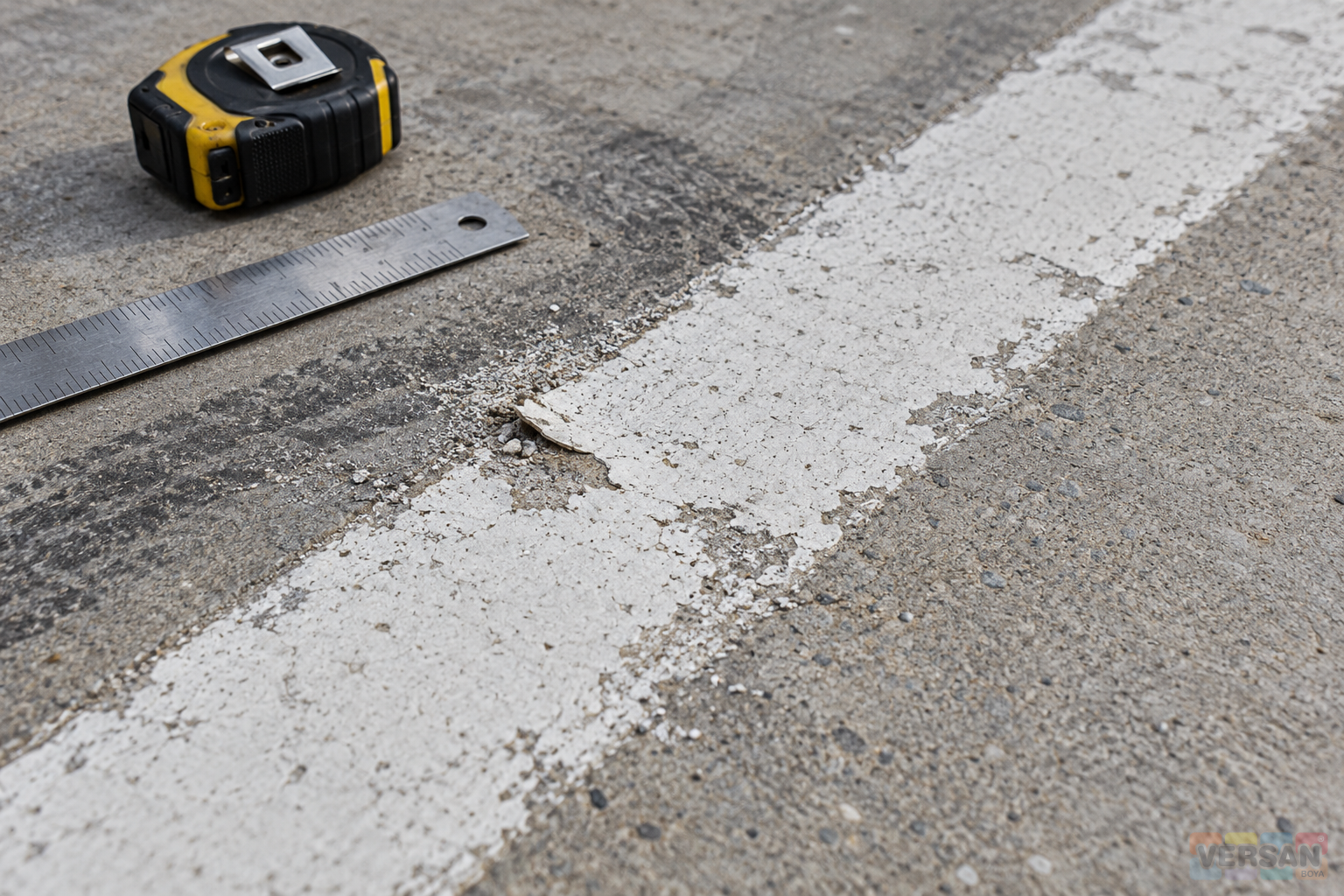
Asphalt, bare concrete, previously painted concrete and a resin-coated parking deck should not be treated as one interchangeable surface. Record what is physically present, including old marking layers, local patches, tyre deposits, oily areas and locations that retain water. A general photograph is useful for orientation but may conceal a small lifting edge or contamination beneath a parked vehicle. Give each detail photograph a location reference. Areas that cannot be inspected should remain identified as uninspected, rather than quietly being included in an assumption that all surfaces are sound.
Where the underlying floor is resin coated, ask for the existing coating identity and maintenance history. A deck finished with epoxy self-levelling paint presents a different evaluation problem from untreated concrete. Similar product names do not demonstrate intercoat compatibility. The published guide to adhesion and compatibility when renewing old markings explains the questions that should be resolved before selecting the new marking system. Specify where any trial will be placed, what it will assess and who will decide whether the proposed preparation is acceptable.
4. Describe preparation as actual operations
The phrase “surface preparation included” does not explain which activities have been priced. Dust removal, treatment of oily patches, removal of loose marking material and local substrate repairs can require different labour, equipment and access. Mark known defects on the survey drawing and describe the proposed treatment for each group. Establish a hold point at the end of preparation so that the surface is assessed before coating begins. If another contractor is preparing the deck, define how the handover between that contractor and the marking team will be recorded.
A surface that looks lighter after cleaning is not automatically ready for marking. Residues may have been redistributed, and a damp surface can remain unsuitable even when no standing water is visible. The cleaning process must leave a sound, clean and appropriately dry substrate for the selected system. It should also avoid damaging adjacent finishes, drains and equipment. Aggressive chemicals, uncontrolled abrasion or unsuitable pressure washing can create a new defect while removing an old one. The quotation should identify responsibility for collected debris, wash water and the final cleaning operation as well as the coating work.
5. Keep deck repairs distinct from line renewal
Renewing parking lines does not mean resurfacing the entire parking deck. If local patches or a wider floor repair are required, show the material, extent and programme implications as a separate scope. Options such as epoxy topcoat paint belong to a different system evaluation and should not be treated as direct substitutes for a marking product. A damaged substrate cannot be made sound simply by applying a thicker line over it. Reinspect repaired areas before the marking operation, because their condition may now differ from the original survey.
A primer should be selected for a documented substrate and intercoat need. Epoxy primer and polyurethane primer are technical comparison options, not a universal recipe for every car park. If a quotation proposes a specific primer, ask which condition it addresses and how its compatibility with the marking material has been confirmed. Buying both materials from one supplier is not, by itself, evidence that every possible combination is approved. Unresolved product questions should be visible before a quantity and price are finalised.
6. Base material quantities on verified consumption information
The archived Nanomix road marking entry contains historical coverage expressions that do not produce the same calculated quantity. Selecting one number without resolving its basis would create unjustified certainty. Obtain current information for the delivered product and establish the application thickness, substrate and method to which the consumption figure applies. A measured trial can support the site allowance, provided the trial represents the actual work. A small, smooth and easily accessible patch may not represent the losses or texture of a large, fragmented parking area with many short lines and repeated starts.
Show the marking material, any approved ancillary material and package rounding separately where useful. Explain the allowance for uncertainty rather than hiding it within an unexplained waste percentage. Selection from the thinner product group must follow the current instructions for the marking product. An epoxy thinner intended for another resin family should not be added merely because it is described as a thinner. Cleaning a machine and adjusting coating viscosity are different tasks, and their material requirements should not be confused in either the purchase list or application record.
7. Plan phases around circulation dependencies
Closing half a car park and leaving the other half open can sound straightforward. It fails if the only ramp, exit or delivery route is located inside the closed half. Develop phases with the person responsible for site operation, considering vehicle access, pedestrian routes, servicing and any required emergency arrangements. Establish a practical way to prevent uncontrolled entry to the work zone before marking begins. Identify who will notify users, when parked vehicles must be moved and how the operator will deal with vehicles that remain after the agreed clearance time.
Track each phase through area handover, preparation, application, the required waiting period and release. If another section cannot be accessed until the previous one reopens, make that dependency explicit. Night work is more than moving a daytime activity to a different clock time: lighting, equipment movement, communication and cleaning arrangements may all change. The parking marking work-plan article provides a complementary view of this sequence. If the number of phases changes, review setup, attendance and waiting costs instead of assuming that the original labour allowance remains valid.
8. Make quotation lines genuinely comparable
A useful quotation explains the circumstances under which its rates apply. Surveying, cleaning, removal, local repairs, marking, segregation and handover checks can be described individually even when some are priced together. State whether transport, equipment setup and time lost because the site is unavailable are included. Commercial details such as taxes, offer validity, supply arrangements and payment terms should be confirmed by the sales parties using current information. This guide does not set those conditions, and it does not turn an illustrative scope structure into a binding contract template.
Two offers based on the same drawing can still rely on different preparation assumptions. One may include removal of weak old lines, while the other assumes that all lines are sound. One may require a fully empty deck, while the other allows repeated small closures. Create a comparison sheet that places each assumption beside the corresponding work item. A low starting total may exclude an operation that will later be charged as a variation. The purchasing question is therefore which scope and evidence will deliver the agreed result, rather than which container has the lowest unit price.
9. Define the trial as a decision stage
A trial is not only a colour sample. It can help assess the effect of the proposed preparation, the edge quality of the marking and its relationship with the old surface. Locate it on the drawing and record the product, preparation, date and relevant site conditions. The waiting period and any inspection method must suit the product and project requirements. Assessing a sample before it has developed sufficiently can lead to a false favourable or unfavourable conclusion. Identify the person who will authorise progression from trial to the wider work before application is mobilised.
The RAL colour catalogue can support a colour discussion, while a screen display remains different from a physical sample. Expectations for night visibility, slip resistance or a particular service period should be documented separately. None can be established merely from a bright white or yellow appearance on the first day. If a performance requirement exists, the quotation should state the relevant evidence and assessment scope. An agreed visual sample becomes a comparison reference; it does not create an otherwise undefined guarantee about every aspect of marking performance.
10. Separate touch dryness from release to traffic
A marking that no longer feels tacky is not necessarily ready for wheels, turning movements or other operating loads. Release should follow the current product information and the actual applied layer and conditions. If an offer promises reopening on the same day, ask which assumptions support that promise and how a delay will be handled. Weather or substrate conditions can differ from the initial plan. The operator should not interpret the team leaving site as an automatic release certificate; there should be a clear handover message from the agreed responsible person.
At handover, inspect line positions, widths, general layout, missing symbols, overspray and the condition of protected adjacent surfaces. Mark outstanding corrections on the drawing rather than relying on memory. Record the products, quantities and relevant application observations, and agree how remaining labelled materials will be returned, retained or removed. That information can support later consideration of products in the industrial coatings group. A renewal file with an understandable history gives the next maintenance cycle a factual starting point instead of forcing the operator to reconstruct the previous work from photographs alone.
11. Turn survey limitations into explicit assumptions
A busy site may not be fully available during the quotation survey. Lines under vehicles, storage corners and surfaces covered by water should remain listed as inspection limitations. State how those areas have been treated commercially. If the offer covers renewal of visible sound markings, later discovery of extensive lifting should not silently be treated as an already agreed operation. A second inspection after clearance, or a joint check at the start of each phase, can close the information gap. This is more useful than pretending that an incomplete survey has removed all uncertainty.
A variation record should answer a few concrete questions: where is the change, what was found, how does it differ from the starting scope, what operation is proposed and how does it affect the programme? Consider access and phase changes as well as material cost. Repeated verbal instructions to add work make it harder to reconcile completed quantities later. A controlled drawing revision is therefore part of commercial clarity. Added symbols, wider lines or a section that must be closed again should all pass through the same understandable approval and recording process.
12. Send a complete technical enquiry
Before requesting an offer, assemble the substrate description, old marking condition, approximate painted area, symbol quantities and available working hours. Include both overall views and close details of problem areas, together with access restrictions and any known previous product information. Explain when measurements remain approximate. A preliminary area should not be presented as a confirmed purchase quantity. Once the system information and any representative trial have been reviewed, the material allowance and commercial offer can be refined together using the same scope drawing and the same set of assumptions.
A well-prepared request makes the work understandable to the operator, supplier and application team. It shows what preparation is expected, how access will be phased and what evidence will accompany handover. The coating choice remains connected to the substrate and operating conditions throughout that process. Product limitations come from appropriate technical information, while the planning examples provide a practical way to organise decisions. The final commitment should rest on an inspected surface, verified product requirements and an agreed scope, with unresolved items left visible until the responsible parties have actually resolved them.
- Nanomix catalogue archive, page 16: historical product information; current consumption and application approval must be confirmed separately.
- TxDOT Pavement Marking Handbook: surface preparation: general clean/dry substrate and existing-material compatibility principles; US specifications are not automatically applicable to a Turkish car park.