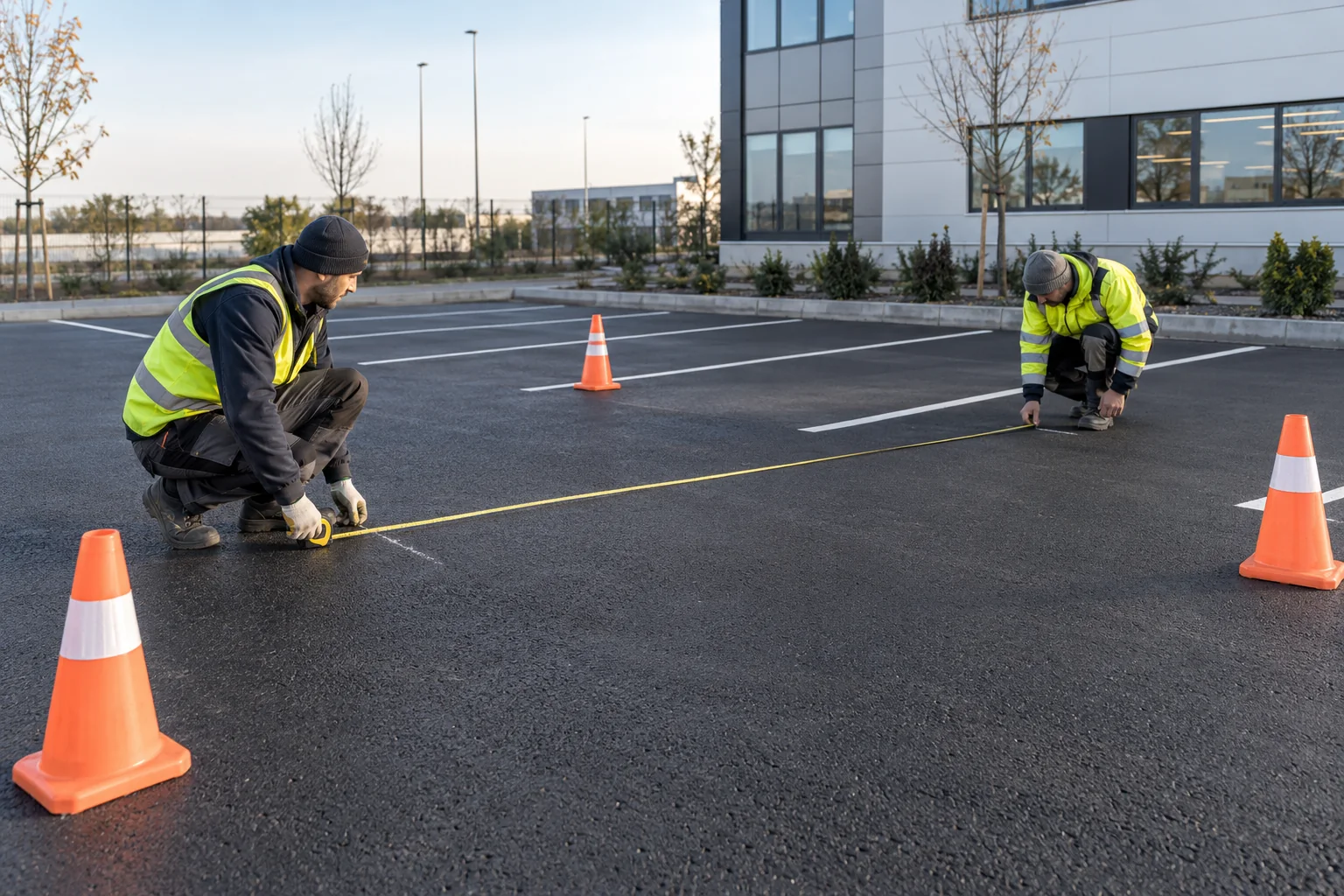
Neat parking lines are the visible result of a marking project, but much of the work takes place before a container is opened. Vehicle diversions, substrate identification, treatment of obsolete markings and the evidence required for reopening all need to be settled in advance. A clear plan prevents the application crew from arriving while basic survey questions remain unanswered. It also gives the operator a realistic view of lost parking capacity, visitor arrangements and maintenance time.
Selecting road marking paint is important, but the product name alone cannot establish suitability for an entire car park. Asphalt, concrete and existing resin floors require different assessments. This guide addresses the preparation of work in private commercial parking areas. Marking dimensions, accessibility arrangements, traffic design and any highway authority requirements must be established through the appropriate approved project. The calculation examples explain quantity planning; they are not an approval of a traffic layout or a universal application specification.
1. Define the scope and responsibility for closing the area
The number of parking spaces is not enough information for a quotation. Record whether the area is open or enclosed, its entrances and exits, delivery movements, pedestrian crossings, night use and permitted shutdown periods. Distinguish markings to be painted from those to be cleaned, removed or retained. The contractor should not discover an essential but excluded activity only after the work zone has been established.
Name the party responsible for barriers, changes to the closure and the final reopening decision. Security, maintenance and the application crew should work from the same plan. Closing one zone may displace vehicles into a pedestrian route elsewhere, so the alternative arrangement must be reviewed as a whole. Resolve visitor information and emergency access before application. HSE's workplace transport checklist offers useful questions about pedestrian routes, vehicle movement and markings. It is referenced as a planning resource, not as a replacement for the applicable Turkish project requirements or the competent designer's assessment of the actual site.
2. Divide the car park into identifiable substrate zones
A single car park may contain new asphalt, older asphalt, repaired concrete and coated ramps. Treating all of these as one surface weakens both the trial programme and the material estimate. Give each zone a reference on a simple plan and record its substrate, visible damage, existing markings and intensity of use. Identify drains, turning points, sheltered corners and shaded areas separately where they may affect the work.
Applying a line over an existing self-levelling epoxy floor is not the same operation as marking bare asphalt. Establish the coating identity, age and condition. A clear epoxy coating or another surface treatment may be present without an obvious colour change. Review maintenance records and assess compatibility through an appropriate trial. Do not assume that the marking paint will adhere equally to every resin finish. Recording an unknown treatment as ordinary concrete removes a useful warning from the job file; retaining the uncertainty allows the technical review to address it explicitly.
3. Separate substrate repairs from marking work
Line paint should not be treated as a repair material for loose aggregate, disintegrating concrete, moving cracks or standing water. Address these conditions through the relevant repair work before proceeding. When repairs are completed, confirm their compatibility with the proposed coating and the conditions under which they may be painted. A repaired patch can differ from the surrounding old surface in texture and absorption even when its colour appears similar.
Consider moisture retained after washing as well as visibly wet areas. Instead of assigning an arbitrary drying period, identify the requirements of the substrate and product. Where a repair or floor build-up includes an epoxy binder, marking cannot be scheduled independently of that system's acceptance conditions. If a more extensive concrete coating project is being considered, the guide to surveying existing concrete and selecting a trial area provides a useful starting point. Keep restoring the floor and adding traffic information to the floor as separate activities in the scope and programme.
4. Approve the layout before opening the paint
Following the old lines does not necessarily reproduce a suitable layout. Parking arrangements may have changed, an entrance may have moved or the vehicles using the facility may now be different. Check the approved setting-out points, alignments, turning areas and marking positions on site. Do not take generic line widths or parking bay dimensions from an unrelated example. The application crew should not be expected to resolve design decisions through improvisation.
After measuring and temporary setting out, walk the area with the operator's representative. Doorways, columns, charging spaces, accessible routes, loading points and emergency equipment may relate differently in the physical space than they appear on a drawing. Agree how obsolete markings will be removed or otherwise treated. Covering them with dark paint is not automatically a suitable permanent treatment for every substrate. Before production marking begins, confirm that retained and new signs will not provide conflicting directions. Save the approved layout with a revision reference so that any later change can be distinguished from an application error.
5. Calculate the painted area rather than the total car park area
Material estimates start with the area actually receiving paint. For a straight line, multiply its length by its width, using metres for both dimensions. As a calculation example only, 600 metres of line at a width of 0.10 metre gives 60 square metres of painted area. The example width is not a design recommendation. Calculate arrows, hatched zones, lettering and other symbols separately and add them to the appropriate item in the schedule.
Next apply verified consumption information, the required coat arrangement and justified site allowances. The Versan road marking catalogue archive contains 5 m²/kg in its Turkish section and 500 g/m² in its English section. These are not equivalent: 5 m²/kg corresponds mathematically to 200 g/m². Selecting one without clarification would produce an unreliable order quantity. Request current technical information and compare it with a representative application record. State the assumption used in a provisional quotation. Show packaging rounding and unopened reserve separately so that the customer can distinguish actual expected consumption from stock retained to manage practical site conditions.
6. Make the trial representative of the intended application
A trial area evaluates the surface preparation and paint together. Record the equipment, proposed line width, coating sequence and product batch. White opacity alone is insufficient: examine the edge, the condition of the film, its relationship with the existing surface and any effect on an underlying coating. Decide during the survey whether materially different substrate zones require separate trials rather than extending one favourable result across the whole facility.
When considering Nanomix Road Marking Paint, request current application guidance alongside the archived document. A successful application elsewhere does not approve this surface. Define when the trial will be assessed and what findings will prevent acceptance. Do not introduce vehicles early simply to improvise a test of the fresh marking. Use the method agreed by the responsible technical party. Retain photographs, the location reference and preparation records for the approved trial. They become a useful comparison during production and help distinguish a change in workmanship from a change in the underlying surface.

7. Manage surface cleaning and equipment cleaning separately
Assess tyre residues, oil, dust and previous maintenance products before application. Select cleaning methods for the actual contamination and substrate. Wiping that spreads oil over a wider area or rinsing that leaves cleaning agent behind does not constitute completed preparation. Once cleaned, a zone should not be casually returned to vehicle traffic, because that can recreate the contamination. Align cleaning and painting with the closure sequence.
Selection within the thinners and auxiliaries range should not be based on an assumption that one solvent suits every coating. A specified application thinner and an equipment cleaner can serve different purposes. Even when a cleaning thinner is appropriate for equipment maintenance, that does not authorise pouring it onto the pavement or using it as a universal treatment for oil-contaminated ground. Plan use and waste handling from the safety data sheet and site arrangements. The article on choosing the correct paint thinner explains this distinction further. Check the labels of auxiliary materials delivered to site against the approved application record.
8. Assess weather and enclosed-space conditions explicitly
Rain, wind, pavement temperature and overnight moisture can affect an outdoor programme. Air exchange and neighbouring activities require attention in enclosed parking areas. A weather forecast supports planning but cannot replace measurements at the surface. Sunlit asphalt and a shaded ramp can present different conditions at the same time. Specify where readings will be taken and when they should be repeated during the work.
For a solvent-based coating in an enclosed area, ventilation, ignition-source control and worker protection must follow the safety data sheet and site risk assessment. This article does not prescribe a generic fan capacity or a universally safe waiting period. More air movement also does not automatically establish earlier readiness for traffic. Historical application references in the archive, particularly those involving heated equipment, should not be treated as permission to improvise such a process. Obtain current technical and safety confirmation. The application supervisor needs clear authority to stop work when the approved conditions are not met; pressure to recover the programme should not remove those checks.
9. Apply the markings in manageable, traceable zones
After the trial has been approved, organise work by sections that the operator can isolate and manage. Mark the preparation, application and inspection status of each section on the plan. Activities should not contaminate one another, and equipment routes should avoid completed markings. Define masking and removal arrangements for the selected process rather than leaving them to be resolved when the coating is already applied.
Recording consumption by zone makes unexpected differences easier to investigate. They may reflect quantity errors, equipment settings or changes in texture and absorption. Higher consumption should not automatically be described as better performance; compare it with the specified application arrangement. Follow the current instructions for intervals between coats and check for renewed contamination when work pauses. Record overspray, irregular edges or incomplete coverage at the zone handover. Finding these issues only when the entire facility is about to reopen makes correction more disruptive. The same zone records can later help the operator identify where maintenance effort should be concentrated.
10. Keep associated painting work technically separate
Parking refurbishment may include barriers, railings, protective steel posts, walls and ceilings. These should not be grouped under a single marking-paint specification. Select an appropriate industrial coating system for metalwork independently of the pavement markings. For example, a quick-drying industrial primer and quick-drying industrial paint can only be considered for the relevant metal component after its substrate and system requirements are confirmed. These links do not identify alternatives for painting lines on asphalt.
Similarly, a gloss polyurethane topcoat proposed for protective metalwork requires its own primer and exposure assessment. Walls and ceilings belong to the appropriate architectural coatings specification. Sequence overhead and adjacent work so that dust and paint droplets do not contaminate new markings. Separate material and equipment lists help prevent the wrong container reaching the wrong activity. Sharing the same refurbishment budget does not make these surfaces one technical application, and approval for a railing system should never be taken as approval for a floor marking.
11. Do not use touch dryness as permission to reopen
A line that no longer feels tacky is not necessarily ready for tyre loading, steering movements or cleaning equipment. Touch-dry, dust-free and hard-dry headings in an archive describe different observations. None should be converted into a universal traffic release time for every substrate. Assess the current product instruction, the actual conditions and the acceptance method agreed by the responsible technical party.
Record the zone reference, application completion time, inspection time, conditions and person making the release decision. Barrier removal and vehicle directions should follow the same instruction. A guard moving cones because a line looks dry is not equivalent to technical acceptance. If the underlying resin floor has also been renewed, its readiness matters alongside that of the marking. The guide to epoxy floor moisture, loads and commissioning explains the broader handover considerations. Where only part of the car park is reopened, make the boundary understandable to visitors as well as to the maintenance team.
12. Combine visual acceptance with a complete handover record
Photographs are useful but should not be the whole acceptance process. Compare the completed markings with the approved layout and examine continuity, edges, coverage and the treatment of obsolete signs. Where the specification requires other performance or slip-related assessments, use competent personnel and the defined methods. Do not claim that an unmeasured property has been achieved merely because the lines look white, straight and consistent.
The handover file should include products and batches, measured quantities, trial approval, application dates, environmental records, zone release permissions and corrective work notes. If part of the work remains incomplete, do not describe the entire project as finished. Photographs taken from consistent directions and labelled with zone references support later comparisons. Give the operator concise maintenance information covering initial restrictions and the manufacturer's recommended cleaning approach. Avoid adding unsupported service-life promises or guarantees expressed as a fixed number of vehicle movements. A carefully documented result is more useful than a confident claim that the available evidence cannot substantiate.
13. Plan maintenance around use as well as dates
Markings at entrances, tight turns, loading points and frequently braked areas may not age like those in lightly used parking bays. Record wear location, contamination, substrate damage and cleaning practices together. Before simply repainting a faded area, consider whether the conditions that produced the change remain present. Repeated local deterioration may justify different preparation or an operational change rather than another identical application.
Share previous records when obtaining a maintenance quotation so that quantities and preparation are assessed on evidence. Reusing the same product does not eliminate the need to inspect the old surface. When enquiring through the road marking paint product information, include substrate or coating identity, photographs, previous application dates and the type of traffic. This connects the material enquiry to the preparation and shutdown plan instead of reducing it to container count. Maintenance does not necessarily require every bay to be renewed together, but the safe distinction between available and closed areas must be re-established for each phase.
14. Resolve the final questions before issuing the work order
Can the work be finished in one day? A drying figure alone cannot answer this. Survey, cleaning, repairs, drying, setting out, trials, application and acceptance all contribute to the programme. Plan the operational interruption around the complete sequence. Resolve unidentified substrates or missing technical information before committing to a completion time.
How many kilograms should be ordered? Establish the painted area, current verified consumption, coat arrangement and site conditions first. Clarify the inconsistent archived coverage statements and compare the agreed basis with representative application records. Show packaging rounding and unopened reserve explicitly rather than hiding both inside a single consumption figure.
The lines look dry; can vehicles return? Visual appearance is not release authority. The specified conditions for both the marking and any underlying system must be met, and the responsible person should approve each zone. A well-executed project combines suitable materials and preparation with an orderly handover at the right time. It leaves the operator with a readable layout, a clear record of what was applied and enough information to organise future maintenance without repeating the original uncertainties.
- Versan/Nanomix road marking catalogue archive, page 16: substrate descriptions, drying headings and inconsistent Turkish/English coverage information; current application guidance must be requested.
- HSE: Site layout and internal traffic routes: workplace traffic and marking review questions; not presented as a binding Turkish design standard.