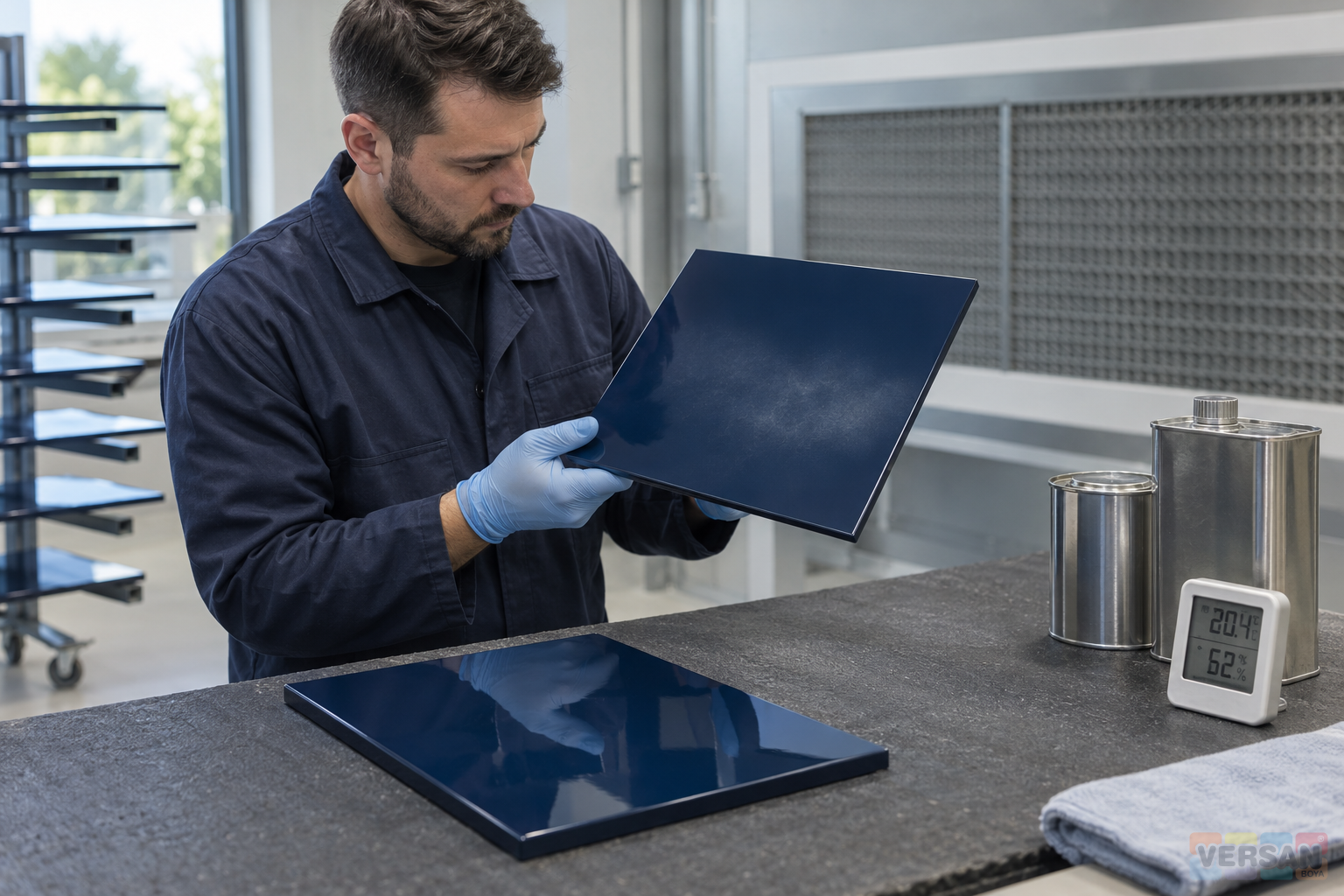
A cloudy patch on nitrocellulose paint often prompts an immediate response: add thinner, adjust the spray gun or apply another coat. None of those actions identifies what happened. A useful investigation begins by separating the visible symptom from the proposed cause. A milky haze, reduced gloss and a rough sprayed texture may look similar in a telephone photograph, yet they require different questions. Record the first appearance, the affected areas and the difference from an accepted sample before changing the process.
This article provides an investigation framework for products such as Nanomix Gloss Nitrocellulose Paint. It does not replace the current technical data sheet, safety data sheet or written product-specific repair advice. The exact material, substrate, coating sequence and application method must be identified together. A family name alone cannot establish a thinning ratio, environmental limit or universal repair method.
1. Describe haze, gloss loss and texture separately
Blushing can present as a pale, cloudy appearance within a coloured or clear coating. Gloss loss describes a change in reflection and does not necessarily involve a white cloud. A visibly rough surface, dust contamination or a dry-looking spray pattern is another observation. Agree on those descriptions before opening the investigation. If production, inspection and purchasing use the same word for different defects, they may approve a material change that addresses the wrong problem.
Inspect the sample under consistent lighting and from a repeatable direction. Take both an overall view and a close photograph, with a sound reference panel in the same frame where practical. Automatic exposure can exaggerate differences between separate photographs. Record when each image was taken relative to application. An early wet reflection is not the same as the appearance accepted after the specified assessment period. Preserve the original sample rather than repeatedly wiping or recoating it while the investigation is still being defined.
A deliberately matt finish also needs its own reference. If the specified product is Matt Nitrocellulose Paint, compare it with the approved panel for that product. Do not treat a customer's photograph of a glossy surface as a gloss standard for an intentionally matt order. Distinguishing the intended finish from an unintended change prevents a defect investigation from becoming an undocumented redesign.
2. Identify the material and complete coating sequence
The investigation record should name the exact paint, colour, batch, container opening date and storage history. Add the thinner identity and the quantity used. Two containers supplied under the same colour reference can still have different preparation histories. A photograph of the original label is more reliable than a later recollection of the product name. Retain relevant material samples in suitable closed, correctly identified containers in accordance with the applicable instructions.
Describe the coating sequence from the substrate upwards: substrate preparation, primer, sanding, cleaning, waiting period and topcoat. Wood, MDF, an existing finish and prepared metal raise different questions. The presence of Nitrocellulose Primer in the sequence does not demonstrate that the preparation was suitable. The material match and the way the operation was performed must both be reviewed.
The Nanomix catalogue archive helps establish the product family and historical guidance. A document without a stated revision is not a substitute for the current instructions for the delivered batch. Confirm the relevant paint and thinner pairing before relying on an old workshop note. Historical mixing habits can be useful background, but an unrecorded successful job is not a controlled recipe for every subsequent order.
3. Establish when the change became visible
A haze observed during application should not be investigated exactly like a dull appearance first noticed the following day. If a panel initially looked acceptable, include its later storage, movement and contact conditions in the timeline. If the first part already showed the symptom, examine the initial preparation record. These are investigation leads, not proof of a particular cause. They help decide which information to retrieve before arranging a trial.
Record actual times for the first piece, intermediate inspection, new mix preparation, equipment cleaning, a break and the restart. Note changes in the working area alongside those events. Put an unaffected part next to the affected part in the production sequence. This can reveal a process change that would disappear in a single statement that the whole shift used the same paint. Avoid assigning precise times retrospectively when they were never recorded.
Do not confuse apparent touch dryness with readiness for every later operation. Premature intervention can obscure the original symptom or create a second defect. Keep an investigation sample and define its assessment time. The separate handling and storage decisions discussed in the furniture finishing line guide to drying and stacking can help structure that part of the record.
4. Measure conditions at the application location
Manufacturer guidance identifies moisture-related blushing in some nitrocellulose lacquer systems. That general explanation does not prove the cause of every pale patch in a workshop. Record air temperature, relative humidity and the condition of the part at the actual application location. Identify the instrument and the measurement position. A thermometer in an adjacent office cannot fully describe the conditions of a panel entering the finishing area.
Do not apply one morning reading to the entire working day. Note cold parts arriving from storage, nearby open doors, changing air movement and transfer into another drying area. Keep the reference sample close enough to provide a meaningful comparison. Obtain permissible conditions from the current product instructions; this article deliberately does not assign one numerical temperature or humidity limit to all nitrocellulose paints.
If conditions fall outside the approved process, adding an unspecified additive is not an environmental control plan. Agree the response with the responsible production and technical personnel. Ventilation has both application and safety functions. Reducing necessary extraction or introducing unsuitable heating equipment is not a valid appearance correction. Follow the safety data sheet and the requirements for the actual working area throughout the investigation.
5. Control thinner identity and dosage
Nitrocellulose Thinner is part of application preparation, rather than merely a convenient cleaning liquid. A solvent used to clean equipment is not automatically suitable for addition to paint. Products carrying similar family names are not universally interchangeable. Establish the exact material, the dose and the measurement basis before testing a different thinner.
Keep mass and volume distinct. The record should show how the paint quantity was measured, when the thinner was added and how the mixture was homogenised. A small successful trial is difficult to reproduce if its preparation was never measured. The guide to matching thinner with the coating system explains why the manufacturer's specified pairing should be the starting point.
Some manufacturers offer retarders for particular lacquer applications, but that does not make them unrestricted replacements for normal thinner. Do not transfer another manufacturer's additive dose or repair instructions to a Nanomix product. Obtain written compatibility advice before changing the preparation. Adding more solvent after a defect appears can also make the original mixture impossible to reconstruct, weakening the evidence needed for a useful technical response.
6. Review equipment and the air supply separately
Record the spray equipment, nozzle, application pattern and relevant settings alongside the material preparation. Use the equipment and coating instructions to establish the approved setup. A finish difference beginning at one edge should prompt a review of access, travel direction and application movement before it is attributed to the paint batch. Mark the affected area on the part photograph so the application sequence can be compared with the visible symptom.
Review maintenance records for the air supply and relevant filtration. If water, oil or residue from a previous material is suspected, have the responsible personnel verify the system. Repainting one part is not evidence that the air supply is sound. Equipment verification and coating trials are separate activities. Identify what was previously used in the cup, hose and gun rather than assuming the equipment was dedicated to the current product.
Consider Cleaning Thinner within an approved equipment cleaning procedure; do not introduce recovered cleaning liquid into a fresh paint mix. Define how the changeover to the next product is checked. If the cleaning material or sequence changed during the shift, record it as a distinct variable. Altering the paint formulation while equipment cleanliness remains uncertain confuses two different lines of investigation.
7. Include substrate and intercoat preparation
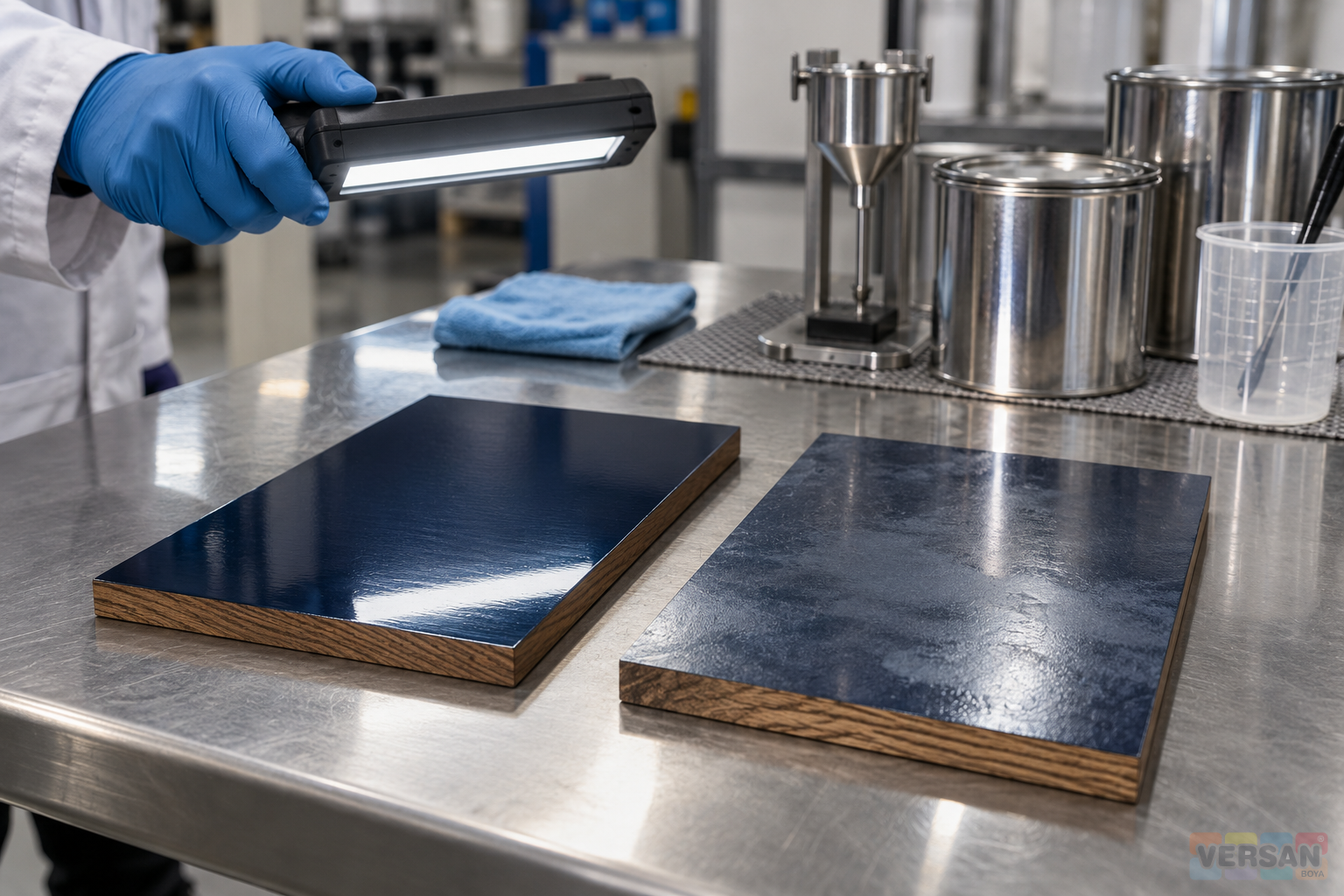
Broad faces, edges and repaired areas can have different preparation histories even when the parts look identical before coating. Review sanding, dust removal and the wait after priming. The options within Wood and Furniture Coatings perform different tasks; primer, coloured topcoat and clear varnish should not be treated as a single interchangeable material.
A useful reference panel should have the same substrate and coating sequence as the part under investigation. A good result on a metal coupon cannot validate an MDF edge preparation. Include local filler work, edge treatment and earlier touch-up areas in the record. The MDF primer, sanding and edge preparation guide provides related questions for comparing those surfaces.
If the identity of an existing finish is unknown, record that uncertainty. Random solvent wiping or using a more aggressive thinner does not replace a compatibility assessment. Establish the manufacturer-supported trial and preparation before applying a new operation. A cloudy topcoat and a disturbed underlying layer may be observed together; keep appearance and layer soundness as separate assessment headings. A visually improved surface should not automatically close both questions.
8. Define gloss through an accepted physical sample
Semi-Matt Nitrocellulose Paint and a gloss topcoat have different intended appearances. Preserve the accepted physical sample with its material identity and inspection conditions. Correct colour does not automatically mean correct finish. Purchasing and production should agree which appearance was specified, especially when different sheens can be supplied under a similar colour reference.
If gloss is measured, define the suitable method, measurement angle and locations in advance. Results taken with different arrangements should not be combined as though they were equivalent. A visual comparison is useful, but it should not be presented as an instrument test. Record local texture and appearance alongside any numerical result. An average can conceal a small cloudy area that matters to the customer's acceptance decision.
When Nitrocellulose Varnish is used as a clear finish, the underlying colour and pattern contribute to its appearance. Do not transfer an opaque paint reference directly to that assessment. Compare the sample in the agreed lighting and normal viewing direction. Making every surface glossier without checking the intended finish may change the approved design rather than correct the investigated defect.
9. Change one variable in a documented trial
The first trial should reproduce the existing approved preparation with complete material, substrate, environment and application records. Then assess one technically supported change on a separately identified panel. If thinner, spray settings, applied quantity and drying location all change together, even an improved result cannot explain which change was responsible. A controlled comparison is more useful than a collection of successful but unrelated sample panels.
Identify each panel physically and in the file. Keep preparation information, initial appearance, assessment time and the final decision separate. Use consistent photographs and retain the panels for comparison. A trial result relates to the tested product, substrate and conditions; it does not automatically approve every material entering the next shift. Define what will be checked again when the process moves from a coupon to a production component.
Nitrocellulose Paint Binder is a formulation-related material, not a general workshop additive for repairing a finished paint. Evaluate it only within an approved recipe and technical process. The purpose of the trial is to establish the behaviour of a defined system, not to invent an unrecorded mixture. Keep the technical reason and authorisation for each preparation change in the investigation file.
10. Set the repair boundary before treating production
Before reworking a cloudy surface, identify the finish and establish the condition of the existing layers. Sanding, recoating or another manufacturer-supported operation should be assessed on a suitable small trial. An attractive initial appearance alone does not demonstrate a complete repair. Check colour, gloss, texture and readiness for the intended subsequent operation together, using the agreed acceptance conditions.
List the affected parts, held parts, inspected areas and chosen method. Keep the distinction between sound and defective samples visible. If a repair trial introduces another defect, do not extend it across the entire batch while the result remains unresolved. A documented boundary also helps purchasing and planning understand why a partial repair might require further evaluation rather than an immediate dispatch decision.
Gloss Acrylic Varnish belongs to a different system option and is not a universal repair coat for an existing nitrocellulose finish. Changing the product family requires its own compatibility and service assessment. Consider the old layers, preparation and accepted appearance alongside material cost. Select the operation from the verified coating sequence, not from a promising product name.
11. Define a clear return-to-production check
When the trial is accepted, update the working instruction so everyone follows the same preparation. Include material identity, measurement basis, environmental checks, first-part inspection and the response if the symptom returns. Avoid using an old verbal recipe alongside a new written instruction. The operator, quality reviewer and technical contact should work from the same approved record.
The first production part still needs assessment. Its geometry, surface area and application access may differ from the coupon. Define further check points when a new mix is prepared or working conditions change. The frequency should follow the actual process and its risks; this article does not prescribe a universal number of pieces or minutes between inspections. Record the result rather than treating the absence of a complaint as evidence of acceptance.
If alternatives such as Gloss Polyurethane Varnish are considered, review their components and preparation independently. Do not carry the usual nitrocellulose thinner into another system. A family change does not close the original investigation by itself. Technical suitability, the appearance reference and a production trial should establish the new process before it is adopted.
12. Send a file that supports a technical decision
Provide overall and close photographs of the same part, original material labels, measured quantities, coating sequence and the actual event timeline. Include an unaffected reference. A single cloudy-surface photograph cannot establish which thinner was used or when the symptom began. Identify missing information honestly, and do not convert an operator's estimate into a measured value.
The Thinners and Auxiliaries listing helps locate candidate materials, while the Product Range shows the wider system options. Similar names do not establish identical functions. State the requested decision clearly: thinner compatibility, trial design, repair assessment and a replacement system are different technical questions.
The completed file should retain the first observation, the change actually verified, the accepted panel, the acceptance conditions and the production release decision. If the cause remains uncertain, describe what was investigated and what was demonstrated rather than claiming a definitive diagnosis. That approach turns a dispute over whiteness or dullness into a traceable process decision that the workshop can repeat and review.
13. Limit conclusions when the original record is incomplete
Consider a hypothetical workshop where morning panels look acceptable and panels made after a break look cloudy. Both groups used the same paint, but the thinner quantity in the second mix was not measured. Before replacing the paint batch, investigate the missing preparation information and conditions after the restart. Preserve one sound panel and one affected panel. Do not calculate the missing quantity from the operator's usual habit and then report it as a known measured value.
The first technically supported trial might be a new reference panel with fully recorded preparation. Its result does not establish which mistake occurred in the unrecorded second mix; it demonstrates how the documented process behaved under the trial conditions. Interpret subsequent comparisons with the same discipline. Keep demonstrated results, investigated possibilities and unknown information separate. Production pressure can require a prompt decision, but it does not justify adding measurements that never occurred or trials that were never performed.
Technical sources and their limits
The Nanomix documents below are catalogue archives, not replacements for current technical and safety data sheets. Independent manufacturer sources support general explanations of moisture-related haze and thinner control. Their product doses and proprietary repair procedures have not been transferred to Nanomix materials. Application and rework decisions require the verified instructions for the delivered product.
- Nanomix nitrocellulose topcoats — catalogue archive, page 27
- Nanomix thinners — catalogue archive, page 42
- Mohawk: moisture-related cloudiness in lacquer finishes
- Sherwin-Williams: product scope of a nitrocellulose lacquer retarder
- Rust-Oleum: following the coating manufacturer's thinner instructions