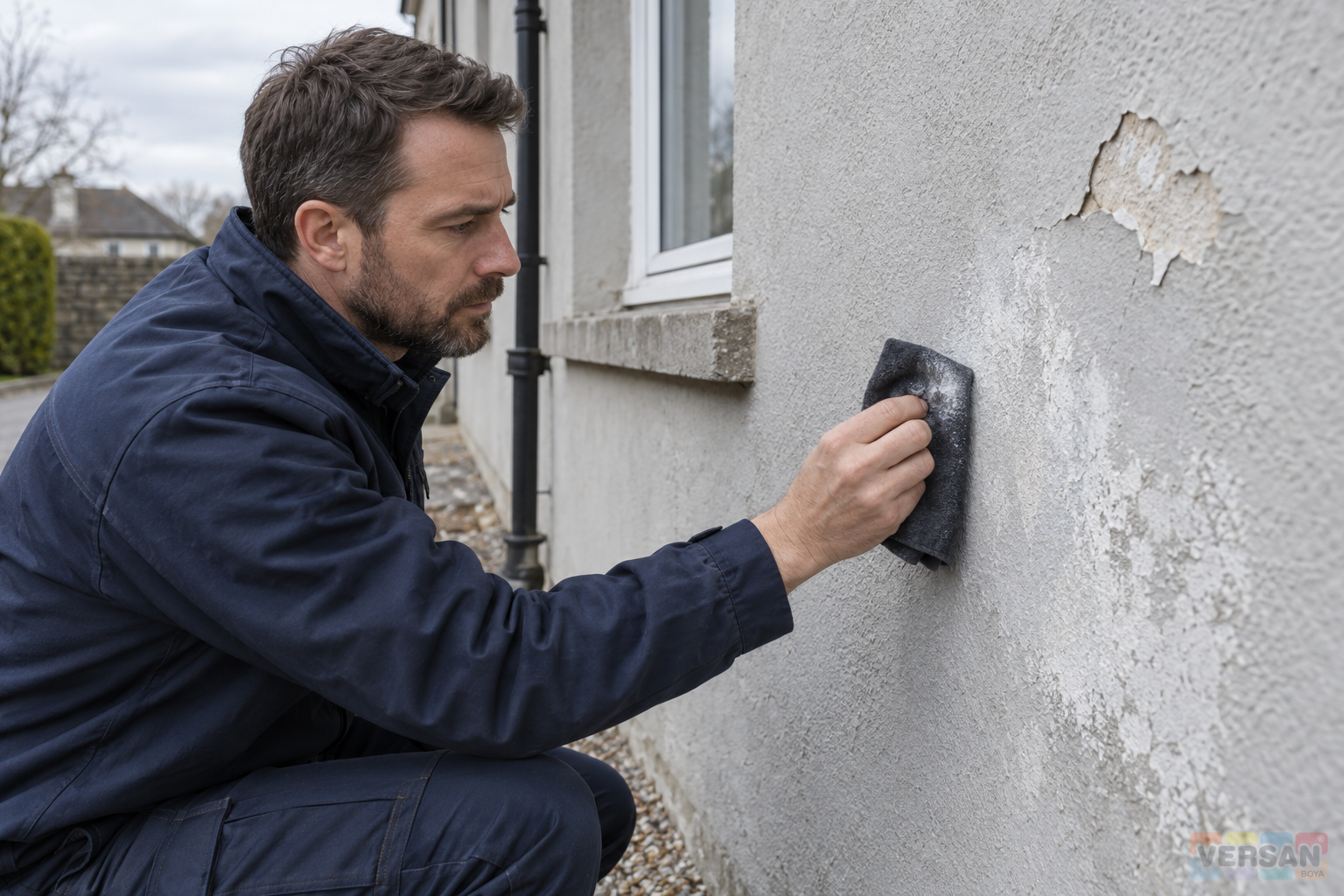
When exterior paint looks faded, leaves powder on a hand or forms raised patches, applying one preparation method to the entire building is rarely a sound starting assumption. Powder transfer, deposited dirt, chalking and mineral deposits are different observations. Blistering involves a local lifting of the coating from the underlying surface. These conditions can occur together, so the repainting scope should follow their distribution and the condition of the existing layers.
This guide explains what to record before selecting materials from Architectural Coating Systems. It does not diagnose a moisture source or product failure from a photograph. Facade inspection, a suitable cleaning trial and assessment of the old coating should work together. Verify substrate, environmental, primer and application requirements against the current instructions for the actual product to be delivered.
1. Describe powdering and blistering separately
Chalking describes a fine powder developing on a weathered exterior paint film. Blistering describes local lifting and separation from the underlying surface. Powder transferred to a dark cloth is useful investigation evidence, but it does not establish that every particle originated in the coating. Deposited street dirt, nearby construction dust and the mineral substrate should also be considered when describing the observation.
Mark powder transfer, peeling, raised patches, cracks and colour changes separately on the photographs. Record each area both close up and in its position on the building. A close photograph alone cannot show whether the symptom is below a sill, beside a rainwater pipe or across a broad exposed elevation. Location helps define the next inspection step and can be as important as the surface appearance itself.
The first record is an observation map, not a final diagnosis. Avoid naming a paint defect, water leak or unsuitable primer as the confirmed cause before it has been investigated. Describe what is visible and what remains unresolved. This gives the cleaning team, applicator and technical adviser a common starting point. It also preserves the distinction between an initial impression and the evidence used for the final decision.
2. Divide the facade into meaningful areas
Different orientations, shaded walls, balcony undersides, window surrounds and roof details do not necessarily experience the same conditions. Identify each elevation and the relevant local details. Show the symptom distribution and coating condition on the same map so sound and affected areas can be compared. A photograph of one wall does not approve the same renewal method for every side of the building.
Try to establish the old paint identity, age, previous repairs and recent maintenance. Where information is unavailable, mark it as unknown rather than adopting a guessed material name. Small repairs made at different times can create different layer sequences within one elevation. The survey should identify the mineral substrate and existing finish together. Include places where access prevented inspection, because an uninspected area is not an area confirmed to be sound.
The existing guide to exterior coating selection by moisture, climate and substrate covers the wider system decision. The focus here is the separation of visible conditions before renewal. Using the same paint family on two walls does not establish that their preparation should be identical. The condition found during inspection can change both the scope and the sequence.
3. Review moisture indicators alongside building details
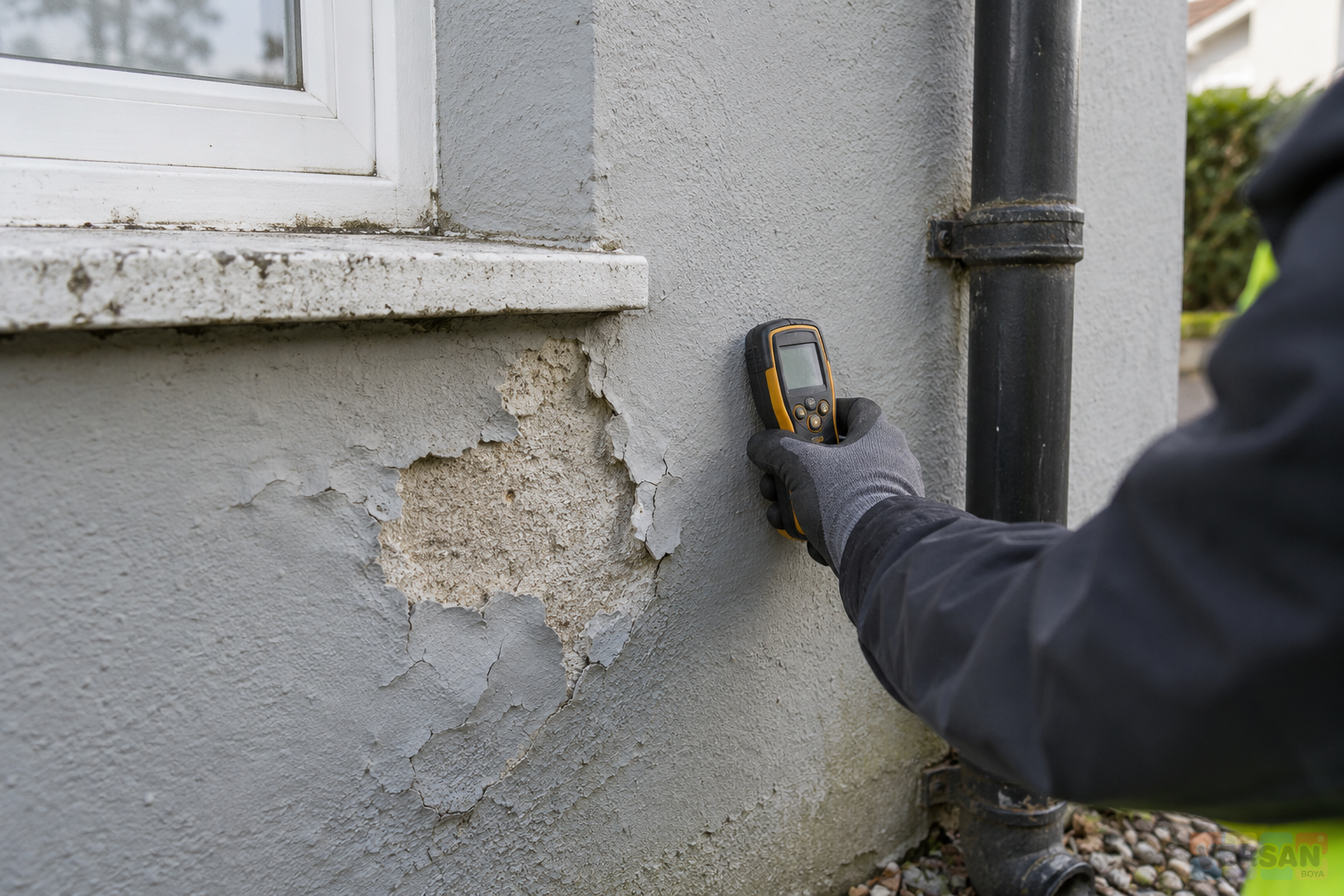
If blistering is near a sill, joint, parapet, roof junction or rainwater pipe, include that detail in the inspection record. A blister does not identify where water came from. External wetting, another building issue and conditions during the original application are separate possibilities to investigate. Where a building detail needs specialist assessment, include that work in the renewal plan rather than assigning the entire problem to the paint selection.
A single handheld moisture meter reading should not be described as the definitive moisture percentage of the whole wall. Record the instrument method, substrate, measurement location and relevant weather history. Comparing affected and adjacent areas with the same device can support an investigation, but the reading does not locate a water source by itself. State the purpose and limitations of the measurement instead of attaching unsupported certainty to the displayed number.
Covering a raised patch before investigating the moisture question can change the appearance without resolving the reason for the failure. Separate building-detail repairs from coating work in the scope. Paint should not be presented as a universal repair for a defective junction. Identify which detail will be corrected, who will check it and what must be confirmed before coating begins.
4. Test cleaning on a documented small area
Select a suitable trial area to assess how deposited dirt or surface powder can be removed. Record the initial condition, equipment and method. A wet surface appearing darker immediately after cleaning is not proof that chalk residue has been completely removed. Reassess when the surface is in an appropriate condition for inspection. Use photographs of the same marked area before and after the operation rather than comparing unrelated parts of the wall.
The cleaning method should suit the existing finish and substrate. Avoid treating a single pressure or chemical recipe as suitable for every facade. Consider damage to sound paint, fragile render, adjacent finishes and building details. Cleaning belongs in the planned scope, including how its result will be checked. A hurried wash should not disappear from the record simply because painting is the more visible part of the project.
When considering Matt Acrylic Exterior Paint, include the prepared substrate requirements in the product decision. Applying extra coats over unremoved powder is not a substitute for preparation. Accept the cleaning trial before selecting the next operation. A colour improvement by itself is insufficient to demonstrate that the surface is suitable for the proposed primer and topcoat.
5. Distinguish residue from unsound coating layers
An old coating may remain sound after cleaning, while another area may detach with an underlying layer. These areas should not automatically receive the same treatment. Record the level at which separation occurs and the condition of the material beneath it. Applying primer above a loose layer should not be assumed to remove that underlying separation. Assess the substrate's suitability for the new system independently of its cleaner appearance.
If a formal adhesion assessment is required, establish the method, area and acceptance criteria in advance. A hand observation or small scraping check must not be reported as a completed standard test. The observation can still inform the survey when its limits are clear. If the exposed render continues to break down, the issue is broader than topcoat appearance; substrate soundness and the repair scope need attention.
The guide to primer, filler and wall preparation provides related preparation questions. Products such as Transition Primer should be evaluated in an approved system, rather than treated as universal bridges over any weak old finish. Primer function and existing coating soundness are different assessment headings and should remain separate in the record.
6. Identify the exposed mineral substrate
Removing loose or blistered paint can expose a surface that requires a different preparation from the intact wall. Identify render, concrete, earlier repairs and the remaining coating edges separately. Dust, weak material and the old coating boundary matter to the new layer sequence as well as the finished appearance. Surface repair, preparation and decorative painting are distinct tasks, even when one contractor performs all of them.
Exterior Wall Filler is a candidate for an appropriate surface levelling operation. It is not an automatic solution for building movement or water entry. Confirm the repair material against the actual substrate and selected primer. Do not adopt a historical mixing instruction from an archive without checking the current delivered product. A local repair over old paint and work on a newly prepared surface should not be assumed to have identical requirements.
Exposed Concrete Primer has a specific preparation context. Its name does not make it necessary on every previously painted facade containing concrete. Match the product's intended use to the surface actually exposed and the subsequent coating. Recording substrate classes alongside area quantities makes it easier to prevent an unsuitable material generalisation during ordering and application.
7. Select primer from the verified substrate condition
Silicone Exterior Primer and Silicone Sealer Primer are different candidates for technical evaluation. A word such as silicone or sealer in the product name does not demonstrate that every moisture problem has been resolved. Determine the primer requirement from substrate soundness, absorbency, existing layers and the instructions for the chosen topcoat.
Write a preparation acceptance point before priming: has cleaning been accepted, have loose layers been addressed, are repairs ready and are the conditions suitable? Applying more primer cannot be assumed to compensate for an unresolved step. A small system trial may be required where the substrate remains uncertain. Assess primer and topcoat together in that trial; the fact that primer spread across the surface is not evidence of complete system suitability.
A wall combining repaired areas and intact old coating may retain preparation differences. Mark the operation performed in each area on the survey. Obtain application and dilution requirements from current product instructions. This guide does not assign a common dilution percentage or waiting time to every exterior primer. Its purpose is to connect the material decision with documented substrate information.
8. Match the topcoat to service and appearance requirements
Selection of Matt Silicone Exterior Paint should address more than hiding the old colour. State the substrate, existing coating, selected primer, texture and required finish. A product intended for exterior use is not automatically suitable for direct application to every unprepared wall. Technical suitability and the accepted appearance sample should be considered together.
A textured option such as Textured Silicone Exterior Paint can create a different finish from the existing coating. Concealing a minor visual irregularity is not the same as making an unsound substrate suitable. Do not describe texture as a shortcut over loose layers or an unresolved moisture source. Review the colour, texture and local repair boundary on the proposed trial area.
When reviewing entries for Silicone Exterior Paint, do not merge closely named products into one stock item. Match the exact code and source scope with the technical team. Moving one product's archival data into another product's application instruction can create an incorrect process. Ordering should identify the selected material rather than simply requesting exterior paint of a particular colour.
9. Plan the application and waiting conditions together
A repainting schedule should not depend solely on when the crew is available. Review the forecast, actual surface condition and product instructions together. A wall that appears suitable in the morning may later experience direct sun, changing wind or rain exposure. Plan the working order by elevation and detail. Approval of conditions on one wall should not automatically release work on the other sides of the building.
Cleaning, repairs, primer and topcoat introduce separate waiting and inspection points. Removing those points from the programme to accelerate the work does not establish readiness. Historical catalogue times refer to stated conditions and must be verified for the current product and actual wall. Readiness for another coat and readiness for later exposure are also distinct decisions. The crew should know which operation is being held and what evidence will release it.
Interior Emulsion Paint is not an exterior option merely because its colour or name resembles the specified material. A wish to use remaining stock does not remove the need to confirm the intended application. Exact material identity in the work instruction helps the crew detect the wrong container. Delivery from storage is therefore part of process control, not just a purchasing activity.
10. Assess the complete system on the trial area
The trial should represent the preparation and coating sequence, rather than consist only of a small colour spot. Record cleaning, necessary surface repair, selected primer and the proposed topcoat arrangement in the same area. If the trial crosses the boundary between affected and apparently sound existing paint, show that boundary in photographs. This gives the reviewer a clearer understanding of which renewal conditions were actually assessed.
Review the preparation result and layer condition alongside colour and texture. Define any instrument measurement or formal test and its acceptance limits before carrying it out. Do not describe a visual check as an unperformed durability test. Trial acceptance applies to the stated system and conditions; it is not a guarantee that the building can never develop another defect. Retain the evidence needed to explain the scope of the decision.
The Versan Boya Product Range helps compare materials for technical evaluation. If the accepted trial changes the proposed system, update preparation, primer and application instructions as well as the colour reference. Continuing with an older method can defeat the purpose of the new approval. Record the final selection in a form that purchasing, application and inspection can all use consistently.
11. Price preparation classes alongside area quantities
A single facade rate per square metre can hide major differences in preparation. Define cleaning, loose-coating removal, building-detail repairs, levelling, primer and topcoat as separate scope items where relevant. Not every operation is required in every area. A mapped scope helps resolve later variations because the parties can identify what was initially included, where it was included and what additional condition has been discovered.
Do not turn theoretical catalogue coverage directly into a guaranteed purchasing quantity. Substrate condition, texture, layer sequence and consumption observed in an appropriate trial should inform the plan. Read the stated unit carefully: kilograms and litres are different quantities. Where an archival translation or value differs, request current technical confirmation rather than choosing whichever number produces the preferred estimate.
For example, two elevations can require the same colour but different preparation work. This is a planning example, not a claim about a completed customer project. One wall may need a documented cleaning assessment while another also requires loose-layer removal and a detail repair. The quotation should make that distinction visible. The topcoat container price alone cannot describe the total cost of the renewal operation.
12. Connect the initial survey to the completion record
Keep more than a final photograph of the repainted building. Retain the symptom map, cleaning trial, moisture investigation, existing-layer assessment, repair record and approved system. Record the actual products and batches with the application dates. If a local issue appears later, the team should be able to retrieve the preparation history instead of guessing how the entire facade was treated.
Completion review should address appearance, the agreed scope and the process records together. An unresolved moisture question or unaccepted trial should remain visible rather than being hidden by a completed-work label. Identify the responsible people and outstanding decisions. Review colour consistency, local repair appearance and details under the conditions agreed with the customer. State where inspection could not be completed rather than implying that all areas were verified.
Separating chalking from blistering is more than naming a defect. It establishes the order in which cleaning, substrate condition, moisture investigation and the new coating sequence should be assessed. The finished file should distinguish the cause actually demonstrated, information still missing and the system accepted. A useful renewal plan begins with the verified surface and continues through recorded application, rather than ending at a product name.
13. Avoid merging different symptoms into one repair instruction
In a hypothetical survey, suppose a south elevation shows widespread powder transfer while a north-facing window area has a local raised coating patch. Do not merge these observations into a single confirmed product failure. Investigate cleaning and remaining layer condition on the south wall, and assess the window detail and layer beneath the raised patch separately. The findings may eventually support the same system or different preparation scopes. Decide from the evidence for each area, rather than the similarity of the first photographs.
Keeping the areas separate in the quotation also makes uncertainty visible. If the building detail has not yet been assessed, identify the investigation needed instead of listing an unperformed repair as complete. Record primer and topcoat evaluation for the cleaned, sound area independently. This example is not a completed project or a guarantee. It illustrates how observations, investigation, repair and coating selection can be connected in an actionable file without implying that uninspected areas have already been approved.
Technical sources and scope
The Nanomix documents are existing catalogue archives and do not replace current technical or safety data sheets. Independent manufacturer sources support the general definitions of chalking and blistering. This guide does not claim that a building investigation or standard test has already been completed. Confirm product-specific ratios, times and system suitability using current documents before application.
- Nanomix silicone exterior products — catalogue archive, page 8
- Nanomix acrylic exterior and surface levelling products — catalogue archive, page 9
- Sherwin-Williams: exterior paint chalking
- Sherwin-Williams: blistering and moisture-related assessment
- Sherwin-Williams: weathering, chalking and film separation