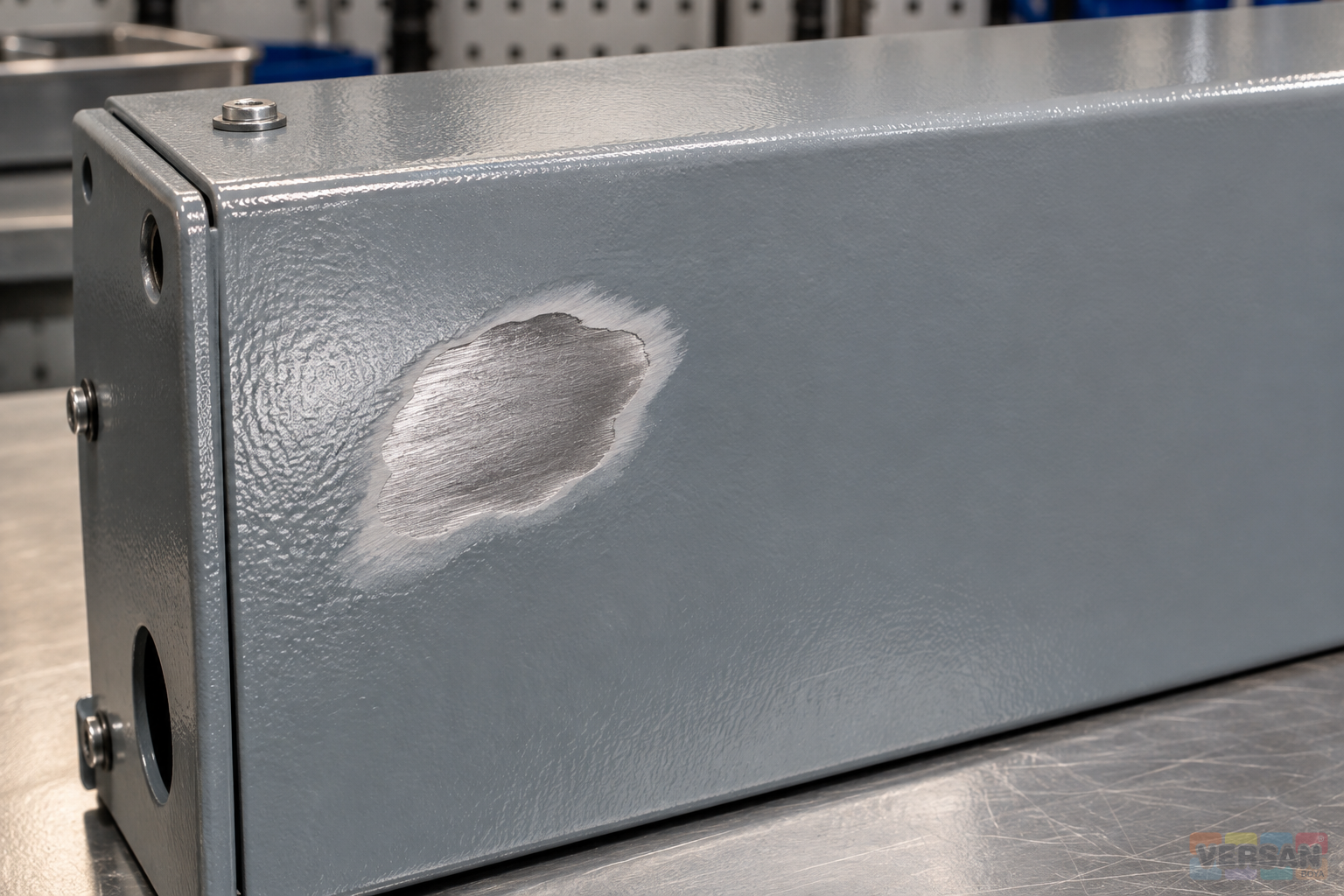
Start with the purpose of the repair
A scratch or chipped area in an epoxy-coated component does not immediately tell you which repair material to use. The first task is to establish what has been damaged, how far the damage extends and whether the surrounding coating can remain in service. Two marks of similar size may require quite different work. One might concern appearance, while another exposes the substrate and requires a review of the protective system. This article sets out an approach to planning local repairs, principally on coated metal components. It is not a universal repair specification for concrete floors, immersion equipment or specialised chemical service. Those situations require their own assessment of the substrate, coating system and operating conditions.
Write the objective into the work order before selecting materials. Is the task to restore continuity of protection, address transport damage, or recover an agreed appearance? These objectives may overlap, but they should not be treated as interchangeable. Selection of an epoxy topcoat must be considered alongside the existing layers and the intended service. Matching a colour reference is not evidence of technical compatibility. The applicator, purchaser and person accepting the finished work should understand the same objective. An explicit description at this stage helps prevent an unspoken expectation of an invisible repair becoming a new acceptance condition on delivery day. Keep the description specific enough to guide a decision.
Identify the existing system and the damage history
Give each repair an identity that remains meaningful after the job is finished. Record the component number, location, date of discovery and any known event associated with the damage. Take a wider photograph showing where the defect sits on the component as well as a close view of the affected area. Link available coating records, product codes, batch details and previous inspection documents to that identity. Where information is missing, mark it as unknown rather than reconstructing it from memory. A container found in a nearby store does not prove that its contents were used on the surface. Ask about previous maintenance because several generations of touch-up work may be present on the same component.
A broad product family is not a sufficient description of the existing finish. The industrial coatings range contains products intended for different roles and working conditions. Calling a surface epoxy-coated does not establish that any new epoxy product can be applied successfully over it. The record should identify the exact product and its current technical documentation wherever possible. An unknown existing surface may require technical investigation and a suitable trial before repeated repairs are authorised. The published guide to investigating epoxy coating adhesion loss provides a related starting point for organising observations. A practical repair plan should not be presented as a laboratory diagnosis of the underlying failure.
Look beyond the visible mark
Do not define the repair boundary only by drawing around a change in colour. Record the condition of coating edges, any surrounding lifting or blistering, and whether similar defects occur elsewhere. Describing an observation and identifying its cause are separate activities. An edge may be visibly lifting, but a photograph alone cannot establish that incorrect mixing caused it. The technical person responsible for the work should determine which examinations are appropriate, who is competent to perform them and how their results will be interpreted. Avoid uncontrolled tests that damage otherwise serviceable coating. If an agreed inspection method is destructive, include restoration of its test locations in the scope and distinguish those locations from the original damage.
Opening the first repair area may reveal a wider problem than expected. The applicator should neither leave weak coating in place merely to stay within an initial sketch nor extend the work across the entire component without an agreed decision. A useful work order provides a route for pausing, documenting the finding and obtaining a revised scope. Where the substrate layer needs renewal, an epoxy primer is considered as part of a verified system. Metal loss, cracking or another concern about component integrity must not be concealed as a cosmetic touch-up. Refer that concern for the appropriate engineering assessment, with a clear distinction between coating responsibilities and structural acceptance.
Define the transition into sound coating
The junction between a repair and retained coating deserves specific attention. Hempel's maintenance and repair surface-preparation guideline describes feathering sharp coating edges and preparing the overlap onto sound paint. It also calls for removal of remaining dust. These are general principles, not a complete prescription for a different manufacturer's product. Preparation method, required cleanliness and acceptance conditions must be taken from the approved system documentation. There is no single abrasive grade, overlap width or film thickness suitable for every local repair. Record the selected requirements in a form that the next person handling the component can understand. Inspection should identify what has been prepared and whether it has been released for the following operation.
A small sketch can distinguish the exposed centre, transition area and surrounding surface that must be protected. It can also identify machined faces, openings, labels and connections requiring masking. Consider nearby activities that could contaminate the prepared area and arrange the sequence accordingly. Specify cleaning materials through the approved procedure; the name epoxy thinner does not make a product an appropriate cleaner for every contaminant. The preparation record should describe the method used rather than rely solely on the final photograph. If work is interrupted between preparation and coating, the responsible person should decide what needs rechecking before release. This makes the handover understandable even when a different shift completes the repair.
Confirm the role of every repair material
The materials list for a local repair may be short, but each item still needs a defined role. The coating in contact with the substrate, any intermediate layer and the final appearance layer belong to the same system decision. An epoxy shop primer should not be substituted for a repair primer simply because both names contain epoxy. Likewise, successful use of a product on a new production line does not establish its suitability for touching up an aged finish. Technical confirmation should refer to the exact products and actual working conditions. Link components and ancillary materials on the work order so that the intended combination remains clear during issue from stores.
The local technical archive distinguishes epoxy primer from epoxy topcoat, supporting the importance of their separate functions. However, numerical information in an archive is not automatically a current repair instruction. Confirm whether a mixing ratio is by mass or volume and whether it applies to the product version being supplied. If an alternative system is being discussed, the suitability of a polyurethane primer or another material over the existing coating requires its own assessment. This product link is not a compatibility approval. Include the technical confirmation reference in the purchasing request. If supply changes, update the decision record instead of leaving the applicator to infer why a different container has arrived.
Make appearance expectations tangible
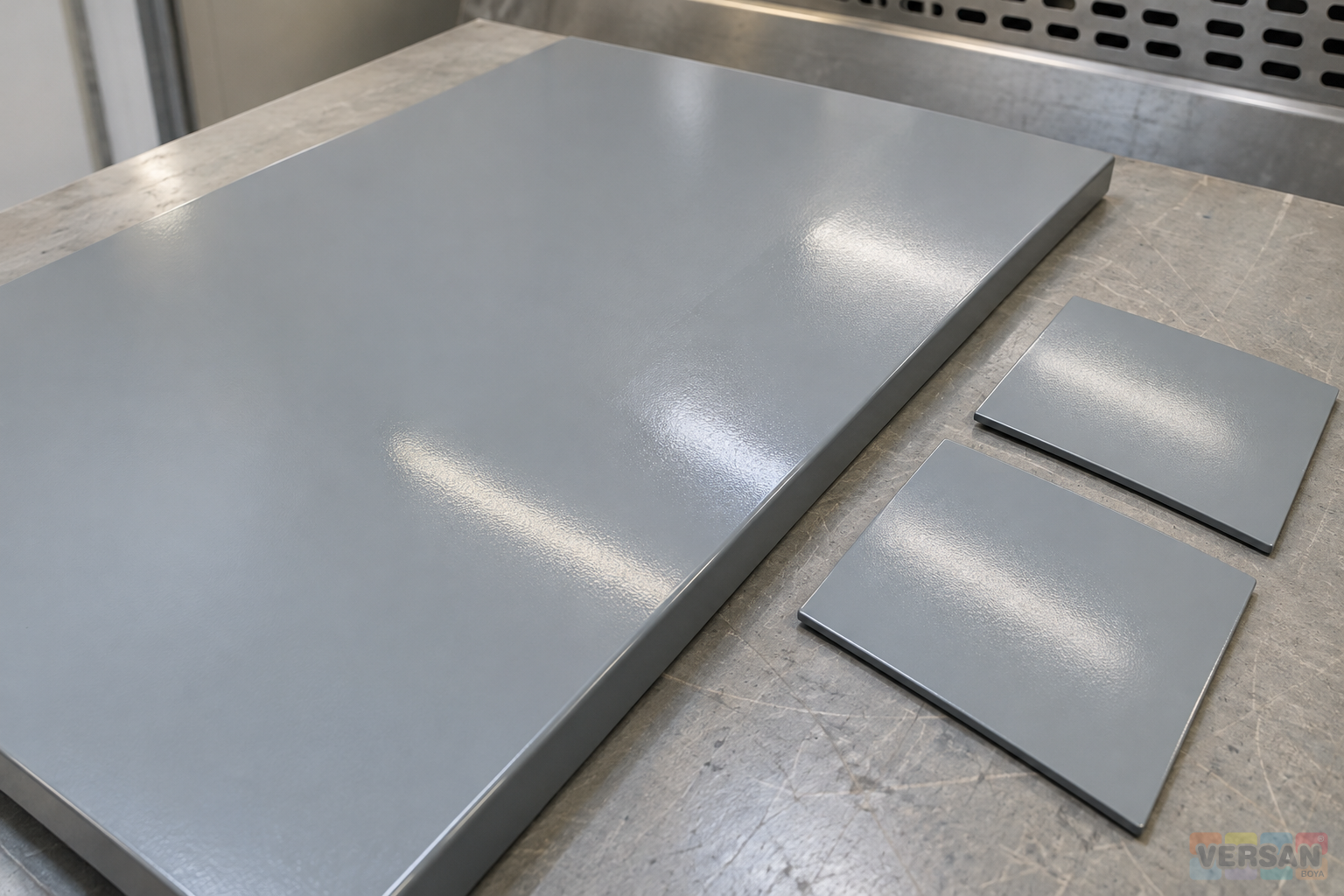
Treat appearance as a separate acceptance topic alongside technical conformity. Does the customer expect a repair that is unobtrusive at normal viewing distance, a consistent panel, or a complete match across the whole component? The answer can affect both scope and method. A shared colour code should not be presented as a guarantee of an invisible junction between new material and an existing surface. Use a trial connected to the materials and process proposed for the work. If the trial is made only on a separate coupon, record that it does not reproduce every feature of the actual coated component. Its purpose is to support an informed decision rather than promise an outcome that has not been demonstrated.
Agree how the sample will be viewed, including lighting, direction of observation and a representative viewing distance. Photographs are useful records, but different cameras and displays are not assumed to reproduce identical colours. The availability of gloss topcoat and matt topcoat options illustrates why appearance is a distinct selection issue; neither link automatically recommends that product for an epoxy repair. Retain the approved sample with its identity, date and the characteristics considered. If approval covers colour only, do not expand it into approval of layer structure, thickness or service suitability. A precise acceptance record should state what the decision includes and what remains to be checked.
Link preparation and application records
A small repair area does not remove the need to identify the mixture applied to it. Record product and component codes, batch numbers, preparation time and the locations receiving that mixture. Consider whether the measuring method remains suitable when only a small quantity is required. Reducing a packaged ratio by eye is not a defensible work instruction. Mixing order, any required induction period, permitted thinning and usable working time belong to the current product documentation. The published epoxy thinner and mixing-order guide discusses the organisation of those decisions. Repair records can be separate from production records while retaining the same material traceability. Any decision about leftover mixture must remain within the applicable product limitations.
Plan the next coat using the product instructions, the actual conditions and the condition of the preceding layer, rather than an available slot in the shift timetable. An intermediate inspection may be needed before later work conceals evidence that should have been reviewed. Include that inspection in the work order. A different ancillary material, such as polyurethane thinner, is not a substitute for an approved epoxy-system material merely because it is close to hand. Mark interruptions, suspected material errors and unrecorded additions explicitly. Keep the work on hold until the relevant decision has been made. A clear status is more useful than a record completed afterwards from a person's recollection of events.
Separate technical conformity from visual acceptance
At completion, compare the work performed with the authorised scope. Check repair locations, products, layer sequence and supporting records. Where measurements are required, the project must define their method, equipment and evaluation criteria. A displayed number does not by itself establish acceptance. The location, substrate geometry and applicable requirement must be understood. Evaluate appearance against the approved reference under the agreed conditions. Readiness for use also requires the relevant product and project conditions to be satisfied; a dry feeling at the surface is not the complete release decision. Technical acceptance of the repair and permission to return equipment to service may involve different responsibilities. Record those decisions separately where necessary so that their meaning remains unambiguous.
Do not immediately cover an unexpected observation with another touch-up. First identify its location, appearance and relationship to the acceptance criteria. A difference in gloss, for example, needs a decision by the person authorised to accept that characteristic. Switching to quick-drying industrial paint or an antirust primer simply because it is available is not a substitute for evaluating the system. If further work is authorised, retain the first repair record and link the additional operation to it. This history makes repeated defects easier to investigate. Keep accepted and unaccepted areas clearly identified, especially where several components are visually similar and move between preparation, coating and inspection stations.
Recognise when the local scope needs review
An apparently small repair may eventually require renewal of a panel or a larger part of the component. That decision should not be tied to an arbitrary percentage of surface area. Unknown coating history, recurring separation nearby, insufficient access for preparation or appearance expectations that cannot be met locally may change the assessment. Define how those findings will be handled rather than imposing one universal threshold. Discuss the cost, interruption and acceptance conditions of a wider intervention. Do not promise that a local touch-up will be invisible without a relevant demonstration. If the parties choose full-panel coating, issue a revised scope with the reason and approval preserved instead of silently replacing the original local-repair description.
For floor work, do not copy a metal-component repair procedure without reassessing its assumptions. Products such as self-levelling epoxy coating require consideration of their own substrate and intended use. Making this distinction early prevents a common word in product names from flattening very different applications into one method. A technical enquiry should combine the surface type, existing system, damage photographs, service environment and appearance objective. The published epoxy coating quotation information guide can help organise the scope. A structured enquiry allows the technical team to ask more useful questions. It does not justify a definitive product, schedule or performance promise before the actual surface has been assessed.
Leave a repair record that remains usable
A useful completion file brings together the original condition, agreed scope, applied method, material batches, intermediate inspections and final decisions under the same repair identity. Use clear photograph names rather than relying on the order of images in a messaging conversation. Identify who applied the coating, who inspected the work and who accepted it. Open matters should remain visible on the handover record so that a later maintenance team does not assume that every issue has been resolved. If work affected several faces of a component, one photograph of its front is insufficient as a location record. Describe each intervention so that it can be found again without requiring the original applicator to be present.
Arrange follow-up in relation to the component's real service rather than using an invented universal inspection interval. Explain which repaired areas should be observed and whom to contact if a new finding appears. This follow-up is not an unconditional durability guarantee or a promise of service life. Its value lies in making later decisions informed by earlier work. When requesting support, provide the exact known product codes, available coating history, general and close photographs, and the appearance you need to achieve. That information moves the discussion beyond a quantity of paint to the requirements of the surface. Verified scope, suitable materials and explicit acceptance criteria allow even a small local repair to be managed as a professional quality-controlled task.