
An industrial coating quotation needs more than a product name and a total amount. It should explain where the work starts, what condition the component must be in when it arrives, and which activities are covered before and after painting. Otherwise, two prices for the same object may describe substantially different services. This article presents an operational way to record work boundaries when discussing industrial coating systems. It is not a legal interpretation of a contract, a price guide, or a universal allocation of responsibilities. The purpose is to turn assumptions into questions and decisions that the people involved can understand.
Consider a hypothetical enclosure. One quotation assumes that it will arrive at the workshop dismantled, labelled and ready for preparation. Another assumes work on the installed enclosure, including arrangements around nearby equipment. Comparing their totals without aligning these assumptions does not compare equivalent work. A quotation comparison table helps establish a shared basis. The following discussion concentrates on the less visible items beneath that table: exclusions, conditional work and later additions. It does not repeat a lifecycle costing exercise or suggest that every difference necessarily justifies an additional charge.
Describe the object before describing the exclusion
Start with an identifiable component or area. A drawing reference, location, component group, approximate quantity and description of the surfaces provide a more useful foundation than a general statement that a machine will be painted. The external housing, removable guards and machined mating faces may have different boundaries. Marking these distinctions allows the buyer, applicator and technical representative to discuss the same physical object. Photographs can support the description, but they need dates and component references. A close photograph of one corner should not silently become evidence for the condition of an entire batch of similar parts.
The initial inventory can include uncertainty. If an internal compartment has not been opened, say that its surface has not been inspected. A surface to be examined after dismantling should not be described with the same confidence as an accessible surface already reviewed. Discussing an epoxy primer does not resolve that uncertainty. Product selection and scope definition answer different questions. The inventory can instead identify which quotation item will need reconsideration when access becomes available. This preserves a usable preliminary proposal while making its information limits visible to everyone who relies on it.
Use separate descriptions for included, excluded and conditional work
Included work belongs to the proposed process on the information currently available. Excluded work has not been included in that proposal and needs a separate arrangement if required. Conditional work depends on information or a decision that is still outstanding. Combining all three in a long note makes the document difficult to use. A short description, a supporting reference and an identified decision owner can be sufficient for each item. These labels do not determine contractual consequences by themselves. They organise the discussion that the authorised parties must complete through their own commercial and technical procedures.
A conditional item also needs a decision point. A note saying that corrosion discovered under the old coating will be assessed later leaves important questions unanswered. A clearer operational record says when the surface will be exposed, what observation will be recorded, who will assess its effect and which part of the work will wait for that assessment. It should not imply that a price or programme adjustment has already been accepted. Recording an unresolved point is useful precisely because it prevents uncertainty from being presented as a completed decision. It also avoids treating the entire quotation as unusable when only one bounded question remains open.
Keep dismantling and reassembly visible
Accessing a surface may require the component to be removed from equipment. The coating activity and the removal activity should not automatically be treated as the same service. Disconnecting electrical items, preserving mechanical settings, removing sensitive elements and identifying loose parts can involve different responsibilities. A product discussion with a paint supplier does not establish who will perform those tasks. Define the condition in which the component is expected to arrive and where it will be placed after coating. This is a handover description, not an instruction for dismantling equipment or an approval of a safe isolation procedure.
Reassembly can create further questions about mating faces, fasteners, settings and final checks. These should reach the relevant technical owner rather than disappear inside the paint description. An enclosure being considered for quick-drying industrial paint may have different handling arrangements from a housing being discussed for a polyurethane gloss topcoat. Those product links are separate enquiry routes, not a list of interchangeable coatings. If the specified system changes, the assumptions about transfer and reassembly may also need review. The scope record makes that review possible without claiming that the paint supplier has taken responsibility for the complete machine.
Treat masking as a boundary decision
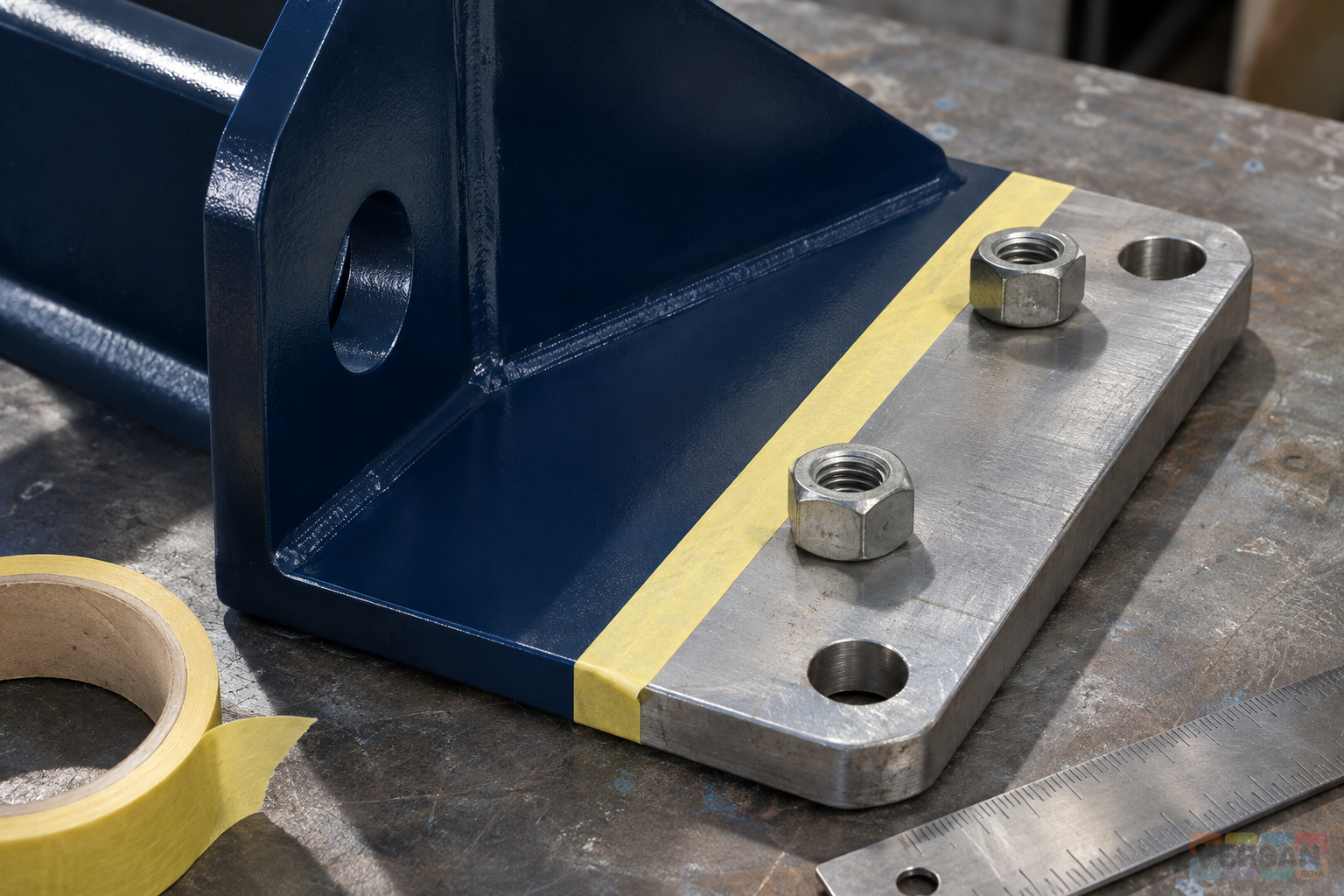
Masking defines where a coating ends. Threads, bearing seats, gasket faces, identification plates and moving interfaces do not necessarily require the same form of protection. Writing masking included may therefore be insufficient. Describe the protected feature and, where practical, mark the boundary on a drawing or photograph. Ask whether fitting the protection, inspecting it and removing it are all within the same item. The actual protective material needs selection against the substrate and process conditions. The quotation should not become an improvised recommendation that any convenient tape is suitable for every surface, temperature or coating system.
Protecting a sensitive feature on the component is also different from protecting neighbouring property. Installed equipment may be near glazing, cables, stored goods or other machinery. If a separate team must clear the area, state the expected handover condition rather than assuming that clearance will happen automatically. For example, an area may need to be available with nominated movable items removed before the coating team starts. This is a hypothetical scope description, not a ready-made site safety method. Its purpose is to expose the interface between the coating work and surrounding operations so that the responsible people can define the necessary arrangements.
Separate access arrangements from coating materials
Seeing a surface from ground level does not establish that all of it can be reached appropriately. Work platforms, restricted spaces, operating production lines and shared work areas may affect the proposal. Identify the working zone, the expected availability period and the conditions required before the applicator receives access. This article does not choose access equipment or design a permit system. It identifies a question that must have an owner. If an access assessment is outstanding, the quotation should show which assumptions depend on it rather than allowing a material description to imply that the physical work is already fully planned.
The number of work stages also deserves attention. An area initially planned as one continuous operation may later be divided into smaller sections because production must continue. That can change temporary protection, repeated setup and intermediate handovers. It does not automatically establish a particular extra cost, but it creates a scope question worth recording. The same method can be used when discussing an acrylic primer and when discussing a two-component acrylic topcoat. Product choice alone does not decide how often the work will be interrupted or how other activities will be accommodated.
State what is known about the existing surface
Complete removal of an old coating, local removal of loose material and preparation of specifically identified areas describe different work. They should not be hidden behind the same broad preparation label. Hempel's technical guidance distinguishes preparation, application and inspection as technical topics. That general structure supports making preparation visible in a proposal; it does not prescribe a method or acceptance level for a Nanomix system. The current product information and actual project requirements still need review. A procedure that is appropriate for one substrate or existing coating should not be assumed suitable for all the other surfaces listed in the quotation.
The accepted Nanomix archive provides historical catalogue information, not a replacement for the current technical and safety documents needed for a particular project. In a maintenance job with an unidentified existing coating, discussing an antirust primer does not remove the need to evaluate the existing film. The scope record can identify an inspection, trial area or document request that must be completed before a particular item is confirmed. Numerical values from an archive should not be transferred to unrelated products or unexamined conditions. Record what needs current confirmation instead of giving incomplete information an appearance of precision.
Distinguish metal repair from coating renewal
Removing an existing coating can reveal a condition that involves more than paint consumption. Geometry, joint condition or loss of metal may need examination by the relevant technical authority. The quotation should state whether such an assessment is included and how the coating operation will receive its outcome. Welding, replacement of a component or correction of fabrication should not silently become part of a painting item. Equally, the applicator should know the condition in which the preceding work is expected to be handed over. This makes the interface visible without substituting a quotation note for an engineering decision.
When a possible repair area is found, record more than the phrase problem discovered. Identify the component, observation time, image reference and immediate effect on the proposed coating activity. Once the responsible specialist defines any repair, the coating preparation around that repair can be discussed separately. Selecting an epoxy topcoat or another system does not automatically transfer structural assessment to the coating manufacturer. The scope file should connect specialist responsibilities without merging them. Outstanding approvals must remain outstanding in the record; progress on other parts of the job should not make an unresolved item appear complete.
Name auxiliary materials and cleaning activities clearly
The material description can raise separate questions about the principal coating, suitable auxiliaries, packaging and process consumables. When reviewing thinners and auxiliary products, do not assume that every thinner is equivalent. The accepted Nanomix archive lists rapid, acrylic, epoxy and stoving thinner groups separately. That distinction does not establish a current mixing ratio or approve a specific product pairing. It indicates why the proposal should identify which auxiliary product was assumed and which current information will confirm suitability. A product category should not be used as a substitute for an agreed application specification.
Equipment cleaning and dilution also need clear descriptions. Links to quick-drying industrial thinner and epoxy thinner provide routes for separate technical enquiries; they do not mean that either product can be used in both activities without confirmation. A material item can record its quantity basis and delivery form. If a different method is later selected, the original assumptions provide a reference for discussing its effect. The intention is not to turn a quotation into an operating manual, but to ensure that changes can be related to something more concrete than a remembered conversation.
Define the return condition of the work area
The end condition should be discussed before work starts. Used masking, empty containers, preparation debris and general work-area cleaning do not necessarily belong to one indistinct cleaning activity. The record can identify who considers collection, temporary holding and transfer through authorised procedures. The nature of the material and applicable requirements must be reviewed using the relevant documents and local processes. This article assigns no waste classification or disposal method. It simply asks where the proposed service ends and what condition the next responsible party expects to receive, including any unresolved material or documentation that needs a separate decision.
HSE's UK guidance notes that coating risks depend on the application method and working environment. The limited principle used here is that work arrangements need evaluation alongside the product. It does not supply Turkish legal advice, a ventilation calculation or a choice of protective equipment. A quotation discussion should make required assessments visible and attach them to the appropriate people. The checks and documents expected when an area is returned can be linked to the same file. Finishing the painted surface does not by itself demonstrate that every surrounding site activity has been completed or formally closed.
Move later additions from observation to decision
An additional-work record should begin with the changed condition, not simply a new amount. State which original assumption was used and how the new observation differs. Component identity, date, photograph and a brief description can provide enough context for an initial review. Then identify the affected item, decision owner and work awaiting a response. This does not automatically determine whether something is commercially an extra. It gives the authorised parties a specific situation to discuss. The record is particularly useful where several changes occur close together and later recollection might otherwise merge them into one general event.
If work must be repeated, record why. Reopening a painted area for another trade, adding a new component and discovering a previously inaccessible surface are different events. Quotation revision control helps identify the document version currently being used. The added-work record explains the physical event behind that revision. Preserve the earlier basis while identifying who communicated the new decision and when. A change in product choice should receive the same care: a discussion about a single-component acrylic topcoat must not silently replace the system assumed elsewhere in the file.
Check measurement and evidence expectations
Where quantities or areas appear in a proposal, record their origin. A client drawing, a site observation and an initial estimate have different information limits. Identify who will update the quantity, how inaccessible surfaces will be treated and how a change in component count will be communicated. This is not a prescribed measurement method. It allows later discussions to refer to an identifiable starting point. In a batch, combining several geometries into one unexplained quantity can make it difficult to establish which group was added or changed. A modest amount of structure can prevent that confusion without creating an unnecessarily elaborate document.
Evidence requirements can also be hidden scope. Ask whether the expected delivery consists only of final photographs or includes product information and process records. If a particular report or certificate is requested, confirm that the relevant party can actually provide it. A document that does not exist should not be presented as the automatic outcome of the work. Recording the evidence name, coverage and expected delivery time helps the applicator understand what information must be collected during the process. Data that was never recorded cannot reliably be recreated after completion merely because someone later requests a report.
Close with a short shared scope summary
A practical final review can compare the component list, protected surfaces, completed work and open areas against the agreed description. It should distinguish an intentionally unpainted feature from an omitted surface. Where a formal acceptance standard is required, its applicability and use need the appropriate technical authority. The recording method described here does not replace that standard. It keeps the delivery discussion connected to the scope originally reviewed. The best summary is short enough to use at a meeting while remaining specific enough to direct the reader to the supporting drawing, observation or outstanding question.
If a question is still open, retain it as open. Identify the component, the next responsible person and its relationship to the remainder of the work. A shared summary used by purchasing, application and client representatives makes it harder for a new request to be absorbed invisibly into an old decision. Exclusions then become part of an understandable technical conversation rather than an opaque note beneath a price. The objective is not a longer quotation. It is a proposal in which the important boundaries, assumptions and next decisions are easy to find and discuss.
Sources and scope
- Nanomix epoksi — resmî kabul edilmiş arşiv katalog / accepted archived catalogue
- Nanomix tiner grupları — resmî kabul edilmiş arşiv katalog / accepted archived catalogue
- Hempel — Technical Guidelines: preparation, application and inspection
- HSE — Paint and coatings: application method and work environment