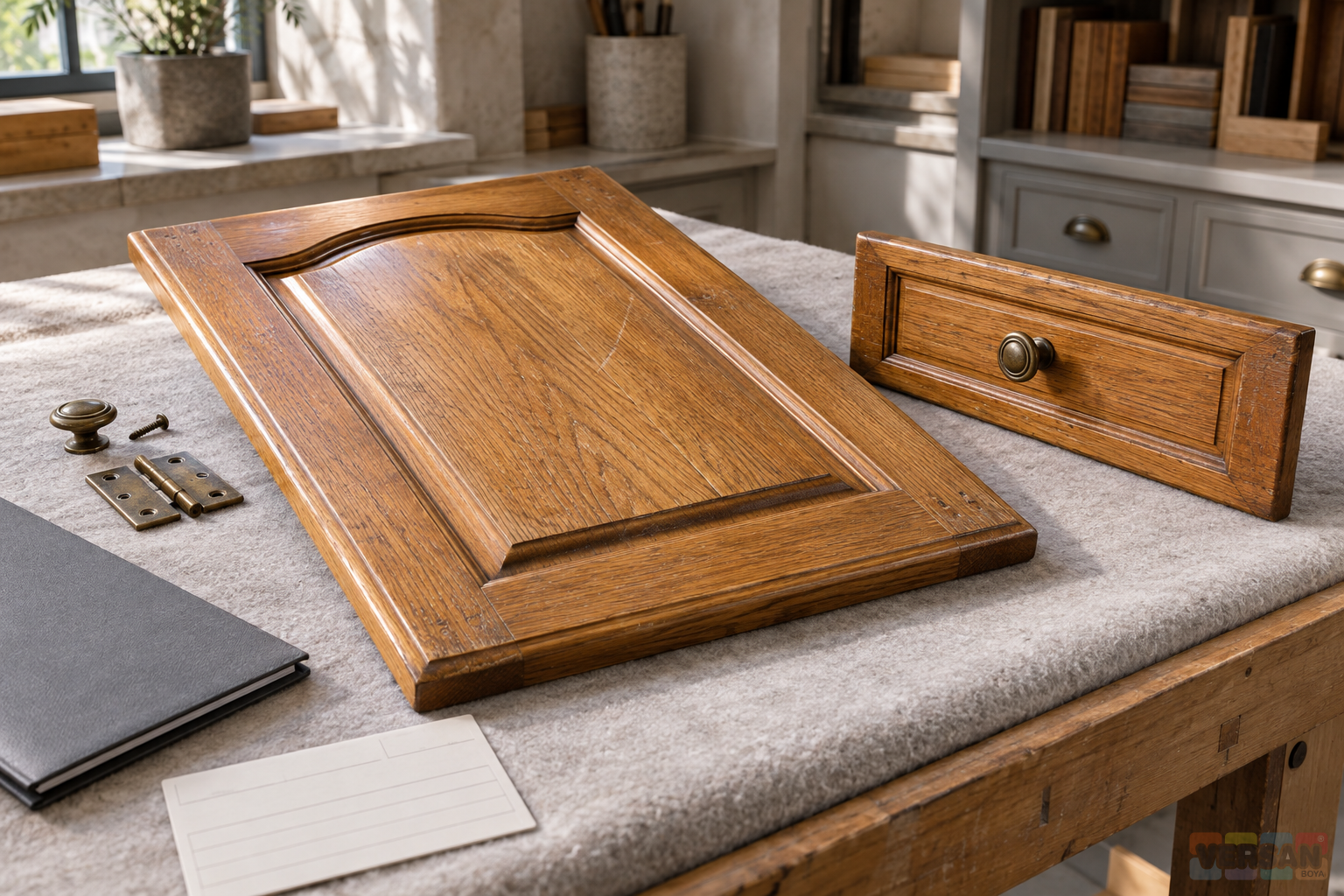
A furniture varnish renewal quotation needs more than the approximate area of a table or a collection of cabinet doors. The history of the existing finish, the way the furniture is used, its ability to be dismantled and the intended appearance all affect the scope of the discussion. Two contractors may use similar quotation headings while making different assumptions about preparation, sample approval, transport and handover. A useful enquiry makes those assumptions visible before the purchaser compares the commercial offers.
This article proposes an original briefing and review framework. It does not identify an unknown coating from a photograph, prescribe a stripping procedure or select an abrasive grade for an uninspected surface. Current product and safety documents, together with a competent assessment of the actual furniture, are needed for application decisions. Photographs and physical samples support that assessment, but do not independently establish compatibility or durability. The aim is to make unlike scopes easier to distinguish and the remaining decisions easier to manage.
Describe the furniture as groups of components
Alongside a general description such as cabinet or dining table, identify the components to be treated. Doors, drawer fronts, the top, legs and concealed faces may not require the same intervention. Distinguish fixed components from parts that can be removed. Where dimensions are available, explain how they were obtained and label estimates honestly. The user, contractor and person preparing the quotation need a common understanding of which surfaces are included. Component groups can later provide the basis for tracking changes without redefining the entire job.
The furniture varnish page helps introduce a product family; it does not establish a renewal procedure for every existing item. Include overall photographs, useful close views and images of areas that will remain outside the work. Connect each image to an identifiable component. If several similar pieces are present, say which one was inspected. A previously repaired door or a drawer renewed at another time should not inherit the assumed history of the rest of the furniture simply because the items now stand together.
Separate known coating history from unresolved identity
Look for maintenance records, previous invoices, product labels or an earlier application file where these exist. Check that the evidence actually relates to the component being considered. An old finish cannot be assigned to a chemical family merely because it appears glossy. If a previous touch-up material is unknown, keep that uncertainty as an assessment item. The certainty expressed in the briefing should match the available evidence rather than the confidence with which a familiar coating name is used in conversation.
The presence of several options within the wood and furniture coatings catalogue does not grant permission to apply them directly over an existing finish. The condition of the existing layers and their relationship with a proposed system still require assessment. The article on existing-coating compatibility and repair boundaries provides related context. Where the enquiry states that the old coating is unidentified, ask how that uncertainty affects the proposed scope, sample stage and decision to proceed. It should not disappear between the initial survey and the written quotation.
Record visible damage before assigning a cause
Describe scratches, colour variation, worn edges, staining or areas of missing finish by location. An overall image establishes context, while a close view can show a useful detail. Lighting and camera angle can change the apparent severity of a mark, so avoid deciding its depth or origin from one photograph. A statement about what is visible is generally more useful than a broad conclusion that the varnish has failed. It helps the contractor explain which additional evidence or inspection would be needed.
Where an existing finish has genuinely been identified as nitrocellulose varnish, record that information and its source. The family name alone does not decide whether a local intervention is adequate or which new system should be used. It may remain unclear whether the observed damage lies in the timber, a colour layer, a sealer or the clear topcoat. If inspection cannot occur before an initial quotation, ask for the assumptions to be stated and for the findings that would require reassessment to be identified explicitly.
Explain the real conditions of use
Describe where the furniture will be used and the contacts it will encounter. A frequently cleaned dining table, a decorative display cabinet and a unit exposed to daylight beside a window may create different expectations. Give practical information about use intensity, cleaning habits and objects normally placed on the surface. Do not attribute existing damage to a particular activity unless that connection is known. The intention is to provide context for evaluating the proposed finish rather than to obtain a sweeping claim about resistance.
A general catalogue description for polyurethane varnish does not automatically guarantee performance against a particular household chemical, hot object or pattern of use. Ask how a requested performance will be described and which product evidence supports it. A real use scenario is more informative than a phrase such as resistant to everything. If the quotation includes care conditions or use restrictions, arrange for that information to reach the eventual user. A condition known only to the purchaser can be lost during delivery and installation.
Treat colour, sheen and timber character as separate expectations
The purpose of renewal may be to retain an existing appearance or to make a deliberate change. Describe the desired tone, sheen, visibility of grain and treatment of open pores separately. An instruction to make it the same is incomplete when the reference surface is uncertain. A protected internal face and an exposed outer face may no longer appear alike. Identify the intended reference and explain where it will be assessed, so the contractor does not have to choose between conflicting examples during the work.
The name of a family such as acrylic varnish does not by itself define the required appearance. A retained physical reference and an approved sample may make the discussion more concrete. Screen images vary with the display, camera and lighting, so they should not be treated as an unconditional promise of a precise match. The article on furniture coating sample approval for colour, texture and gloss explains a related recording approach. Keep the identity of the approved reference connected to the current scope.
Define a gloss requirement through the acceptance discussion
An appearance requirement should not end with the word gloss in a product description. Discuss the normal viewing direction, relevant lighting and the reference piece against which the result will be considered. Reflections also reveal the form of the surface and the surrounding light sources. Expectations need to take the existing substrate and proposed preparation into account. If numerical acceptance criteria are required, the method, applicable conditions and responsibility for interpretation must be established rather than borrowed from an unrelated product.
Gloss polyurethane varnish and gloss acrylic varnish are distinct catalogue options. They should be assessed through current product information and the actual substrate, not treated as automatically interchangeable over an old coating. A sample can be visually attractive without proving that its chemistry is suitable for the existing layers. Keeping technical suitability and aesthetic approval as separate decisions makes it easier to understand what the quotation does, and does not, establish at the sample stage.
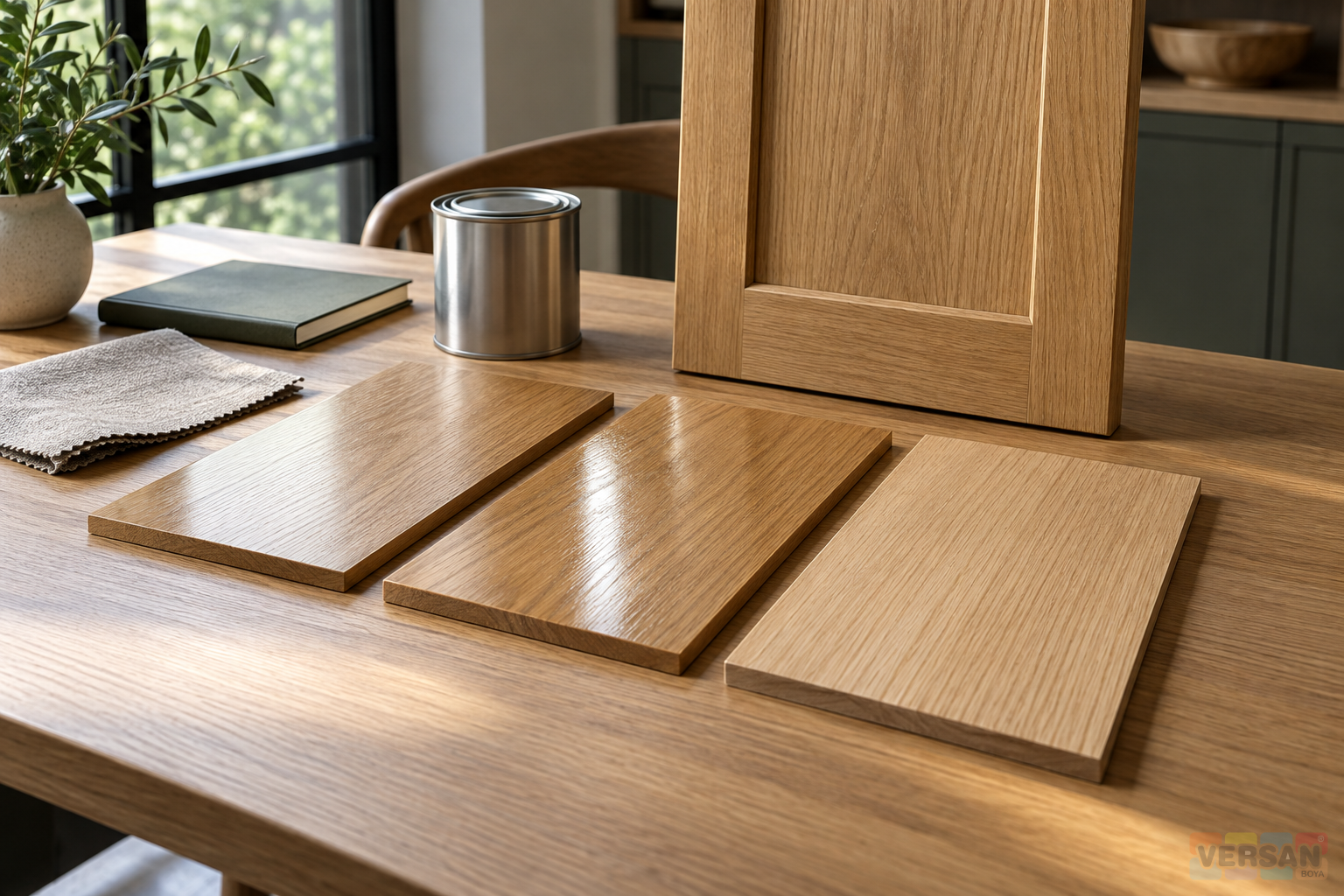
Use physical samples for matt appearance discussions
Descriptions such as matt or soft sheen can be interpreted differently between users and product families. Unless a defined numerical requirement has been agreed, do not treat a descriptive word as a universal measurement class. Discuss the sample size, timber and underlying preparation. A small flat panel may look different from a profiled door or a broad tabletop. The quotation can state how that difference will be considered during acceptance instead of relying entirely on a catalogue photograph or a screen image.
When requesting information about matt polyurethane varnish or matt acrylic varnish, include the existing finish and intended use. An appearance-only sample approval must not be used as a technical compatibility approval. Ask for the sample's product identity and preparation approach to be recorded. If the proposed materials or process subsequently change, clarify whether a new assessment is necessary. The earlier approval should not silently expand to cover a different system merely because the descriptive sheen name remains similar.
Resolve silk-matt expectations without arguing over labels
One person may ask for semi-matt while another uses silk-matt without intending the same appearance. Rather than settling the matter through terminology alone, examine a shared physical reference and describe what is accepted. Record the feature that is liked and the appearance that is not wanted. If the sample is compared in more than one lighting environment, identify those environments. A photograph can support the record, but should be linked to the location and identity of the actual retained reference.
Silk-matt polyurethane varnish and silk-matt acrylic varnish share descriptive words while belonging to different product families. Neither compatibility nor an equivalent final appearance should be inferred from that naming. Sample selection, technical document review and commercial scope approval need to be coordinated. If several people participate in appearance decisions, identify who gives the final approval. Otherwise, different preferences may emerge as contradictory instructions after preparation or application has already started.
Allocate dismantling, transport and on-site responsibilities
Differences between quotations may arise from work organization rather than material selection. Identify who removes the doors, separates the fittings, labels the parts and performs reinstallation. Explain where components will be held and which items must remain in place. Fixed furniture may introduce additional questions about protecting nearby areas and coordinating the use of the room. These are scope and responsibility questions, not application instructions. Keep any uncertainty that depends on measurement or inspection visible in the quotation attachments.
State explicitly whether backs, edges, internal corners and joints are included. Complete renewal can mean different things to different readers. If hardware replacement or adjustment is requested, ask whether it is priced separately from the finishing work. Condition records at collection and delivery can also help distinguish earlier marks from newly observed damage. Agree how component identity will be preserved during movement, particularly where similar doors or drawer fronts could be confused. Clear identification supports the appearance discussion as well as the practical reassembly of the furniture.
Compare preparation and repair options as distinct scopes
A local appearance correction, renewal of selected components and a broader intervention are different jobs. Ask the contractor to explain the observations supporting each proposed option. If additional repair may become necessary after closer inspection, define how it will be authorized. Avoid committing to a precise removal procedure or duration for a surface that has not been assessed. Current product documentation and a competent evaluation of the layers should inform application decisions before the briefing is converted into a detailed method.
The existence of another catalogue family such as decorative wood varnish does not make it an automatic alternative for interior furniture renewal. The material must be considered with the existing layers and service requirements. Where a new finding arises, explain which component will be held and what evidence is needed to resume the work. A change then becomes a recorded decision connected to cost and appearance expectations, instead of an informal additional task that different participants remember differently at handover.
Make the trial stage a decision point in the quotation
If a trial is proposed, state what it is intended to establish. Technical suitability, an appearance example and an illustration of workmanship are different objectives. Whether the assessment uses a concealed part of the furniture or a separate representative piece should be decided competently for the actual case. This article prescribes neither a trial method nor a universal waiting period. Ask how sample preparation, review and any necessary revision are included in the offer, and whether approval is required before the main scope proceeds.
A trial may leave more than a simple accepted or rejected result. In a hypothetical case, the appearance could be approved while questions about the existing layers remain open. Another technically considered option might not meet the desired aesthetic result. Record which aspect is unresolved and who is responsible for the next decision. Retain the sample identity and review date. If the product or preparation changes, revisit the relevance of the earlier sample instead of treating its approval as a permanent authorization for any later variation.
Read price against the complete scope
A unit price can make unlike offers look equivalent. Compare the included surfaces, preparation assumptions, dismantling, transport, samples, fittings, installation and delivery arrangements together. Ask the quotation provider to clarify the treatment of commercial items such as taxes and travel. This article provides no price range and assumes no single cost structure for every job. Understanding the basis of the offer also makes it easier to discuss how unexpected additional work would be assessed rather than debating a number after the scope has already changed.
For example, one hypothetical offer might cover removable doors only, while another includes the carcass and work carried out in the room. These totals are not directly comparable even if their headings are identical. The purchaser can prepare a shared scope schedule and mark the differences between the offers. Missing items should be clarified with the provider instead of being filled with guessed prices. This keeps the commercial comparison centred on the actual need and agreed acceptance requirements rather than on assumptions that remain invisible to both parties.
Link handover with packing and first-use conditions
Completion of finishing work does not necessarily mean immediate readiness for every type of service. Packing, transport, installation and first use need the current product conditions and the contractor's written guidance. A surface that looks dry does not prove that every use condition has been satisfied. Keep the accepted appearance reference, treated-component schedule, outstanding items and care information together in the handover record. Conditions that are not communicated to the eventual user can disappear as the furniture passes from contractor to installer and then into ordinary service.
The article on packing and first care of polyurethane-varnished furniture addresses this transfer stage separately. Ask which material and conditions support the supplied care advice; do not assume one cleaner or waiting period is appropriate for every varnish. If a mark or an appearance difference is noticed during acceptance, describe it and compare it with the recorded starting condition and approved reference. A clear observation should precede the choice of any corrective intervention, especially where the cause has not yet been established.
Keep approval authority and open questions visible
At the final review, each significant decision should have an owner. Identify who confirms the surface information, who approves the appearance sample and who accepts the commercial effect of additional work. One person may hold several roles; what matters is that the decision can be traced. The file should show separately whether technical suitability, appearance and price scope have been resolved. A question that remains unanswered should stay on the open-items record rather than being treated as closed simply because work has commenced.
Keep photographs, component identities, service information, document status, the retained reference and quotation scope under a consistent job identity. Preserve the previous version when recording a later decision, while making the current agreement easy to find. This is an editorial management proposal, not an account of a real customer project or proof of a product's performance. A strong furniture varnish renewal enquiry makes uncertainty manageable at the right stage. It helps the participants bring aesthetic expectations, technical limits and commercial responsibilities into one coherent discussion before those responsibilities are dispersed across the work.