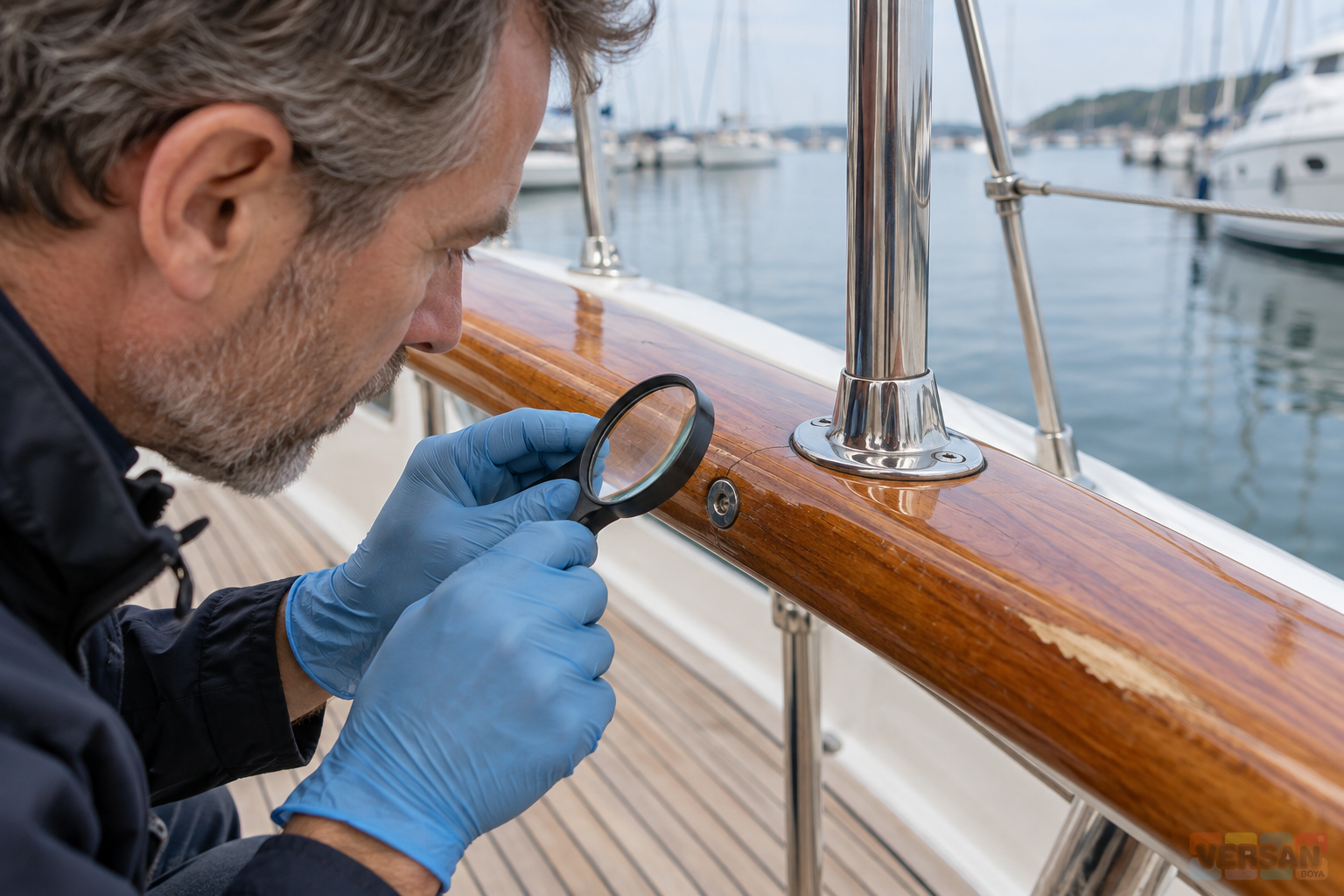
Loss of gloss is not the only observation that matters when reviewing varnished yacht timber. Fine cracks, lifting edges, peeling and changes visible beneath a transparent film raise different questions. Early inspection can identify an opportunity to maintain retained coating, while another area may require removal of damaged layers or assessment of the timber before recoating. The decision should classify the surfaces rather than prescribe one operation for the entire boat. This article offers an evidence-based way to define the maintenance scope. It is not a replacement for the current application instructions of the particular varnish selected.
When preparing an enquiry for yacht varnish, provide the timber type, known coating history, location and observed damage together. A product's presence in a marine category does not establish identical suitability for every exposure or substrate. Review the marine coating range against the actual use. The earlier article on sunlight, moisture and yacht-timber maintenance discusses general planning. The specific focus here is how early symptoms alter the choice between maintenance, local repair and more extensive refinishing. Unknown information should remain visible throughout that decision.
1. Identify the timber elements separately
Give each timber element a reference before beginning the review. Handrails, lids, doors, seating and decorative panels do not necessarily share the same service conditions. Record horizontal and vertical faces, details where water can collect, end grain and areas around metal fixings. A simple register makes a photograph understandable when someone else reviews it later. Good condition on an accessible face is not evidence that all retained coating is sound. Equally, one damaged fixing area does not automatically require removal from every timber element. The scope should follow recorded observations rather than the convenience of applying a single description to the whole yacht.
Where known, record the timber species, earlier product identity, maintenance date and coating system for each element. Do not fill gaps by guessing. A previously owned boat may contain different coatings applied at different times. The wood and furniture coating family can introduce available chemistry categories, but yacht suitability still requires specific confirmation. Keep decorative appearance, coating integrity and timber condition as separate fields. This helps transfer an observation from the inspector to the technical adviser without losing its meaning. Later inspections can then return to the same elements and determine whether a feature has changed rather than comparing unrelated photographs.
2. Treat dullness as an observation, not a complete diagnosis
Dullness is often one of the first changes an owner notices. Establish whether surface dirt or cleaning residue is affecting the appearance and note the lighting under which it is visible. Any cleaning method must be suitable for the existing finish. Arbitrarily wiping the surface with a strong solvent can turn the inspection into a source of damage. Record the appearance after an appropriate cleaning assessment. If the dullness occurs together with cracks, lifting or discolouration beneath the film, the review should not remain a purely cosmetic discussion. Inspect different areas of the same element to distinguish a widespread change from an isolated feature.
Epifanes' maintenance guidance distinguishes intact, well-adhered varnish with lost gloss from cracked or lifting systems. That classification provides a general decision principle. The manufacturer's coat numbers and sanding instructions must not be transferred to Nanomix materials. The yacht varnish guide explains the product category, while an actual maintenance specification still needs evidence of film integrity and compatibility with the new coating. A strong reflection does not prove that every layer is sound. Conversely, a dull surface is not by itself proof that complete stripping is the appropriate scope.
3. Distinguish superficial marks from coating cracks
A fine line cannot always be classified confidently from a photograph. Record its direction, relationship to neighbouring marks, whether it reaches an edge or fixing and whether it changes over time. An isolated mark where mechanical contact occurs presents a different inspection question from a network of lines. Magnification and suitable lighting help describe the feature, but they do not remove the need for an appropriate technical assessment of depth and integrity. Avoid unnecessarily cutting into sound film simply to make a feature easier to see. Document what can be observed and identify what remains uncertain.
Do not assume a new coat will restore the integrity of an underlying cracked layer. Investigate the affected layer, the surrounding coating and any suspected route of water entry. If application history is unavailable, tell the technical team. A decorative timber varnish and a marine maintenance material should not be substituted for one another solely because their names sound similar. Product pages provide a starting point for enquiry; suitability over the actual retained system needs current documentation and an appropriate trial. Keep a change of chemistry separate from a decision about the condition of the old film.
4. Define a sound boundary around lifting and peeling
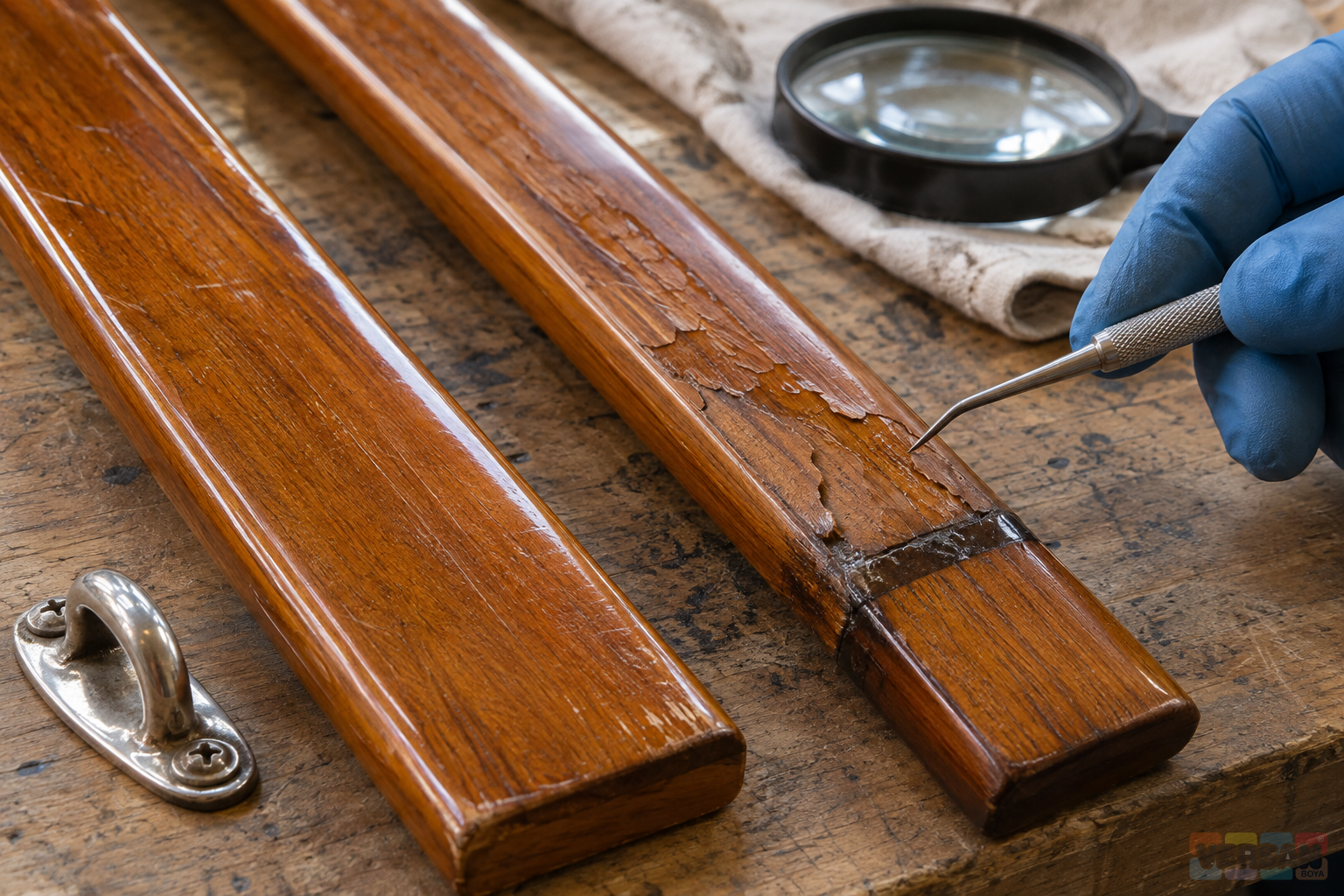
Varnish lifting from an edge, separating in flakes or exposing timber is a different condition from simple loss of appearance. The layer that will receive the new material needs to be shown suitable for retention. An apparently attractive area beside a defect does not automatically establish a reliable repair boundary. A local repair plan should consider cleaning, removal of damaged film, preparation of the transition and the intended final appearance separately. Select removal methods to protect the timber and nearby hardware. This article does not prescribe a universal hot-air or chemical-stripping procedure for every boat or existing finish.
If damage lies in the middle of a prominent element, a repair boundary may remain visible after the work. A technically preparable patch and an aesthetically acceptable patch are related but different decisions. Refinishing to a natural element boundary can be considered alongside the client's appearance expectations. Transparent coatings reveal the underlying timber, so a colour difference cannot always be concealed by adding more varnish. The article on retained varnish compatibility and repair limits offers a complementary discussion. Its furniture context is not a marine application recipe and should not be treated as evidence of yacht exposure performance.
5. Assess changes beneath the clear film separately
Darkening, staining or a whitish appearance beneath a transparent finish is not proof of one specific cause. Surface contamination, film appearance and timber condition should be investigated separately. Record repeated features around fixings or joints with particular care. If timber appears soft or structurally questionable, pause the cosmetic maintenance plan and obtain an appropriate specialist assessment. Varnish should not be represented as a material that restores the integrity of load-bearing timber. Where an element has a safety function, a visual coating review cannot substitute for a structural decision. Keep that distinction clear in the report and quotation.
If moisture assessment is necessary, select the instrument, procedure and product-related limits through technical review. A numerical moisture value cannot be assigned from a picture. Even where timber looks dry, recoating the same detail without investigating a repeated symptom can leave the cause unresolved. The role of a clear timber preservative differs from that of varnish; neither automatic compatibility nor universal use beneath a clear coating should be assumed. The article comparing timber treatment and clear finishing explains that distinction. Chemical compatibility and service location remain specific questions for the materials selected.
6. Review edges, end grain and fixings
Damage rarely needs to be assumed uniform across all faces. Handrail ends, lid edges, screw areas and joints can each have their own line in the inspection register. Do not concentrate only on the broad upper face that is easiest to photograph. A repeated opening or separation beside a fixing calls for investigation of the detail as well as the coating process. Define whether hardware removal, reinstatement and safe access are included in the proposed work. A photograph should not be used to announce a certain fitting failure without investigation. Record the concern and direct it to the appropriate assessment.
The objective is not to cover the same unexplained defect again at every maintenance visit. Location and recurrence records make an unresolved detail easier to recognise. If underside or inaccessible areas have not been viewed, state that limitation; do not classify uninspected surfaces as sound. Timber characteristics, past cleaning materials and adjacent sealing products may be relevant questions for the new system. They should not be addressed through arbitrary solvent cleaning or stacking unrelated resin types. When requesting technical instructions, identify exactly which faces were examined and which information is missing. The quality of the decision depends on that distinction as much as on the number of photographs supplied.
7. Support the maintenance option with evidence
A maintenance-coat option should be considered where the existing film is suitable for retention and compatibility with the proposed material has been established. Appearance loss alone may not require complete removal, while good appearance does not guarantee the condition of every layer. Use coating history, suitable cleaning and preparation information, observations of retained areas and trial results together. If those inputs are insufficient, leave the scope unresolved. A client's preferred completion date cannot convert unknown technical information into confirmed evidence. Keeping uncertainties explicit in the quotation is a better starting point than presenting a convenient but unsupported certainty.
Check the product identity, system components and service location when selecting candidates from the product catalogue. Another manufacturer's maintenance coat count or waiting period does not become a requirement for this material. A small compatibility trial is assessed with documentation and technical advice; it cannot guarantee the future behaviour of all yacht surfaces. Separate elements approved for maintenance from those requiring repair or further inspection. Purchasing and application teams can then refer to the same scope. Material quantities should follow that defined work rather than be based on a broad assumption that every visible timber face receives the same treatment.
8. Define the limits and appearance of a local repair
Local repair can be considered where damage is genuinely confined and surrounding coating is suitable for retention. Do not establish the repair area solely from the visible missing flake; the preparation boundary must also be sound and practical. Timber tone, film level and reflected appearance may remain different after the work. A representative trial and appearance approval provide a more controlled reference than a promise of an invisible repair throughout the yacht. Record why a boundary was selected. Where different faces of the same element have different conditions, a single patch decision should not silently cover them all.
Choosing another coating class does not automatically simplify the repair. The polyurethane varnish family and the acrylic varnish family offer different categories. These links do not certify each product for exterior marine timber. In particular, resin terminology cannot establish compatibility where the retained system is unknown. Current product information, suitable substrate conditions and manufacturer confirmation are needed together. The commercial scope should describe expectations for colour continuity and the alternative of refinishing a complete element. Although a repair may use little material, its access and preparation requirements can still be substantial.
9. Describe the full-refinishing scope accurately
Widespread lifting, uncertain layers in several areas or failure to establish a sound repair boundary may lead to consideration of extensive refinishing. This is not simply a proposal to cover damaged coating with a fresh glossy layer. Removal of retained material, timber assessment, preparation and the new coating's application conditions are separate tasks. Distinguish observed damage from possible conditions that might only become visible during removal. A quotation should explain how unexpected substrate issues will be assessed. Do not announce hidden damage as already established, or price several different scopes as though they represented the same known condition.
Extensive refinishing does not automatically mean treating every piece of timber at once. Use the element register to define the boundaries. Plan safe access, hardware protection, the working area and a suitable application window. The reducer for a new system must also be selected correctly. Reviewing thinners and auxiliary materials introduces the product categories; a link to synthetic thinner does not establish it as an approved reducer for the varnish. Cleaning and thinning are different tasks. For both, follow the actual material's current instructions and safety documentation rather than using availability as evidence of suitability.
10. Record the trial and application method
The trial should represent the typical condition of the retained surface. Appearance on new clean timber does not establish compatibility over an old coating. Record the product, retained layer, preparation, method, conditions and application date. Relate the evaluation stage to current instructions. Touch dryness, completed maintenance and readiness for service are not interchangeable descriptions. If a different procedure becomes necessary during the trial, record it as a revised method. The earlier approval cannot automatically authorise that change across the remaining work. A traceable record gives the inspector and applicator a shared account of what was actually done.
Organise photographs as an overall element view, the affected area and a close detail. Identify the element and viewing direction so that the same location can be found later. Light changes can alter reflected appearance; compare conditions before describing a different photograph as evidence of rapid deterioration. The trial approval should identify the question it answers, such as appearance, practical application or a defined technical check. A small trial does not establish a guaranteed service life. Confirm chemistry and exposure suitability separately. These records are also useful when a new team takes over and needs to avoid repeating assumptions from an earlier conversation.
11. Identify what should be observed after maintenance
At completion, record how each element was treated rather than assigning the entire yacht a single good-condition statement. Previous damage points provide useful locations for later observations. If discolouration, a crack or edge lifting recurs, compare it against the same reference. Review timing depends on use, exposure, the material and technical recommendations. This article does not establish a universal annual interval for every yacht. Cleaning and return to use must also follow the selected product's guidance. Adding an unapproved polishing or maintenance material for extra shine can make the condition of the new coating harder to assess.
The owner's file can include product documentation, the approved sample, completed scope and unresolved questions. A later contractor can then learn the actual earlier procedure. The coating frequently asked questions explain general terms, but decisions about the yacht's specific damage still need an individual assessment. State clearly where parts were not inspected. Do not record adhesion or moisture tests that were never carried out. Accurate transfer of uncertainties supports subsequent product selection more effectively than a reassuring but unsupported completion note. The maintenance history becomes useful only when observations, actions and limitations remain distinguishable.
The same file also helps compare commercial proposals. One quotation may include only new varnish, while another includes removal and timber assessment. Those prices are not offers for identical work. A shared element list, procedure and description of uncertainties make the differences understandable. If quantities cannot be finalised before a surface is opened, define when a further measurement will be made. Keep the unit price separate from the complete job cost. Potential discoveries during removal should be described through an assessment process rather than treated as confirmed damage before the work begins.
12. Prepare an enquiry suited to the maintenance decision
Provide the element list, approximate area, known product history and symptom classification in a technical and quotation request. Identify uninspected faces alongside the photographs. You can describe maintenance coating, local repair or refinishing as the proposed scope, but do not present an unconfirmed option as an approved system. If material quantity is unknown, leave it open. Preparation and hardware work need separate planning beyond ordering varnish containers. Discuss access, the intended schedule and the owner's return-to-use requirements early enough for them to be considered with the technical conditions.
Early yacht-varnish maintenance starts with classifying the first observation correctly. Retained sound coating, a repairable local area and a region requiring extensive renewal should not be confused. The objective is to establish evidence for the boundary, not minimise every defect or strip sound surfaces unnecessarily. Avoid assumptions that a new coat strengthens damaged underlying layers, every catalogue varnish is suitable for marine exposure or an image can replace a measurement. Good records, current product information and controlled trials support the decision together. A sound maintenance plan explains both what is known and what still needs confirmation before application.